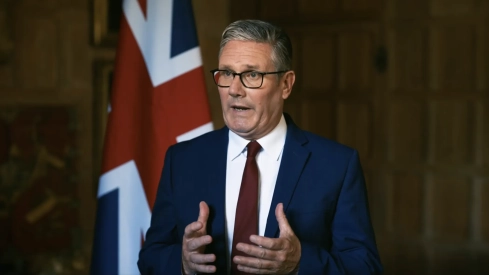
Keir Starmer said goodbye this Wednesday to the House of Commons after six years at the head of the Labour Party and barely two as Prime Minister of the United Kingdom. In his last control session, the British leader declared his political career over and defended that he leaves the Government with the country in better conditions than when he arrived.
Next Monday he will formally leave Downing Street and hand over power to Andy Burnham, winner of an internal process in which no rival managed to gather the necessary support to challenge his leadership.
The farewell had little to do with the rough sessions Starmer used to experience every Wednesday. MPs from different parties lowered the tone, his family followed the intervention from the gallery and several of his closest collaborators could barely hold back tears. Chancellor Rachel Reeves was particularly emotional and a good part of the House ended up on their feet to applaud the outgoing Prime Minister. The Speaker of the Commons, Lindsay Hoyle, even had to remind that applause is discouraged inside the British chamber.
I am proud of everything we have achieved together.
— Keir Starmer (@Keir_Starmer) July 15, 2026
To everyone who has supported this Labour government: thank you. pic.twitter.com/B8fGyirsP4
A farewell between emotion, football and jokes
The day began with a much more serious tone. Starmer remembered former Conservative MP Ann Widdecombe, murdered last week, and asked the House to consider dedicating a commemorative shield to her like those remembering Jo Cox and David Amess. The Prime Minister warned that three MPs or former parliamentarians have been murdered during his eleven years in Westminster and called for new measures to protect democracy and the security of public representatives.
Then came football and jokes. Conservative MP Graham Stuart compared Starmer to Jude Bellingham for having led Labour to a historic victory and argued that the nearly 400 MPs of his own party had ended up showing him the red card. Starmer received the comparison with a smile and acknowledged that it would probably be the first and last time someone would equate him with the English footballer. The still Prime Minister promised his full support to both Burnham and the England national team, which this Wednesday plays against Argentina in the World Cup semi-final.
Kemi Badenoch also set aside much of the usual harshness of her clashes with Starmer. The Conservative leader acknowledged his performance in supporting Ukraine and recalled the welcome the United Kingdom extended to Volodymyr Zelenskyy after his clash with Donald Trump at the White House. At the same time, she warned Labour that a change of prime minister would hardly solve their problems on its own. Starmer thanked Badenoch for the private help she offered him during particularly difficult personal moments, such as the death of his brother and the arson attack on his family home.
The Labour leader concluded his speech by thanking the work of his ministers, officials, advisors, and MPs. He also addressed his wife, Victoria, and their two children before uttering a final "Goodbye" from the podium. Although he has described the day as the end of his political journey, Starmer will retain his seat for the time being and will move to the backbenches of the House of Commons when he leaves Downing Street.
From a historic majority to losing control of the party
Starmer assumed the Labour leadership in 2020, after the party's worst electoral defeat since 1935. During the following four years, he rebuilt a deeply divided party, regained ground in the political center, and achieved a historic parliamentary majority in July 2024 after fourteen years of Conservative governments.
The great contradiction of his tenure lies in the speed with which that victory ended up turning into a leadership crisis. Two years later, a majority of his own MPs concluded that he could not lead them to the next general election.
In his farewell, Starmer has championed the strengthening of labor rights, measures against child poverty, the reduction of healthcare waiting lists, and increased investment in defense. His government also approved new rules against institutional cover-ups, promoted restrictions on access to social media for children under 16, and sought to stabilize relations with the European Union after Brexit. His legacy is more solid in foreign policy, especially due to sustained support for Ukraine and his coordination with France and other European partners.
The internal balance is quite a bit more irregular. Economic growth, presented as the Executive's great mission, advanced in fits and starts and was accompanied by an increase in unemployment, persistent pressure on the cost of living, and difficulties in repairing very deteriorated public services.
Immigration continued to occupy the center of the political battle while Reform UK expanded its electoral presence. Starmer also failed to build a clear narrative that connected all his decisions, and the continuous strategy readjustments conveyed a sense of provisionality inside and outside the Labour party.
To that wear and tear were added several policy rectifications and errors in the choice of collaborators. The appointment of Peter Mandelson as ambassador to the United States, despite his known relationship with sex offender Jeffrey Epstein, ended up becoming one of the most damaging episodes for Downing Street. The explanations offered by Starmer fueled the impression that he had lost control of his own Government.
The poor Labour results in the May local elections accelerated the internal rebellion and ultimately forced him to announce his resignation on June 22.
Burnham arrives unchallenged at Downing Street
Andy Burnham has cleared the path to leadership with the support of 349 of the 403 Labour MPs. The threshold required to present a candidacy was 81 endorsements and, once the accumulated strength of the former mayor of Greater Manchester was known, no adversary could mathematically reach that figure. The party will formally complete the process this Friday, without the need to hold a vote among the membership as Burnham has remained the sole candidate.
The future prime minister returns to the center of national politics after nine years at the helm of Greater Manchester. His victory in the Makerfield by-election allowed him to return to the House of Commons and reinforced among Labour members the idea that he could contain the growth of the far-right Reform UK and connect better with the electorate in the north of England.
Burnham will take over a party that maintains a broad parliamentary majority, although it arrives battered by Starmer's wear and tear and by increasing electoral fragmentation.
The handover will be completed on Monday. Starmer will go to Buckingham Palace to present his resignation to Charles III and the monarch will then task Burnham with forming the new Government. The British parliamentary system allows the prime minister to be replaced during the legislature without immediately going to the polls, so Labour will be able to continue governing until the elections scheduled, at the latest, for 2029.
One of Burnham's first decisions will be the composition of the new cabinet. Rachel Reeves' continuity at the head of the Economy seems unlikely and Shabana Mahmood, current Home Secretary, is among the main candidates to replace her, although the future prime minister's team has not yet confirmed any appointments.
Burnham will come to power with the economy, the cost of living, immigration, and the recovery of public services on the table. The House begins its summer recess this Thursday, so the new prime minister could govern until September without undergoing his first control session.
