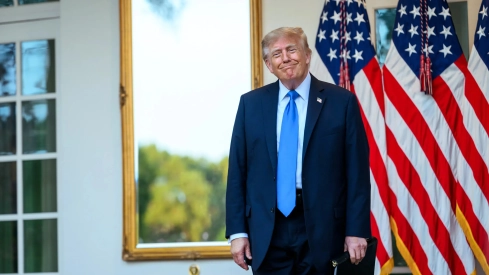
Donald Trump asked Americans to vote as if his name were on the ballots. After losing control of both chambers of Congress and seeing Republican governments that seemed safe fall, he has chosen another explanation. "I was not on the ballots, and if I had been, we would have won BY A LANDSLIDE!" he wrote during election night. The president who had turned the midterms into an examination of his mandate now tries to distance himself from their results.
The dimension of the punishment is better understood by looking at where Democrats have won. Texas will send James Talarico to the Senate and will have Gina Hinojosa as governor. Kansas has elected a Democratic senator for the first time since 1932. South Carolina, Iowa, and Ohio have also changed hands in Republican seats. These are victories that force a review of an electoral map accustomed to considering large territories lost for Democrats.
The New York Times projections place Democrats at 228 seats in the House of Representatives, compared to 139 Republicans, well above the 218 needed to control the institution. In the Senate, the estimate points to a majority of 54 seats for the Democratic bloc, including allied independents, compared to 44 Republicans. These are forecasts for the final distribution, with races still pending allocation, which depict a much broader defeat for Trump than the narrow loss of Congress.
The blue tsunami has a material explanation that cuts across states and candidacies. Trump returned to the White House promising prosperity and lower prices. Two years later, tariffs, rising fuel costs, and the consequences of the war with Iran have turned the economy into a problem for his administration. Outrage over deportations and democratic deterioration has been accompanied by a much more everyday question about the cost of living.
Healthcare helps to understand this connection. KFF's analysis of the SSRS election poll gives Democrats a 19-point advantage in trust to manage healthcare, 49% compared to 30% for Republicans. In 2024, Kamala Harris's advantage over Trump on this issue was seven points. The cost of insurance and treatments, the loss of subsidies for Obamacare premiums, and Medicaid cuts have given concrete content to the campaign against the president.
The winning coalition is once again expanding among young people and Hispanic voters. According to the voter poll released by Associated Press, about seven out of ten people under 30 supported Democrats, as did approximately six out of ten Hispanics. These data describe the electorate that participated on Tuesday. Comparing them with presidential elections requires bearing in mind that midterms mobilize a different population and register different participation.
The left gains strength with different recipes
The victory of Abdul El-Sayed in Michigan is one of the most relevant for the progressive wing. A doctor, son of Egyptian immigrants, and advocate for universal healthcare, he will arrive in the Senate after a campaign in which Trump made him a target of attacks against his name and his religion. He will be the first Muslim senator in the United States. His triumph also occurs in a contested state that the president won in 2024.
"To all parents who have struggled to explain to their children why the president openly mocks someone for their name or how they pray, tell them tomorrow that the bad guys lost," El-Sayed said while celebrating the result. His candidacy has united the defense of civil rights with proposals on medical debt, drug prices, and access to healthcare. This combination allows the progressive sector to discuss with results the argument that their positions condemn them to win only in safe Democratic districts.
Talarico has opened another gap in Texas, where no Democrat had won a Senate election since 1988. His victory over Ken Paxton comes in a state that Trump won by almost 14 points two years ago. The former elementary school teacher and Presbyterian seminarian has used his faith to combat the appropriation of religion by the right, while placing the cost of living and the power of large donors at the center of his campaign.
"We have defeated Goliath. We have sent a message to billionaire donors, to all the corrupt defenders of this broken political system," he proclaimed after defeating an adversary backed by Elon Musk. The message has a national reading. A candidate can talk about inequality, question billionaires, and win in Texas.
The new majority also includes Troy Jackson, the union leader and forestry worker who defeated Susan Collins in Maine, and Adam Hamilton, the Methodist pastor who achieved the historic upset in Kansas. Jackson brings a discourse linked to labor, wages, and healthcare. Hamilton presented himself as an independent-minded Democrat capable of reaching a conservative electorate. "These elections have been a reaction against the cruelty in Washington," he stated when celebrating his victory.
The advance of the left has another expression in the House of Representatives. New progressive names join figures like Alexandria Ocasio-Cortez, Ilhan Omar, and Rashida Tlaib, including Darializa Ávila Chevalier, Claire Valdez, Chris Rabb, Donavan McKinney, and Melat Kiros. The Democratic Socialists of America, DSA for its acronym in English, claim more than 50 victories for candidates linked to their organization at different levels. This figure includes federal, state, and local positions.
Over 50 DSA victories tonight prove socialism can win in the U.S.
— DSA (@DemSocialists) November 4, 2026
Workers deserve more and a reality where all of us live with dignity and hope is closer than we think.
The job's not done, though. Tomorrow, we continue organizing, fighting, and winning for the working class!
The volunteer organization, small donations, and grassroots campaign work have allowed a current that has been growing for years since Bernie Sanders' presidential campaigns to expand. Janeese Lewis George's triumph in Washington DC adds a highly visible mayoralty to a space that already includes Zohran Mamdani in New York. The Democratic debate will now have more voices willing to demand universal healthcare, affordable housing, and limits on corporate power.
The result, however, belongs to a broad coalition. El-Sayed, Talarico, Jackson, and Hamilton represent different sensibilities. They share a rejection of the government and attention to the cost of living, with different answers on how to reform the economy. The dispute opening within the Democratic Party consists of deciding how much of that campaign translates into a common agenda and how far its leaders will be willing to go.
States also change the map of power
The Republican defeat extends to governments with the capacity to decide on education, healthcare, reproductive rights, and cooperation with immigration authorities. In Texas, Gina Hinojosa has unseated Greg Abbott, who was seeking a fourth term. She will be the state's first Latina governor and the first Democrat to hold the office since Ann Richards left in 1995. The simultaneous victory of Hinojosa and Talarico gives the turnaround a depth that goes beyond an exceptional candidacy.
Georgia will have Keisha Lance Bottoms as governor, the first black woman elected to lead a state in the country's history. Democrats have also won the governorships of Ohio, with Amy Acton, and Iowa, with Rob Sand. The combination of these results regains ground in states where the party had lost presence and ability to compete, especially outside of large cities.
Other triumphs expand the representation of communities that Trump has repeatedly targeted. Xavier Becerra will govern California and Deb Haaland, New Mexico, where she will be the first indigenous woman to lead a state. Peggy Flanagan will reach the Senate for Minnesota as the first indigenous senator, while Chris Pappas will be the first openly gay man in that chamber. In the case of Becerra and Haaland, Democrats retain governments they already controlled; their political and symbolic importance coexists with that difference compared to the states taken from the Republicans.
These positions offer tools to dispute federal policies, appeal decisions in court, and develop their own programs. Their margin will also depend on state legislatures and available budgets.
The night has not erased all Republican strongholds either. Florida has elected Republican Byron Donalds as governor. And pending races, especially in Alaska, require waiting for vote processing and their counting rules. The extent of the tsunami is better measured by preserving these differences than by declaring still-open elections over.
Trump loses Congress but retains weapons to block it and threatens to use them
The first presidential reaction followed a known pattern. Trump attributed responsibility to defeated candidates, lashed out at Fox News, and tried to separate his popularity from the Republican result. He also attacked Abbott, whom he endorsed during the campaign. "I don't like to consider it a defeat for me, I wasn't running for election," he stated on Fox. The phrase comes after asking his followers to vote precisely with him in mind.
The loss of both chambers changes the conditions of his last two years in office. Democrats will be able to chair committees, open investigations, demand documentation, and subject government officials to appearances. In the Senate, they will also have the ability to block judicial appointments and other positions that require confirmation. The president loses a legislative majority willing to facilitate his agenda and faces an opposition with institutional instruments to scrutinize it.
Money will be one of the main battlegrounds. Congress intervenes in the approval of spending and can discuss allocations for immigration policies, military operations, and federal programs. This forces negotiation of laws and funding with a president who retains the veto power. The new majority cannot suddenly cancel all previously authorized spending or unilaterally replace the Executive in the direction of the Administration.
Nor are 54 senators enough to pass any law. As long as current rules are maintained, much of ordinary legislation needs to overcome the Senate's parliamentary blockade, which usually requires 60 votes. Procedures and exceptions exist, but a Democratic majority will still have to seek agreements or face an internal discussion about those rules. And overturning a presidential veto requires two-thirds in both chambers, a figure much higher than the majority obtained.
This limit also affects expectations about a possible impeachment process. The House of Representatives can approve an accusation against the president by a simple majority. Convicting him and removing him from office subsequently requires the support of two-thirds of the senators present. The election result opens a period of greater parliamentary control; any additional step would require evidence, a specific procedure, and support that these elections do not guarantee.
The test for Democrats will be to turn the punishment of Trump into recognizable improvements for those who voted for them. Healthcare, housing, and prices unite voters who disagree on other matters. Maintaining this alliance will require results and a clear explanation of any blockages they may encounter. It will also condition the 2028 presidential race, in which party establishment leaders and a left strengthened by its own victories will coexist.
The institutional change will begin to take effect on January 3, 2027, when the new Congress takes office. Hakeem Jeffries is the Democratic candidate to preside over the House of Representatives and, if elected, will be the first black leader to hold that position. Until then, recounts remain to be completed and results certified, while the outgoing Republican majority retains its functions during the last weeks of the legislature.
