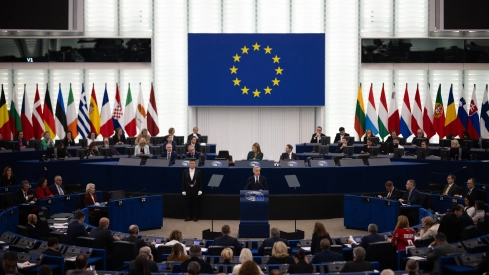
The Prime Minister of Canada, Mark Carney, responded this Thursday from Strasbourg to Donald Trump's threats with a resounding message. His country will freely decide with whom it strengthens its relations and will continue to advance towards a deeper alliance with the European Union, even if Washington tries to prevent it through a new tariff offensive.
Carney spoke before the plenary session of the European Parliament just hours after Trump called the proposal to make Canada the first country associated with the EU “ridiculous” and “hostile.” The US president even threatened to impose “very significant tariffs” and even to stop trading with Europe if the rapprochement goes ahead.
The Canadian response came without fanfare, but with a firmness difficult to ignore. “No one is going to dictate our culture or with whom we can reach international agreements,” Carney stated after his speech. The Prime Minister also defended that “Europe and Canada are stronger together” and welcomed the initiative presented by the President of the European Commission, Ursula von der Leyen.
The President of the Government, Pedro Sánchez, publicly joined the European support. He did so by sharing an image on his social networks that combines the stars of the EU flag with the Canadian maple leaf. A simple, but unequivocal gesture, after Trump's angry reaction.
— Pedro Sánchez (@sanchezcastejon) September 17, 2026
Canada rejects Trump's pressures
Carney presented the rapprochement as an “alliance for the future” capable of protecting the autonomy of both parties against the pressures of major powers. His proposal includes much closer cooperation in critical minerals, energy, artificial intelligence, defense industry, digital trade, research, and university education.
In the midst of a storm, Canada and the EU can anchor our ground. pic.twitter.com/nyWLP8a8vL
— Mark Carney (@MarkJCarney) September 17, 2026
Canada possesses significant reserves of gas, hydrogen, and more than thirty essential minerals for manufacturing batteries, semiconductors, electric vehicles, and defense material. Europe, for its part, contributes industrial capacity, research, access to a market of 450 million consumers, and regulation that sets standards in much of the world.
The relationship already has important foundations. The trade agreement between Canada and the EU, known as CETA, has eliminated practically all tariffs between both markets. Ottawa has also become this year the first non-EU partner of the European financing program for the defense industry.
Carney now wants to advance Canadian participation in programs such as Erasmus+ and Horizon Europe, in addition to creating supply chains less dependent on the United States. “An alliance strong enough so that no one can dictate our decisions,” he defended before the MEPs.
The immediate challenge will be to convert the political proposal into a viable legal figure. The category of “associate member” does not appear in European treaties and will have to be defined and agreed upon by the Twenty-Seven. The researcher of International Studies at the Complutense University, Ruth Ferrero, has warned that the project will require complex negotiation on its limits, its institutional fit, and the concrete advantages that Canada would receive.
Washington's pressure brings its allies even closer
Trump's reaction confirms the shift that the relationship between Washington, Ottawa, and Brussels is experiencing. The US president has again resorted to tariffs to try to condition a sovereign decision of two historical allies. Canada already bears taxes of up to 50% in some strategic sectors, while Europe maintains a fragile agreement with the United States that limits a large part of tariffs to 15%.
The threats are precisely causing the effect that the White House intended to avoid. Canada seeks to reduce its enormous dependence on the US market, the destination of around 70% of its exports, and Europe tries to strengthen its energy, technological, and military autonomy. Trump's pressure has accelerated a relationship that had been growing for years and now acquires an openly geopolitical dimension.
The Canadian prime minister has avoided presenting the project as a bloc opposed to the United States, although much of his speech has revolved around the need to resist economic coercion. He has also recalled that tariffs are increasingly used as a pressure tool and that supply chains have become vulnerabilities exploited by great powers.
The European Commission has insisted that the rapprochement aims to strengthen Canada and Europe without directing the alliance against any third country. Carney has gone a step further and called for a relationship capable of preventing any government from “controlling our open markets, undermining our sovereignty or eroding our freedoms.”
Brussels and Ottawa will now have to specify the scope of the partnership and convince the Member States, some of whom have cautiously welcomed a figure that has not existed until now. The next EU-Canada summit, scheduled for the end of October, will be the first scenario to turn the Strasbourg declaration into concrete commitments.
Add ElConstitucional.es as a preferred Google source for free.
Stay informed about all the latest breaking news with the best information. Against disinformation, for democracy and social rights.
