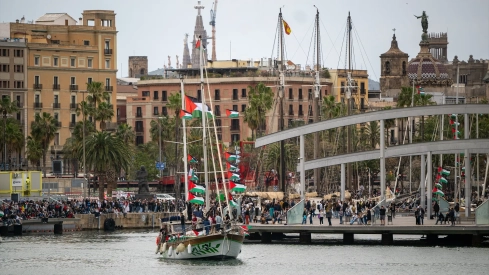
The Audiencia Nacional expands its investigation into the Israeli boarding of the Global Sumud Flotilla, intercepted on October 1, 2025, while carrying humanitarian aid to Gaza. Judge Francisco de Jorge, who until now was examining possible illegal detentions carried out on Spanish vessels, will also allow investigation into alleged tortures, injuries, and damages committed on board.
The decision comes after the appeals filed by Izquierda Unida, the Communist Party of Spain, and other plaintiffs against the initial delimitation of the case. According to the order, the complaints indicate that some activists suffered "inhuman or degrading treatment" while still on Spanish-flagged ships, before their transfer to Israeli vessels or facilities.
The flotilla was trying to reach Gaza, which was hit by Israeli attacks and restrictions on the entry of aid. The magistrate himself recalls that its members embarked to deliver supplies and protest the killings of civilians. This humanitarian purpose is part of the context in which Spanish Justice must now examine the use of force during the interception and detentions.
What happened on the Spanish ships
The flag of the vessels is decisive for the investigation. The Audiencia Nacional can examine possible crimes committed on board Spanish ships regardless of the nationality of those traveling on them. That is why the judge has rectified the scope of his first resolution and has left the case open to mistreatment, injuries, and damages that can be proven during the boarding.
The expansion still depends on the evidence. The statements of the crew members and other affected persons must specify what happened on each ship, who intervened, and if there are indications to support an accusation of torture. The order allows investigating these facts; it does not establish that the crimes are proven.
The complaints point, among others, to Eyal Zamir, head of the Israeli General Staff, and Ram Rothberg, former head of the Navy. Rothberg left that position in 2016, long before the operation against the flotilla. His inclusion in the case makes it especially important to clarify what specific action the accusations attribute to each commander.
The abuses reported after the transfer
The judge distinguishes the events that occurred on the Spanish ships from the alleged subsequent mistreatment, reported on Israeli vessels and detention centers. Regarding the latter, he has not yet assumed jurisdiction or directed the procedure against specific individuals, although he does authorize proceedings to identify their possible perpetrators and ascertain if they are in Spain.
This verification has legal consequences. To investigate alleged torture committed abroad by foreign citizens in Spain, the law requires additional conditions, including that the victim be Spanish and that the alleged perpetrator be in Spanish territory. Identifying those involved first will allow the judge to determine if he can also proceed along that path.
De Jorge has, however, refused to classify the boarding as piracy. He considers that this figure requires a purpose of personal gain that he does not find in either the activists or the military. When reasoning about the actions of the latter, the magistrate states that "they were following instructions from the political power" to prevent obstacles to Israeli operations. The rejection of that classification leaves the investigation for illegal detention and for other crimes that may be proven intact.
Since admitting the complaints in July, the investigating judge has kept a central question on the table: whether Israeli forces could board Spanish vessels, take control of them, and detain those traveling on them. He also asked the Prosecutor of the International Criminal Court to rule on the relationship of these events with its investigations into Palestine and on the possibility that the Audiencia Nacional examine them separately.
The next step will be to hear witnesses and victims to reconstruct what happened from the entry of the Israeli military onto the ships until the transfer of the activists. Their statements will allow for the specification of the facts reported aboard the Spanish vessels and the intervention attributed to each person.
Add ElConstitucional.es as a preferred Google source for free.
Stay informed about all the latest breaking news with the best information. Against disinformation, for democracy and social rights.
