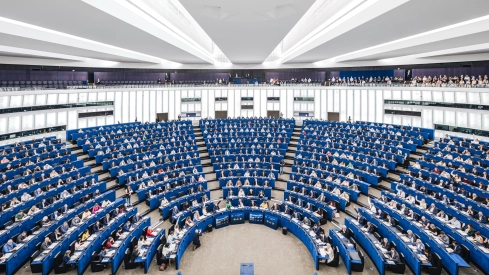
The European Parliament expressed this Thursday its "full support and solidarity" with Ceuta and declared the Spanish sovereignty and territorial integrity of the autonomous city "unquestionable". The resolution passed in Strasbourg with 339 votes in favor, 225 against, and 16 abstentions, although its content opened a deep division among the groups.
The text promoted by the European People's Party brought together conservatives, Renew liberals, and the three far-right groups. Socialists, Greens, and other left-wing formations voted against it. Among the Spanish parties, the PSOE and the PNV also distanced themselves.
The difference was not in the support for Ceuta or in the defense of its Spanish identity. The main clash came from the language used and the accusations incorporated against the Government. The resolution describes the massive entry on July 30 and 31 as an "invasion" and a form of "hybrid warfare," links the extraordinary regularization with a supposed "pull effect," and holds the Executive responsible for having reacted late.
The resolution lacks binding effects, but it increases political pressure on Morocco and consolidates the Ceuta crisis within the European agenda. It also calls for using the 114.7 million euros in emergency aid granted by the European Commission to reinforce security, improve care for affected people, and restore normality.
Europe increases pressure on Morocco
The European Parliament demands that Rabat fulfill its commitments on border control, migratory cooperation, and readmission. The text considers any declaration that questions Spanish sovereignty over Ceuta incompatible with the relationship between the European Union and Morocco.
The resolution also opens the door to suspending and recovering European funds delivered to third countries when there is a lack of cooperation or the interests of a Member State are threatened. The measure comes from an amendment by Vox, although the plenary rejected its more extreme proposal to immediately cut all funding destined for Morocco.
The document calls for accelerating the return of those who do not have the right to remain in EU territory. The reference includes unaccompanied minors, although any return must comply with European legislation, individually study each case, and guarantee the best interest of the minor and a safe reception in the country of destination.
The plenary has also expressed its "deep regret" for the death of 141 people who tried to reach Ceuta by swimming during those two days. The resolution calls for greater cooperation between Spain and Morocco to prevent a similar tragedy from happening again.
The Popular Party has celebrated the result as European backing for the position it has been defending since July. Its president, Alberto Núñez Feijóo, has assured that "Europe has been with Ceuta and with Spain" and has called for a joint response to protect the external border.
The Secretary General of the European People's Party, Dolors Montserrat, has stated that the vote sends a clear message. "Ceuta is not for sale. It is defended," she said before demanding that Rabat readmit people who can be returned in accordance with the law.
The left rejects the narrative of "invasion"
The socialists have justified their vote against due to the incorporation of the term "invasion" and conclusions that attribute decisions to the Government that would have aggravated the crisis. They also reject that a link between extraordinary regularization and massive entries is taken as proven without conclusive evidence to demonstrate it.
The resolution states that the Spanish authorities disregarded previous warnings and belatedly requested help from the European Border and Coast Guard Agency (Frontex), Europol, and the European Union Agency for Asylum. The Government maintains that the known message from the National Intelligence Center was part of an informal communication, lacked new information, and did not anticipate the dimensions of what happened.
The Executive defended this Thursday before the European Commissioner for Home Affairs and Migration, Magnus Brunner, its willingness to accelerate return and international protection procedures when exceptional crises occur. The Minister of Interior, Fernando Grande-Marlaska, has asked that any change maintain legal guarantees and allow for a quicker response.
The far-right Vox has presented the result as a victory for its positions and has highlighted the possibility of conditioning funds delivered to third countries. Its leader in the European Parliament, Jorge Buxadé, has also announced that he will request the creation of a special commission to investigate the planning, execution, and responsibilities of the massive entry.
The Government will now continue the negotiation initiated in Brussels to achieve a permanent presence of Frontex, a stable seat for Ceuta and Melilla in the European Committee of the Regions, their entry into the Customs Union, and funding that recognizes the particularities of the southern border.
Add ElConstitucional.es as a preferred Google source for free.
Stay informed about all the latest breaking news with the best information. Against disinformation, for democracy and social rights.
