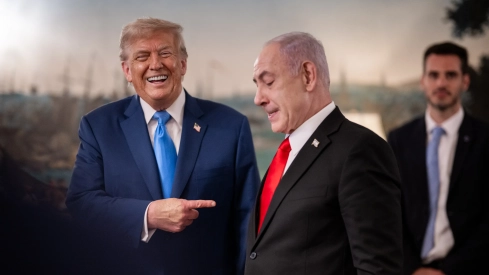
Donald Trump announced this Tuesday that the United States will stop providing Israel with the approximately 4 billion dollars annually it receives in aid, although he made it clear that Benjamin Netanyahu's government will be able to continue buying American weapons. The announcement comes in the midst of legislative elections in the US and after years of military support from Washington for the Israeli offensive on Gaza.
The US president explained in a telephone interview with Fox News that the aid will end at the end of this year because, he claims, Israel no longer needs that money. He also assured that the decision was discussed with Netanyahu, whom he referred to by his nickname, "Bibi."
"We give them 4 billion dollars in material and money, and they don't need it. Bibi Netanyahu contacted me and we've been talking about it for a couple of years because it's a lot of money," Trump said. The president added that Israel will be able to continue acquiring weaponry from the United States. "They can buy whatever they want," he assured.
The promise raises doubts about the future of US funding, but the president himself has placed the continuity of the military relationship at the center of his message. The sale of weapons leaves the door open for Israel to continue supplying itself with material from its main ally, after an offensive that has caused tens of thousands of Palestinian deaths in Gaza.
President Trump on U.S. aid to Israel: "We were giving them $4 billion. We are. But it gets cut off at the end of the year. Why? Because they don't need it.
— Kaitlan Collins (@kaitlancollins) November 3, 2026
"Why should we suffer the slings from lunatics like El-Sayed when they don't need it? It's a bad talking point." pic.twitter.com/xkfmbs5lTg
Money and weapons for Israel
The amount Trump referred to is close to the 3.8 billion dollars annually foreseen in the military cooperation agreement signed between Washington and Tel Aviv in 2016, during Barack Obama's presidency. That pact contemplated a total of 38 billion over ten years, until 2028.
Of that annual amount, 3.3 billion was earmarked for military financing and another 500 million for anti-missile defense. The allocations depend on the US Congress and, for now, Trump has not detailed how the announced change will be formalized nor all the items that would be affected.
Washington's support for Israel has gone far beyond that annual figure since the beginning of the war in Gaza. The Costs of War project, at Brown University, calculated that the United States allocated at least 21.7 billion dollars in military aid to Israel between October 2023 and September 2025, under the presidencies of Joe Biden and Trump himself.
The Israeli offensive began after the Hamas attacks on October 7, 2023, in which around 1,200 people died in Israel and another 251 were kidnapped. Since then, more than 74,000 Palestinians have died in Gaza, according to the territory's health authorities. The Israeli attacks have continued despite the ceasefire announced in October 2025 and international warnings about the devastation and humanitarian crisis in the Strip.
Netanyahu also receives the announcement at a time of political uncertainty. His party, Likud, was the most voted in the Israeli elections last October 27, but the prime minister's bloc and his far-right allies lost their parliamentary majority. It garnered 53 seats, eight fewer than the 61 needed to govern in the 120-member Knesset.
Trump looks to the polls
The US president has also linked his decision to the internal political debate and has expressly pointed to Abdul El-Sayed, a Democratic candidate for the Senate in Michigan, who has questioned aid to Israel. Trump has called him a "lunatic" and has presented his criticisms as an electoral argument he wants to shed.
"Why should we endure attacks from lunatics like El-Sayed when they don't need it?" he said, referring to US aid. The president added that if Israel needed support again, the United States would help it.
Trump's words come as Americans vote in midterm elections that will decide the balance of power in Congress during the last two years of his presidency. Republicans face a difficult day. Analyst Nate Silver's model gave Democrats a 95% chance of regaining the House of Representatives and an 80% chance of also winning the Senate before the vote, according to Axios.
In Michigan, one of the states where a Senate seat is being decided, the latest poll from The New York Times and Siena College gave El-Sayed 53% support compared to 42% for his Republican rival, Mike Rogers. This is a poll, not a result, but it reflects the threat Trump's party faces in one of the races that both the White House and the Democratic opposition will be closely following.
