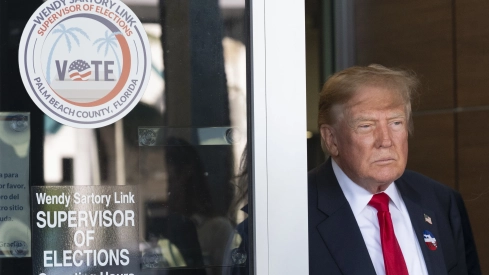
The United States votes this Tuesday in legislative elections that could change the last two years of Donald Trump's presidency. The polls have been open for hours and more than 50 million Americans had already participated in advance. At stake is control of Congress and, with it, the president's ability to push through much of his agenda.
The latest polls paint a complicated day for the Republican Party. The Democratic advantage in voting intention, Trump's low popularity, and unexpectedly close races in conservative states have fueled the possibility of what has been called in the United States a "blue tsunami," referring to the color that identifies Democrats.
The warning for the White House is serious, although the polls still have the last word. Surveys place Democrats in a favorable position to regain the House of Representatives and give them options to also snatch the Senate from the Republicans. Several of the decisive races remain, however, close enough that a small change in turnout or a polling error could alter the result.
Trump has tried to convey confidence in recent hours. "I think the results are going to be better than you think," he said this Tuesday in an interview with Fox. The president has turned the campaign into a defense of his management, but he arrives at the appointment with discontent over the cost of living and the war with Iran weighing on his image.
Polls alert Trump
The latest Reuters and Ipsos poll, conducted between October 29 and November 2, places Trump's approval at 32%. Among likely voters, 52% lean towards the Democratic candidate in their district and 44% towards the Republican. That's an eight-point advantage in a national question that serves to measure the electoral climate, although House seats are decided district by district.
Another recent AP-NORC poll places the president's approval at 35%. The economy appears as one of his weak points. According to that study, only a quarter of adults approve of his economic management, at a time when many families remain concerned about the price of groceries, energy, and healthcare.
Trump assured this Tuesday that inflation is "resolved". The latest data, however, shows that consumer prices rose 3.6% year-on-year in September, compared to 3.4% in August. Concern about the cost of making ends meet has become central to a campaign in which the president has also defended his immigration policies and military decisions.
Projections point in the same direction as polls, albeit with varying degrees of certainty. According to 'Axios', analyst Nate Silver's model, before the polls opened, gave a 95% probability of a Democratic majority in the House and an 80% probability that the party would also regain the Senate. These are probabilities calculated by a model, not vote percentages or results.
The Cook Political Report, one of the reference publications in US electoral analysis, contemplates, at the most favorable end of its forecast, that Democrats could reach up to 240 seats in the House of Representatives. The majority is 218. Reaching that figure would give the opposition a much more comfortable position than the narrow majority with which Republicans have entered these elections.
All 435 seats in the House and 35 of the 100 in the Senate are up for renewal. Until now, Republicans have a 53-47 advantage in the Upper House. To control it, Democrats need to reach 51 seats, since, in case of a 50-50 tie, Vice President JD Vance has the tie-breaking vote.
A Democratic majority in either chamber would allow the opposition to block legislative initiatives and open investigations from Congress. The Senate also plays a decisive role in confirming judges and high-ranking officials. Trump would retain the Presidency and his executive powers, but would face a legislative branch much less willing to accompany him.
The states that can decide the Senate
Alarm bells for Republicans extend to states where a few months ago they expected to have fewer difficulties. The latest round of polls from 'The New York Times' and Siena College gave Democrats an advantage in all seven Senate races analyzed, although in most the margin was narrow enough to keep the outcome open.
Texas is one of the possible surprises of the night. The poll places Democrat James Talarico with 50% against Republican Ken Paxton's 43%. A Democratic victory there would have a strong political impact in a state that has been electing Republicans to the Senate for decades. Trump backed Paxton against Republican Senator John Cornyn in the primaries, so the result will also test the strength of his support within the party.
Other polls paint a closer race in Texas. A recent Trafalgar study placed Talarico and Paxton tied at 48%, a difference that reminds us of the caution needed before the votes are counted.
In Michigan, where Democrats are defending a vacant seat, 'The New York Times' and Siena study gave Abdul El-Sayed 53% against Republican Mike Rogers' 42%. El-Sayed, critical of U.S. military support for Israel, has been targeted by Trump's attacks during the campaign. Retaining Michigan is an important piece for Democrats to turn their opportunities in other states into a Senate majority.
The list of territories to watch is long. In Ohio, former Democratic Senator Sherrod Brown was ahead of Republican Jon Husted by 49% to 44% in that same poll. In Maine, Democrat Troy Jackson led Republican Senator Susan Collins by 51% to 45%. Collins has held the seat since 1997 and has survived difficult campaigns, so her race is seen as another possible indicator of the magnitude of the change.
In Alaska, former Democratic Congresswoman Mary Peltola appeared with 48% against Republican Senator Dan Sullivan's 46%. In Iowa, Josh Turek surpassed Republican Ashley Hinson by a single point, with 48% to 47%. Kansas also figured among the tight contests. In these races, the poll differences leave room for a victory for either party.
The director of the Siena research institute, Don Levy, has described a Democratic majority in the Senate as a "real possibility", although he has warned that either party could end up controlling it. The map forces Democrats to win in several territories that voted for Trump, a task that requires more than just improving their results in states where they are already strong.
North Carolina will also be worth watching, where former Democratic Governor Roy Cooper faces Republican Michael Whatley, and Georgia, where Democratic Senator Jon Ossoff seeks to retain his seat against Mike Collins. Both results may determine how many additional seats each party needs in the rest of the country.
When will the results be known in Spain?
The American election night will be followed in Spain during the early hours of Wednesday. The first polling stations will close at 00:00 peninsular time in parts of Indiana and Kentucky. At 01:00, those in Georgia will close, and half an hour later, those in North Carolina and Ohio.
At 02:00, another important wave will arrive, with the closing of polling stations in Maine and Pennsylvania, among others. Most centers in Michigan and Texas will also close at that time, although we will have to wait until 03:00 for voting to end throughout both states. At that time, polls will also close in Iowa and Kansas. The last polling stations in the country, located in the Aleutian Islands of Alaska, will close at 07:00 in the morning in peninsular Spain. In the Canary Islands, it will be one hour earlier in all cases.
During the early morning, trends could emerge and winners could be projected in some races. The time at which it is known who controls each chamber will depend on how close the results are and the speed of the count. In California, for example, mail-in ballots can take days to be counted; Alaska and Maine also use a ranked-choice voting system that can prolong the announcement of winners.
There are precedents to measure the wait. In the 2022 legislative elections, the Associated Press was able to determine control of the Senate four days after the vote and that of the House of Representatives, eight days later. The first figures of the night may change as votes cast through different means and in areas with different political preferences are incorporated.
Caution with the count is especially relevant after Trump has again cast doubt on the elections. The president has repeated false claims about alleged massive voting by non-citizens, and his Administration has taken disputes related to voter rolls and ballots to court.
On the eve of the election, the Supreme Court rejected a request from the Administration to force California to separate thousands of mail-in ballots from people whose citizenship status was questioned by the federal government. The case reached the high court after lower courts blocked the measure requested by Washington.
Meanwhile, both parties are rushing their calls to vote. The Democratic leader in the Senate, Chuck Schumer, has expressed optimism after casting his ballot in New York and has voiced his hope that his party will achieve a new majority in the Upper House. On the other side, Republican Party leader Joe Gruters has placed the key on mobilizing his own. "Everything depends on turnout. If we mobilize our voters, we win," he stated.
