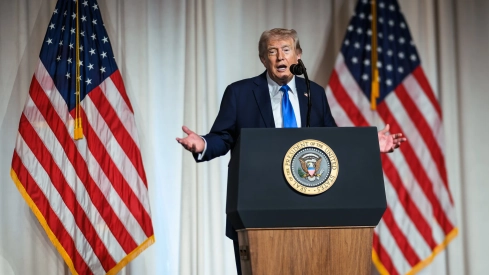
The Administration of the President of the United States, Donald Trump, has announced a new round of tariffs that will affect 60 countries, with the aim of penalizing those economies that, in Washington's opinion, have not adopted sufficient measures to prevent the commercialization of products manufactured with forced labor. The new scheme replaces the temporary 10% tariff applied during the last 150 days, which expired this midnight.
When presenting the measure, the United States Trade Representative, Jamieson Greer, defended that "President Trump recognizes that decades of moral persuasion have not eradicated forced labor from global supply chains. The United States has had a ban on forced labor imports for almost a century, and rigorously enforces it; it is time for our trading partners to do the same."
Furthermore, he assured that the initiative "will correct what constitutes a violation of Human Rights and a distorting trade practice, to improve the well-being of workers around the world." In that vein, he added: "I am encouraged by trading partners who have acted quickly to adopt import bans on products made with forced labor and I hope they ensure their effective compliance."
The new system establishes two tariff levels. Countries with legislation considered adequate against forced labor will maintain a 10% tax, while those whose regulations are considered insufficient will face a 12.5% tariff.
Thus, the first group includes, among others, Argentina, Canada, India, Indonesia, Mexico, United Kingdom, Pakistan, Malaysia, Guatemala, Honduras, and Bangladesh. Likewise, the United States will apply rates of 10% or 12.5% to certain products from the European Union, Japan, South Korea, Taiwan, and Switzerland, while the rest of the investigated economies will be subject to the highest rate. The decision comes months after the US Supreme Court annulled previous reciprocal tariffs imposed under the International Emergency Economic Powers Act, which led Trump to resort to another legal basis to redesign his trade strategy.
Add ElConstitucional.es as a preferred Google source for free.
Stay informed about all the latest breaking news with the best information. Against disinformation, for democracy and social rights.
