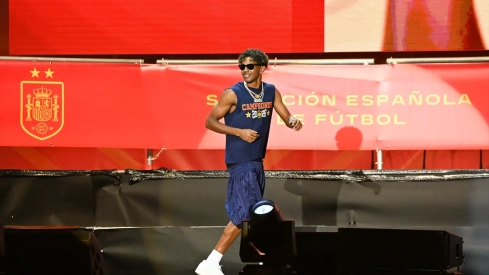
Lamine Yamal has returned to Spain as a world champion, with the second star on his chest and, at 19 years old, has become one of the most recognizable faces of the National Team. As the tournament progressed, thousands of accounts used his origins, his religion, and his identity to insult him or question his belonging to the country he was representing.
The Spanish Observatory of Racism and Xenophobia detected 40,861 contents related to hate speech and discriminatory narratives on the main social networks during June. Sport was the second most frequent trigger, present in 16% of the monitored messages, only behind citizen insecurity.
The report highlights a "significant presence" of racist and Islamophobic publications during the World Cup, directed against national teams, fans, and players. Lamine is expressly singled out for the volume of hostile comments related to his family roots and to a Spanish identity that some users continue to link to ethnic origin.
The figure covers messages detected throughout June and does not mean that all 40,861 were linked to the championship or directed against the player. The data shows a broader digital conversation, although the World Cup provided a scenario of enormous visibility for weeks to spread attacks that had already appeared before the tournament.
Champion with Spain and questioned for his origins
Lamine was born in Esplugues de Llobregat, grew up in the Rocafonda neighborhood of Mataró, and trained from childhood in Barcelona's youth categories. His father is Moroccan and his mother was born in Equatorial Guinea, a family history that is part of the diverse Spain that has ended up conquering the World Cup along with Nico Williams, son of a Ghanaian couple who arrived in the country after crossing the Sahara.
This reality has coexisted throughout the year with messages that ask Lamine to return to "his country", question him wearing the Spanish jersey, or use his Muslim faith to attack him. The first quarter 2026 bulletin had already detected a wave of hatred around publications in which the footballer showed how he lived Ramadan.
Hostility also jumped from the screens to the stands. During the friendly match between Spain and Egypt played in March at the RCDE Stadium, part of the public chanted "Muslim whoever doesn't jump". Lamine described those chants as ignorant and racist, although he avoided attributing them to the entire Spanish fanbase or linking them to his decision to represent Spain instead of Morocco.
"I know that not all of Spain was singing. It was a part of the field," he explained weeks later. The player assured that he had never regretted his choice and that the insults affected any Muslim, regardless of their nationality.
The World Cup confirmed that decision on the field. Lamine has been one of the main pieces of Luis de la Fuente's team and has celebrated the title alongside teammates born or raised in different parts of the country. His sporting success has not deactivated a racism that admits his talent while continuing to dispute his Spanishness.
Rajoy and the French national team "without Frenchmen"
The debate reached a political dimension before the semifinal between Spain and France. Mariano Rajoy wrote that the team led by Didier Deschamps had "a very high level, yes, but without Frenchmen", in reference to the presence of black players and families from former colonies.
All those called up had French nationality and 23 of the 26 had been born in the country. The phrase replaced the legal criterion of citizenship with an ethnic idea of what is French, precisely the same logic that appears in many of the messages directed against Lamine Yamal or Nico Williams.
The Spanish footballer responded without entering into a personal dispute with the former president. "If football serves for anything, it is to integrate. France and Spain are an example of integration," he stated during the press conference prior to the match.
The French Foreign Minister, Jean-Noël Barrot, was much more direct. "France has no skin color," he said before considering that any contrary statement was "stupidity, racism, or a combination of both." The Spanish Government ended up conveying its apologies and described Rajoy's words as xenophobic and incompatible with Spanish society.
The PP leadership chose to protect its former leader. Borja Sémper presented the phrase as a "sarcastic" and "unintentional" comment, despite the rejection it had aroused even among leaders of the French right and far-right. Juan Vivas, the popular president of Ceuta, did distance himself and recalled that nationality does not depend on ethnicity or culture.
The controversy occurred in July and, therefore, falls outside the 40,861 contents counted in the latest bulletin. Its proximity to the analyzed attacks shows, however, how certain ideas about national purity circulate from anonymous accounts to the discourse of figures who have held the highest responsibilities of the State.
Nine out of ten attacks target North African origin
People from North Africa concentrated 88% of the content analyzed in June. The percentage has increased ten points in just one month, which consolidates this group as the main target of the racist and xenophobic discourse detected by the Government's system.
Messages against Muslim people represented 11% and those directed against African or Afro-descendant citizens reached 7%. Categories can coincide in the same publication, as occurs in many attacks against Lamine, where references to Morocco, his religion, and the color of his skin are mixed.
The volume against Muslim people fell fourteen points compared to May and that directed at Afro-descendants decreased four. The percentage decline does not imply the disappearance of these narratives, but rather an even greater concentration of hatred on people identified as Maghrebi or North African.
Content also appeared against Latin American citizens and against the Jewish community, although with a lower presence. The monitoring is limited to racist, xenophobic, Islamophobic, anti-Semitic, and anti-Gypsy hatred that directly affects individuals or groups.
Dehumanization grows and explicit violence remains
The most worrying change is in the harshness of the messages. Content that dehumanizes or severely degrades its recipients reached 48%, compared to 23% registered in May. In just one month, this form of hatred has increased 25 points and has become the dominant category.
Another 32% presented the attacked individuals as a threat to security or coexistence. 10% called for their expulsion from the country, 6% directly promoted violence, 3% praised those who attack these groups, and 1% sought to discredit them.
Most publications did not try to hide their intention. 89% used explicit aggressive language, through insults, threats, and disqualifications, while another 10% resorted to sarcasm or a humorous appearance to spread the same message.
Almost one out of three contents incorporated images, videos, memes, symbols, or modified words to make their detection difficult. These formulas help a publication travel quickly between platforms and allow it to circumvent some automatic moderation systems through numbers, emoticons, or deliberate alterations of language.
Insecurity fuels hatred
Football had a prominent role during June, but the main trigger was citizen insecurity. 69% of the analyzed content linked migrant people to crimes, social conflicts, or public order problems, in many cases through fake news or real episodes presented without context.
The mechanism is often repeated. A crime committed by a foreign person becomes a collective accusation against thousands of citizens of the same origin, while nationality disappears from the conversation when the perpetrator is Spanish. The dissemination of old videos, images from other countries, and manipulated data allows this association to be maintained even when the facts have not occurred as told.
Public policies originated 11% of the detected discourse, especially due to the debate on the extraordinary regularization process for immigrants promoted by the Government. Content related to sexual assaults reached 9%, compared to 3% for terrorism and 2% for the arrival of boats.
These categories show that digital racism feeds both on specific events and sustained political campaigns, capable of presenting immigration as a permanent threat to security, public services, or national identity.
A citizen complaint barely manages to remove one out of ten messages
Platforms removed 61% of the content sample that OBERAXE selected and notified during June. The result is four points below the previous month and hides enormous differences between companies and between the channels used to communicate the publications.
When the complaint was filed like any other user, only 10% of the content was removed. Half disappeared during the first 24 hours, another 1% in the following 48, and the remaining 4% before a week had passed.
When the Observatory re-communicated the messages through the trusted channel reserved for accredited entities, platforms removed another 51%. The disparity reveals that a publication can remain accessible after a citizen complaint and disappear when the same warning arrives backed by an institution.
TikTok removed 98% of the reported content and X reached 93%. Facebook removed 62%, while Instagram stayed at 32%. YouTube closed the ranking with barely 8% and only acted when it received communications through the specialized channel.
What the FARO system actually measures
The report is prepared using FARO, a tool that combines artificial intelligence with the review of a team made up of six people in charge of monitoring and two others dedicated to coordination and analysis tasks. The search is carried out daily on open profiles of Facebook, Instagram, TikTok, YouTube, and X.
The 40,861 contents represent detected and reportable publications, not the number of racist users or the totality of hate spread on the internet. The system focuses on messages written in Spanish and excludes private conversations, closed accounts, and other platforms.
The Observatory first communicates each content as an ordinary user. If it remains published a week later, it reports it again as a reliable communicator. Cases that may constitute a crime are transferred to the Attorney General's Office.
The June bulletin covers from the start of the World Cup to its first knockout rounds. The Rajoy controversy, the semifinal against France, Spain's title, and Lamine Yamal's celebrations fall within the July period, whose analysis will show whether the second star curbed hate or provided new arguments to those who continue to decide a footballer's nationality by their surname, religion, or skin color.
Add ElConstitucional.es as a preferred Google source for free.
Stay informed about all the latest breaking news with the best information. Against disinformation, for democracy and social rights.
