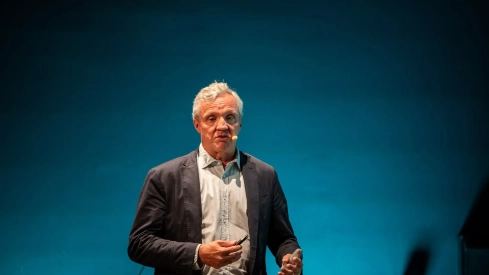
After the phrase "expert in the tourism sector" comes the name of Carlos Garrido de la Cierva. Forty years dedicated to the world of tourism have served him to be behind the counter of a travel agency, create his own, preside over the Spanish Confederation of Travel Agencies and, for four months now, be the face, and the president, of the Spanish Tourism Board. These are not, by far, the only "sticks" that Garrido de la Cierva has touched, so given the long trajectory he carries behind him, it can be said that it is more complex to formulate a question he has never been asked than for him not to have an answer.
Question (Q): After four decades of full dedication, how many congresses have you attended and how many obstacles have you overcome?
Answer (A): Impossible to specify how many congresses, conferences, and professional meetings I will have attended throughout all these years of full dedication to tourism. Beyond the agenda, I keep the learnings, the people met, and the shared battles. Together we have weathered economic crises, technological revolutions, market restructurings, moments of great uncertainty, and a global pandemic. With time, one understands that the uncertainty of what may come is part of the dynamic of life and that the best way to face it is adaptation, dialogue, and teamwork with those around you. I have always understood tourism as an essential activity for Spain, and my commitment to this sector that has given me so much remains intact.
(Q): In less than a month, the first Congress of Travel Agencies, which you presided over "until the day before yesterday," will be held. What is its purpose and what are the main concerns of the sector?
(R): In my opinion, the travel agency subsector must address several essential issues: regulatory pressure, the promotion of digitalization without renouncing the human value of advice, the qualification of talent, and the improvement of competitiveness. Agencies need legal certainty, a balanced application of European regulations, and recognition of their role as responsible intermediaries. Likewise, it is necessary to guarantee consumer protection without each obligation translating into a disproportionate administrative burden. The challenge is to preserve traveler confidence, differentiate oneself through knowledge and proximity, and ensure that professional distribution continues to be an essential link in the tourism value chain.
(P): What is the Mesa del Turismo and what are its functions? Very different from those of the Confederation?
(R): The Mesa del Turismo de España is an association with a long history, which this 2026 celebrates 40 years, and which is made up of renowned entrepreneurs and professionals. Its raison d'être is the defense of the general interests of Spanish tourism and the dissemination of the social function of tourism, as one of the pillars of our economy and, without a doubt, the basis of social stability.
We are not an employers' association like the Spanish Confederation of Travel Agencies, which I presided over until a few months ago. Our mission encompasses the entire tourism sector and develops in a different orbit: to generate influence in its favor before Administrations, the Government and society, at all levels, including the European Union, which is the highest level of organization from which the guidelines that establish our framework of activity emanate.
(P): Do you have the objective of the Mesa de Turismo defined during your mandate?
(R): The main objective of the new management team of the Mesa is to strengthen the institutional weight of the tourism sector to tangibly influence Administrations, the European Union and public opinion, defending tourism as a pillar of the economy, employment, territorial cohesion and Spain's international projection. From commitment, responsibility and transparency, we advocate for a results-oriented approach, with concrete projects such as the creation of a Tourism Observatory.
(Q): Wars are unpredictable and have palpable consequences in the sector you preside over. How do you face this situation? Can the situation be turned around and Spain's tourism benefit?
(A): Tourism is an industry of peace and cultural exchange, so war will always be its worst enemy. Apart from destruction and pain, it brings insecurity and fear, paralyzing tourism not only in the areas it directly impacts, but often also in influential regions that are also harmed. When conflicts arise in certain regions of the world, it is common to hear the reasoning that Spain emerges as a "refuge destination" because we are perceived as a safe, accessible, and quality destination. But the Spanish tourism sector knows very well that growth is not built on the misfortune of others. These "temporarily borrowed" tourism flows do not constitute the basis of the real and sustained growth that has allowed Spain to project itself as a tourism power.
(Q): After the summer, and before Christmas, the most immediate objective is the December long weekend. Can the trend be interpreted at this point, or is it too early?
(A): A priori, forecasts are favorable, although it is still too early to handle concrete figures. We anticipate, however, a positive evolution of national demand during the December long weekend, driven by early booking seeking to secure better rates. It is a getaway with a strong urban and cultural component, especially important for destinations like Madrid or Seville, where travelers are attracted by the Christmas lights and with the desire to get a head start on their Christmas shopping.
(Q): You are qualified to evaluate the differences between the current situation of agencies and what they presented at the end of the last century. Tell me, what are they?
(R): In the past, the great challenge was to master knowledge of the destination, negotiate with suppliers, and offer the client a quality service that could not be obtained through other channels. Currently, agencies still need that knowledge, but other key factors are added, such as digital transformation —including AI—, cybersecurity, personalization, and the ability to respond in real-time to any incident. The challenge is to advise a client who is an experienced traveler and to whom trips are not merely "sold," but rather accompanied professionally at all stages of the journey. The future requires agencies to be able to combine technology, talent, and closeness, in addition to competitiveness.
(P): Is the need, the interest, to associate among those differences? What percentage of existing agencies are associated? What reasons do those that are missing give for not being associated?
(R): The associative movement is more necessary than ever today: no agency, however solid it may be, can face the great challenges of the sector alone. Associations add voice, experience, and capacity for influence before Administrations, suppliers, and public opinion. They not only defend common interests but also offer their associates valuable services, including training. I am convinced that associativism is the key strategy to obtain effective results by articulating a common voice with true impact and will be of special relevance when it comes to enhancing the prestige of tourism professions.
(P): Claim your rights, what does the Tourism Board demand and from whom?
(R): We demand that tourism be recognized for its real value and treated as the strategic sector it is, in line with its weight in the wealth and employment of our country. Considering its direct and indirect impact, tourism generates more than 20% of Spanish GDP. Therefore, we demand a grand State Pact for Tourism that overcomes short-termism and political differences, placing our industry at the center of the country's major decisions.