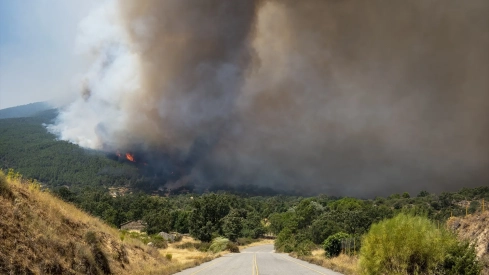
Spain has reached the most dangerous part of summer with nearly 120,000 hectares burned. The affected area doubled between July 8 and 22 and already tripled that recorded on the same dates in 2025, according to data from the European Forest Fire Information System. The large fires in Guadalajara, Madrid, and Ávila have once again opened a question that usually fades when the flames disappear: Who should maintain the forest and what happens when no one does?
The answer begins with ownership. Around 72% of Spanish forest is private, about 20.1 million hectares, according to the Spanish Forest Strategy horizon 2050. The remaining 28% belongs to public administrations and entities, mainly municipalities. The State owns only a small part of the total.
The concept of "monte" (forest/mountain) encompasses forests, scrubland, pastures, and other forest lands. A good part of those 20.1 million private hectares belongs to individuals and companies, although there are also communal forests and collective properties. The Ministry itself recognizes that numerous properties are fragmented, dispersed, very small, or have unknown owners. This structure complicates any continuous management.
Only one in five private hectares is managed
The latest Forestry Statistical Yearbook of the Ministry for Ecological Transition, referring to 2024, estimates the Spanish forest area at 28.58 million hectares. Of these, 7.95 million have some management instrument and 3.99 million are privately owned.
Comparing those 3.99 million with the official estimate of private property, planning covers around 20% of Spanish private forest. The situation has improved compared to 2020, when it barely reached 11.7%, but it still leaves out four out of five hectares.
A management instrument establishes the uses, silvicultural treatments, felling, biodiversity protection, and preventive actions that each land needs. Forest management goes far beyond indiscriminate clearing. It includes reducing and distributing fuel, creating discontinuities in the landscape, maintaining access and water points, favoring resistant species, and recovering activities such as extensive grazing.
Science places the risk in the combination of several factors. The Joint Research Centre of the European Commission points to climate change, lack of fuel management, and the abandonment of rural areas. More heat, prolonged droughts, and dry vegetation allow a spark to turn into an extreme fire, while the loss of agriculture, livestock, and forest exploitation leaves large continuous extensions of fuel.
The IPCC projects an increase in fire risk in all European regions. In Southern Europe, the frequency of heat-induced weather conditions favoring fire would grow by 14% with a global warming of 2.5 degrees and up to 30% in a 4.4-degree scenario.
The owner acts and the Administration must enforce it
Material responsibility falls primarily to the landowner. Public and private owners must carry out the preventive treatments included in regional plans and in the management instruments applicable to their forests. The Forest Law obliges autonomous communities to approve prevention, surveillance, and extinction plans for their entire territory each year.
These documents must establish the works, priority areas, and deadlines. They can also establish agreements, aid, temporary assignments, or subsidiary execution by the Administration. When an owner fails to comply with a requirement, the Administration can carry out the actions and then transfer the cost to them.
Local councils play a particularly important role around homes, urbanizations, and infrastructures. They must demand vegetation management in protection strips and act when the owner disregards the order. Autonomous communities, in addition to managing prevention and extinction, must ensure that municipalities exercise these powers.
The legislation contemplates fines of between 100 and 1,000 euros for minor infractions, from 1,001 to 100,000 for serious ones, and from 100,001 to one million for very serious ones. Non-compliance with restrictions imposed during episodes of very high or extreme risk is considered at least a serious infraction. The problem appears before the sanction, when the requirement is delayed, the owner is difficult to locate, or the Administration lacks the means to execute the works.
The Ombudsman confirmed, after consulting all autonomous communities, that these functions “are not always carried out when necessary, nor with the diligence and determination required by the regulations”. The institution has had to ask local entities to order the removal of vegetation and coordinate their actions with regional governments. It also warned that “it is of little use to establish a protection regime for forests” if administrations lack resources to guarantee its compliance. The power to impose sanctions mainly corresponds to the autonomous communities, while many of the requirements and actions on plots close to inhabited areas fall to small municipalities with limited staff.
Private property also does not free public authorities from their responsibility. Forests protect the soil, store carbon, regulate water, and conserve biodiversity that benefits all of society. The Forest Law contemplates subsidies, incentives, and payments for these environmental services, especially when there is a management plan and the property is in a high-risk area.
A pending pact since the 2025 fires
The Government presented its proposal for a State Pact against the Climate Emergency in December after receiving almost 4,000 contributions from more than 1,300 actors. One of its fifteen axes proposes extending forest management adapted to the climate, economic reality, and depopulation.
The document proposes prescribed burns, silvicultural treatments, extensive livestock farming, sustainable use of biomass, timber construction, payments for ecosystem services, and new local value chains. It also includes a Rural Green Employment Plan for municipalities with fewer than 5,000 inhabitants and permanent emergency resources throughout the year.
Pedro Sánchez revived the proposal this week from the command post of the La Mierla fire. “It is imperative” to reach an agreement that translates into “laws, measures, and economic resources”, defended the President of the Government during his visit to Guadalajara.
The third vice-president and minister for Ecological Transition, Sara Aagesen, has announced a new convention with parties and social agents after the summer. She has also asked the communities to expand their prevention and extinction devices. The PP has not yet committed its support. Its deputy secretary for Institutional Regeneration, Cuca Gamarra, on Friday called the proposal "dead letter" and demanded a national civil protection system with more resources and coordination.
