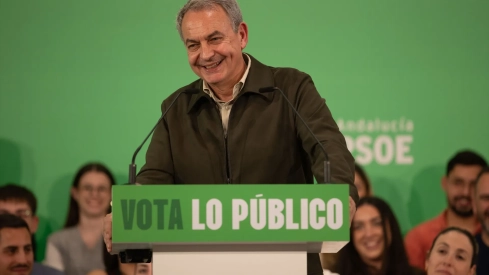
The Senate of Bolivia has approved the creation of a commission to investigate the alleged influence carried out by former Spanish president José Luis Rodríguez Zapatero in relation to the Peruvian company Grupo Gloria in exchange for 200,000 euros between the years 2024 and 2025. "To investigate the alleged influence management exercised," is the objective of said commission.
The Chamber, through a statement, has announced that the commission will be made up of six senators from different political parties. The initiative was proposed by Alianza Libre, the country's main opposition party. The party leader, Tomasa Yarhui, explained: "For us, this issue is of vital importance so that it can be investigated and sanctioned. We are establishing that the facts must first be investigated before consolidating the justification of the crimes" – statements 'El Deber'.
Luis Arce rejects any influence peddling
Former president of Bolivia Luis Arce rejected any participation in the alleged dealings attributed to the former head of the Spanish Executive José Luis Rodríguez Zapatero to favor business interests in Bolivia. His response came after a report by the Economic and Financial Crimes Unit (UDEF) pointed to the Spanish politician for alleged intermediation work benefiting the Peruvian group Gloria, majority owner of the cement company Soboce, in exchange for an alleged economic compensation of 200,000 euros. Faced with these accusations, Arce assured that he never intervened to favor any private company and maintains that his relationship with Zapatero was limited to the institutional and political sphere.
Through a publication disseminated on social media, the former Bolivian president, who remains in pre-trial detention since December for an investigation related to alleged acts of corruption, denied any irregular actions during his time leading the Government.
“I was not and am not involved in any influence peddling that has favored Soboce (Bolivian Cement Company) or any other private company”, Arce affirmed.
The former president also addressed suspicions linking him to the efforts attributed to Zapatero and assured that the contacts maintained with the former Spanish socialist leader were exclusively linked to political issues. As he explained, the conversations revolved around the mediation that the former head of the Spanish Executive exercised during the internal crisis of the Movimiento al Socialismo (MAS) in the period prior to the elections scheduled for 2025.
The controversy has its origin in a dispute that has pitted the cement company Soboce against the state-owned Fancesa for more than ten years over the ownership of shares whose possession would allow the former to expand its production capacity. The Peruvian group Gloria, majority shareholder of Soboce, later joined the conflict, claiming economic compensation from the Bolivian State. Luis Arce defended that this dispute predates his Government and stressed that his Executive appealed a judicial resolution favorable to Soboce, thus rejecting having favored the company. Furthermore, he recalled that the case is still awaiting a definitive decision from the Tribunal Constitucional Plurinacional (TCP) and that no payment related to the litigation has been made.The UDEF report
Likewise, it gained strength after a report prepared by the UDEF of the Spanish National Police became known. The document states that Zapatero would have participated in a "dynamic of intermediation and influences" aimed at favoring the interests of the Gloria group before the Bolivian authorities.
The investigators point to the existence of an alleged economic consideration of 200,000 euros and base part of their conclusions on WhatsApp conversations exchanged between the former Spanish president and his secretary, Gertrudis Alcázar, in addition to several notes recorded in their personal agendas.
The UDEF report
The latest report from the Economic and Fiscal Crime Unit (UDEF) places former Prime Minister José Luis Rodríguez Zapatero at the center of a series of professional dealings related to business interests in Bolivia. Investigators have reconstructed a sequence of events that includes the signing of a consultancy contract, the exchange of documentation on international litigation, the preparation of meetings and trips, as well as the payment of significant sums of money. According to the document accessed by this media outlet, investigators believe that the former president allegedly camouflaged lobbying activities as consulting work.
One of the most relevant elements of the report is the existence of a consultancy contract signed in May 2024 between Zapatero and the Peruvian company Focus Social Research SAC. According to the documentation analyzed by the Police, the agreement contemplated an annual renewable duration and fees of 200,000 euros, in addition to daily allowances of 10,000 euros per travel day and coverage of expenses derived from travel.
The investigation also includes the participation of the former president's closest circle in the preparation of the agreement. Specifically, agents reflect conversations in which Gertrudis Alcázar, Zapatero's secretary, indicates that the contract had to be previously reviewed by José Miguel Vidal Zapatero, the former president's chief of staff. After that review, a modification was introduced that eliminated the clause allowing the contract to be terminated before the one-year term was met.
