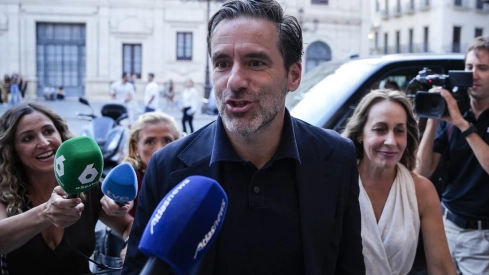
The national spokesperson for the Popular Party (PP), Borja Sémper, assured this Friday that it is already "irrelevant" whether, "at this point," the Minister of Transport, Óscar Puente, resigns or not after the tragedy of Urda (Toledo), and pointed out that there is a "superior responsibility" that, in his opinion, falls on the President of the Government, Pedro Sánchez.
In an interview on 'Telecinco', Borja Sémper stated that what is relevant is not the decision the minister makes, but the actions of whoever has allowed Óscar Puente to remain in office and whoever, he said, has favored politics becoming entrenched in these types of matters.
“For me, what is relevant is not what Óscar Puente is going to do but what whoever has allowed Óscar Puente to be minister for so many years has done, and what whoever has allowed politics to be installed here has done. And this has a name: Pedro Sánchez,” affirmed the popular leader.
Criticism for the lack of assumption of responsibilities
Asked if he understands why the head of Transport has not yet submitted his resignation, Borja Sémper said he has not understood it "for months" and criticized that, with the Government of Pedro Sánchez, "no one assumes any political responsibility."
In his opinion, the eventual resignation of Óscar Puente "does not respond to any assumption of political responsibility or a moral criterion," but to "a partisan calculation" and "an electoral calculation," something that, he maintained, has been happening "for too long" with the socialist Executive.
The national spokesperson for the PP defended that political responsibility "transcends" Óscar Puente, because there is, in his opinion, a greater responsibility on the part of whoever has "created a policy of confrontation," of "tweeting ministers," and of whoever has "politicized everything, even what should not have been politicized, such as technical responsibilities."
“Indecent and immoral” and citizens' fear of trains
After assuring that "everything will eventually be known," Borja Sémper expressed his "indignation" over what happened and described as "indecent and immoral" what, in his opinion, has been seen during these years with political management, which would have caused many citizens to be "afraid to get on a train" and distrust public services.
"They have wanted us to believe that we must accept as normal that things don't work in Spain. And this is immoral, because all winning politics has become a narrative, a theatricalization, a staging, and this has consequences, which are not paid by the rulers, but by the citizens and users of public services," he emphasized.
Remembrance for the victims and praise for Fátima Báñez
In his speech, Borja Sémper also remembered the people who have not yet been able to recover their relatives and friends after the tragedy of Urda, because they are still "among the tangle of iron."
Furthermore, he highlighted the career of former Minister of Labor Fátima Báñez, who died in the accident, describing her as "a competent person" and "a good person." "I believe that in these times it is important to emphasize these values. She was a person who, despite her excellence, never let it go to her head, and it is important to remember this in these times," he concluded.