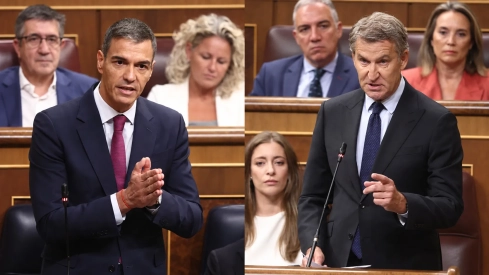
The Ceuta crisis has acquired several political dimensions. On the one hand, an internal crisis that pitted the Minister of Defense against the Minister of the Interior in a battle for the narrative more typical of confrontation with the opposition. On the other hand, an external crisis that has generated currents of opinion that transcend our borders.
With the political course in its early stages and after the first face-to-face between the President of the Government and the leader of the opposition in the Congress of Deputies, each cabinet designs its strategy knowing that the clock is ticking, although there is still game to play and no one knows when the final whistle will blow.
Round of interviews to take the reins
At Moncloa, the focus is clear: project institutional stability against noise and open fronts, to convey the idea that solutions “will come from the Government's management.”
To achieve this objective —which authorized sources recognize as an attempt for Pedro Sánchez to “set the pace again”— the round of interviews that the socialist leader has been conducting in recent days on different sets has been scheduled. After passing through the yellow microphone of Cadena SER and through TVE's 'Mañaneros' program, he will continue in the coming days on other channels such as La Sexta.
A strategy similar to the one designed in 2023, when, prior to the election call, he appeared in different media showing a more personal profile. On that occasion, the novelty was his visit to the podcast La Pija y la Quinqui.
In the interviews already conducted, Sánchez has maintained the idea of exhausting the legislature. These are interventions that also fit with a turbulent summer in which the Government lost control of its communication strategy, and which it is now trying to recover.
Feijóo: message to his own
In Génova, the strategy is also defined. The focus, in this case, is on setting the pace for the Government —at least trying to— and undermining the credibility of a president they see as increasingly “in low hours.”
The president of the Popular Party, Alberto Núñez Feijóo, has launched a request: not to improvise after the declassification of documents on the massive entry into Ceuta at the end of July and to stick to the discursive line set by the national leadership.
“This must be managed with serenity and responsibility because there is a lot at stake,” states the multi-paragraph ‘WhatsApp’ message that the PP leader sent this Thursday to ‘barons’ and members of his steering committee and to which Europa Press has had access.
In that WhatsApp to ‘barons’ and members of the PP leadership, Feijóo emphasizes the need for “coordination” within the party at this time, because it is a “controlled demolition” and there will be more revelations.
Without specifying what other information may be released, Feijóo takes for granted that there will be political and judicial responsibilities for what happened in Ceuta.
ANALYSIS | Double-sided strategies
The picture left by these weeks confirms that each party will adjust its discourse to the rhythm of events, without renouncing a strictly self-serving calculation. Both the PSOE and the PP —with the exception of the government partners, who are playing a different game— agree that there is still room to gain ground against the adversary, and both seem willing to exploit it without concessions.
The risk, however, is that this pulse will raise the volume of the debate to a point of no return: if the feeling of a pre-campaign sets in prematurely, the noise and decibels could end up prevailing over the substance of the issues truly at stake.