The Government is studying appealing before the Constitutional Court the decision of the Supreme Court to maintain the precautionary suspension of the vote for those naturalized by the so-called 'grandchildren's law' ahead of the general elections on November 29. The high court has rejected the appeal filed by the State Attorney's Office to lift the measure, adopted last September at the request of Vox and Iustitia Europa.
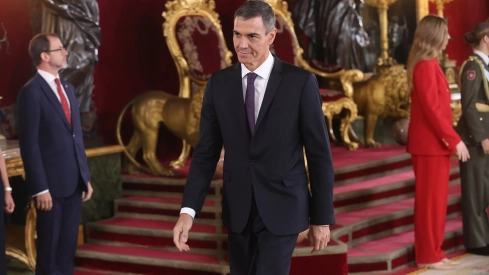
The Minister of Interior, Fernando Grande-Marlaska, conveyed the Executive's discomfort during an informal conversation with journalists at the reception held at the Royal Palace on the occasion of October 12. After learning of the judicial resolution, he lamented that for "some" the right to vote does not seem "so relevant". According to data provided by the Government, 163,020 people who have already obtained Spanish nationality will not be able to exercise their right to vote.
As he explained, the Government will instruct the State Attorney General's Office to examine whether the precautionary suspension can be considered a definitive resolution for the purposes of appealing to the Constitutional Court or if only the affected citizens can appeal it.
The Supreme Court's decision affects those who obtained Spanish nationality under the eighth additional provision of the Democratic Memory Law and were incorporated into the electoral census of absent residents abroad (CERA). The suspension includes an exception for those who prove, by means of the corresponding consular certificate, their status as descendants of Spaniards who suffered exile under the terms established by the court.
Sánchez warns that 400,000 Spaniards could be left without voting
Before the resolution was known, the President of the Government, Pedro Sánchez, had expressed his confidence that the Supreme Court would accept the Executive's arguments and lift the precautionary suspension.
Sánchez had warned that maintaining the measure would deprive 400,000 Spaniards of the right to vote, a situation he considers incompatible with the principle of equality among citizens. "A democracy cannot have first and second-class citizens," the president had defended during his conversation with journalists.
The head of the Executive had also recalled that, since the approval of the Democratic Memory Law in October 2022, various electoral processes have been held, including the 2023 general elections, without, as he has maintained, problems related to the application of this regulation having occurred.
The Supreme Court maintains the suspension and gives those affected five days to present allegations
The Contentious-Administrative Chamber of the Supreme Court has dismissed the appeal for reconsideration by the State Attorney's Office, considering that the circumstances that led to the adoption of precautionary measures persist. The court maintains that there continues to be a risk to the regularity of the electoral roll and reproaches the Administration for not having sufficiently accredited the degree of review of the affected files.
The resolution, which includes the dissenting private vote of a magistrate, also allows affected citizens to appear in the procedure and present allegations about the precautionary measures within a period of five working days from the day following the publication of the decision in the Official State Gazette.
Feijóo defends the Supreme Court's decision on the 'grandchildren's law'
For his part, the president of the Popular Party, Alberto Núñez Feijóo, had stated, before the ruling was known, his confidence that the Supreme Court would be "consistent" with the precautionary measures previously agreed upon.
The opposition leader had argued that the regulation allows for the recognition of nationality for descendants of exiles, but questions whether that recognition extends under the same conditions to those who do not prove such ancestry.
After the resolution was known, Feijóo celebrated the judicial decision and insisted on the need to guarantee the reliability of the electoral roll. "In an election, there can be no doubts about the census. None," he said on his social networks.
