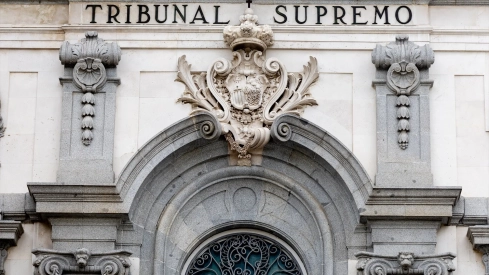
The State Legal Service has warned the Supreme Court that the early general elections on November 29 makes it "materially impossible" to apply in time the precautionary suspension of the right to vote that affects thousands of naturalized Spaniards under the so-called 'grandchildren law'. The State's legal services thus demand that the high court lift the precautionary measures and allow affected citizens to vote.
The warning comes amid a judicial battle over the right to vote for descendants of Spaniards exiled during the Civil War and Francoism. The Supreme Court agreed to provisionally suspend certain registrations in the Electoral Census of Absent Residents (CERA) after the appeals filed against the application of the regulations, while the State Legal Service appealed that decision. Now, the early election has further reduced the deadlines to resolve the conflict.
The Legal Service warns that there is no time to review the files
In its brief to the Supreme Court, the State Legal Service argues that there is no material time to check, case by case, which citizens are affected by the suspension. The problem lies especially in differentiating between those who obtained nationality directly under the assumptions contemplated in the Democratic Memory Law and those who did so through a subsequent instruction from the Ministry of Justice. The Administration itself had already warned of the difficulties in carrying out this verification. With the elections initially scheduled for a later date, consular services estimated that reviewing the files could extend until January 2027. The November 29 election call now reduces that margin to a few weeks.
The Legal Service considers that the situation creates a problem of fundamental rights. In its brief, it argues that, given the risk of disenfranchising Spanish citizens, the right to participate in elections must prevail. It also questions whether an individual selection of those affected can be made in the short period remaining until the elections. The conflict affects thousands of Spaniards residing abroad. According to data handled by the Administration, more than 500,000 people have acquired Spanish nationality under the Democratic Memory Law, although not all are registered in the CERA nor are all affected by the precautionary suspension.
The Supreme Court, for its part, has given the parties a period of 48 hours to present allegations before deciding on the appeal of the State Attorney's Office. The court's resolution will be decisive in knowing how the suspension will be applied for 29N.
The Supreme Court must decide before the 29N elections
The origin of the conflict lies in the Supreme Court's decision to provisionally suspend certain electoral registrations linked to the so-called grandchildren's law. The measure was adopted after the appeals filed against the application of this regulation and especially affects those naturalized through an instruction from the Ministry of Justice that presumed the status of exile for certain descendants. The court has differentiated between those who can directly prove their status as descendants of exiles in accordance with the law and those who obtained nationality through that instruction.
The difficulty has been aggravated by the call for elections on November 29. The Attorney's Office argues that reviewing thousands of files in a few weeks is unfeasible and that attempting to do so could end up causing Spanish citizens to effectively lose the possibility of exercising their right to vote. Furthermore, the Attorney's Office itself has warned that the electoral roll to be used in the elections was already closed on August 1, before the Supreme Court adopted its precautionary decision. Therefore, the court must determine how to fit its resolution with an electoral process that is already underway.
The Supreme Court now has the last word. Its decision must resolve not only a question related to the application of the grandchildren's law, but also how to guarantee the right to vote of affected citizens without opening a review procedure that, according to the State's legal services, is impossible to execute before 29N. The case thus places the high court before a particularly tight schedule: more than 160,000 Spaniards could be affected by the suspension, while the Government demands that the measure be lifted and the Ombudsman insists that the condition of being Spanish must entail the right to vote.
Gabilondo warns of the risk of leaving thousands of Spaniards without voting
In the midst of this legal dispute, the Ombudsman, Ángel Gabilondo, has spoken out, defending that Spanish nationality entails the right to vote.
"Nationality entails the right to vote. It's not that you can be Spanish with the right to vote or Spanish without the right to vote, but rather that if you are Spanish, you have the right to vote," he stated during an informative meeting held this Thursday in Madrid. Gabilondo also asked to avoid "impossible paths" to determine who are "truly Spanish, very Spanish, or very very Spanish." In his opinion, the issue should be resolved by looking at the electoral roll and not through a generalized review of files within a timeframe he considers difficult to meet.
