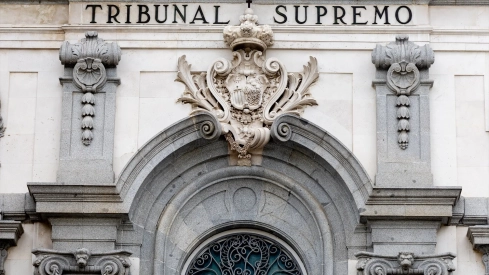
The Supreme Court has granted an unextendable period of 48 hours to the parties to present the allegations they deem appropriate, after the new briefs presented by Iustitia Europa and Vox in relation to the registrations in the electoral census of absent residents abroad (CERA) of people who have acquired Spanish nationality through the so-called grandchildren's law.
This law, approved within the Democratic Memory Law, allowed many children and grandchildren of Spaniards to apply for Spanish nationality, especially in cases related to people who had to leave Spain for political, ideological reasons or during the Civil War and the dictatorship. The problem that has reached the Supreme Court is related to the registration of some of these people in the Electoral Census of Absent Residents (CERA), which is the registry that allows those living abroad to vote in Spanish elections.
An increase in CERA that the Supreme Court sees as an electoral risk
In two orders, the high court has agreed to provisionally suspend, as requested by Iustitia Europa and Vox, new registrations in this census of those naturalized Spanish under the aforementioned law. The magistrates consider that the “extraordinary increase” in the number of voters registered in the CERA, derived from the grandchildren's law and a subsequent instruction, generates “a well-founded, real and serious danger of being able to seriously affect the objectivity and transparency of the electoral process”.
In September, the Supreme Court decided to provisionally suspend the right to vote of certain registered individuals related to this situation, while studying whether the way in which they were recognized as exiles complies with the law. This decision does not mean that they have lost Spanish nationality.
The order, which includes a dissenting vote, states that the census of residents abroad has increased by 408,262 voters from the last general elections in 2023 until July 1st, and adds that this extraordinary increase is “constantly growing”. In the opinion of the Chamber, there is a “risk of alteration of the electoral census through an exceptional increase in the number of new registrants in the CERA, which also affects its legal regularity”.
The precautionary measure does not affect the nationality obtained
The resolution of the Supreme Court does not question the acquisition of nationality through the grandchildren's law, which is articulated through a provision included in the democratic memory law, issued on October 19, 2022, and which allowed children and grandchildren of Spanish origin to opt for it, provided they accredited the requirements of having been born outside Spain, that the father, mother, grandfather or grandmother were originally Spanish and that they had suffered exile for political, ideological, belief or sexual orientation reasons.
The problem that the Supreme Court is now analyzing is more specific. It is related to how the condition of exile was accredited in some of these cases and its effects on the right to vote. The magistrates limit the suspension to the electoral effect of that naturalization, when it has been applied through a government instruction that indicated that the condition of exile would be “presumed” for all Spaniards who left between 1936 and 1955.
Therefore, the measure adopted by the Supreme Court affects the right to electoral participation and to registration or electoral effects in the CERA, but it does not mean that the citizen ceases to be Spanish. In fact, the Supreme Court itself has provisionally limited the electoral effects while the procedure is resolved.
Registrations will continue if there is consular certification
According to the order, registrations in the census will not be suspended in the case of voters who obtain from consular registries a certificate proving that they meet the aforementioned requirements, without the “presumption of the instruction” having been applied to them.
The Supreme Court also maintains that it is necessary to preserve the correctness, clarity and transparency of the entire process, and in particular of the corresponding census, so that “the expression of the popular will, which is the holder of national sovereignty” prevails. In this vein, the magistrates link the eventual irregularity of the registrations with the effects that this situation could have on citizens' confidence in the electoral results, while the precautionary measure is now pending the allegations presented by the parties within the period set by the high court.
