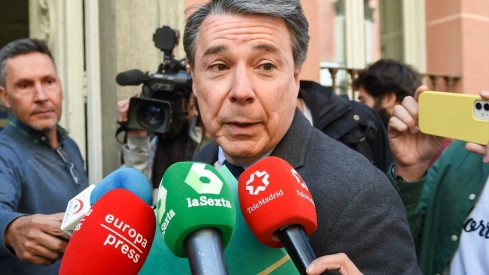
The former president of the Community of Madrid Ignacio González has denied this Monday the accusations of an alleged crime of bribery in the part of the Lezo case that the National Court is judging, along with four other people, for alleged irregularities in the awarding of two public contracts by the Canal de Isabel II linked to a golf course of the public entity.
On the first day of the trial, in which the parties raised preliminary questions, Ignacio González and the rest of the accused, the former managing director of the Canal de Isabel II between 2003 and 2009, Ildefonso de Miguel, and the partners of the company TCT, recipient of the allegedly fraudulent awards, José Antonio Clemente, Pablo Manuel González and Juan José Caballero, the latter two being the brother and brother-in-law of the former Madrid president, have denied the facts for which they are being judged.
The Anti-Corruption Prosecutor's Office requests six years in prison for each accused
For the five defendants, the Anti-Corruption Prosecutor's Office requests sentences of six years in prison as alleged perpetrators of bribery crimes and as necessary cooperators thereof, in addition to a fine of 550,000 euros.
During the preliminary questions, the joint defense of Ignacio González's brother and brother-in-law requested the "expulsion from the case of the representation of the Madrid City Council", considering that, although it is a private prosecution, it "has no accredited or alleged damage".
The court, however, rejected the lack of legitimacy of the council due to the institution's "own allegations", which stressed that "it is integrated into the corporate structure of the Canal de Isabel II, so that any economic damage caused to it necessarily affects the interests" of the Madrid City Council.
The Madrid City Council, considered harmed by the court
Along the same lines, the Madrid City Council has argued that it "holds a legitimate, concrete and current interest in the prosecution of the facts, since the outcome of the criminal procedure directly affects the legal and patrimonial sphere of the corporation".
The Prosecutor's Office, for its part, has also opposed the exclusion of the council from the case, arguing that "it is a shareholder of the Canal de Isabel II and, therefore, can be harmed by the facts that are going to be judged".
The Public Prosecutor's Office has added that "any economic deviation that occurs in the activities of Canal de Isabel II, allegedly carried out at this time by the accused, makes the City Council a legitimate injured party for criminal purposes".
The events date back to 2002 and an urban planning agreement
According to the provisional conclusions brief from the Anti-Corruption Prosecutor's Office, to which Europa Press has had access, the events date back to 2002, when Canal de Isabel II, dependent on the Community of Madrid, signed an urban planning agreement with the Madrid City Council to enable public use of various canal facilities.
In that context, the entity called a tender for the execution of the construction project for the cover of the canal's third reservoir. Two years later, according to Anti-Corruption, the management of Canal de Isabel II, then in the hands of Ildefonso de Miguel and Ignacio González, vice-president of Esperanza Aguirre in the Community of Madrid, "in order to benefit relatives of the latter, promoted and facilitated the processing of a modification of the previous tender", despite the fact that, due to the substantial variations that were to be introduced, a new tender should have been called.
