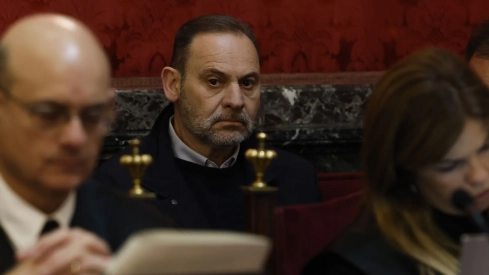
The former Minister of Transport, José Luis Ábalos, announced this Thursday that he will appeal his conviction to 24 years in prison for the Constitutional Court (TC) in the 'mask case', and has reproached the Supreme Court (TS), the body that judged him, for "confusing the application of the law with the power to create it".
According to what he published on the social network X, the former minister's "next step" will be to file an appeal for protection before the court of guarantees "for the violation of fundamental rights".
#EnElNombreDeÁbalos | Próximo paso: Recurso de amparo ante el Tribunal Constitucional por la vulneración de mis derechos fundamentales. Una vez resuelto por la Sala II del Tribunal Supremo el incidente de nulidad de actuaciones que presenté el pasado 15 de julio contra su sentencia condenatoria del 22 de junio, procederé a recurrir ante el Tribunal Constitucional por vulneración de derechos fundamentales, dado que no tengo otra posibilidad por la vía jurisdiccional ordinaria. Acostumbramos a escuchar que, frente a la posible arbitrariedad o contrariedad de sentencias judiciales, siempre asiste el derecho a recurrir. Sin embargo, a mí se me ha negado tal derecho amparándose en un Acuerdo de carácter NO jurisdiccional del propio Pleno de la Sala Segunda del Tribunal Supremo del 2 de diciembre de 2014. Dicho acuerdo se dictó a propósito de un supuesto muy específico: la dimisión de dos diputadas autonómicas 48 horas antes de la celebración de la vista para eludir el enjuiciamiento ante el Tribunal Superior de Justicia de la Comunidad Valenciana. No es mi caso. Yo dimití tras ser suspendido como diputado por la Mesa del Congreso y perder mis derechos y prerrogativas políticas y económicas, una vez que se ordenó mi ingreso en prisión provisional por riesgo de fuga, sin señalamiento de fecha para el juicio y con otra investigación abierta en la Audiencia Nacional por los mismos hechos. Ni las razones ni las consecuencias de mi caso guardan relación con el precedente de 2014. El citado acuerdo no constituye una fuente de seguridad jurídica (como sostiene la acusación ejercida por el PP) toda vez que únicamente el principio de legalidad (lex certa) garantiza dicha certidumbre y la previsibilidad de la norma. Tampoco un acuerdo de carácter procesal de la propia Sala Segunda del Tribunal Supremo que me habría de juzgar puede anteponerse a un derecho fundamental de rango constitucional como es el de la doble instancia penal, plenamente reconocido por nuestro ordenamiento jurídico y amparado por el derecho europeo y los tratados internacionales. No estamos ante una interpretación del derecho, sino ante la creación de una norma procesal por un poder al que no le corresponde, lo que contraviene un derecho fundamental que requiere un tratamiento legislativo de mayor exigencia por su carácter de ley orgánica. Mal servicio al Estado de derecho cuando el máximo órgano judicial confunde la aplicación de la ley con la potestad de crearla. . . En las imágenes: páginas 1 y 79 del auto de la Sala Segunda del TS de 7 de octubre de 2026 (80 págs. en total). @PoderJudicialEs #TribunalConstitucional #TribunalSupremo #DerechosFundamentales #SeguridadJurídica
— EN EL NOMBRE DE ÁBALOS (@abalosmeco) October 15, 2026
The Supreme Court's rejection of the nullity incident
The announcement comes a day after it was made public that the Supreme Court rejected the nullity petition filed against the sentence that declared him guilty of crimes of criminal organization, bribery, influence peddling, and embezzlement.
José Luis Ábalos has stated that, "once the incident of nullity of proceedings that I filed on July 15 against his conviction of June 22 has been resolved, I will proceed to appeal before the Constitutional Court for violation of fundamental rights, given that I have no other possibility through the ordinary jurisdictional route".
The jurisdiction of the Supreme Court, at the center of the complaint
The former minister, who has been in prison since November 2025, has insisted on his complaint that the Supreme Court was not competent to judge him once he resigned as a deputy and lost his parliamentary immunity.
The high court put him on trial considering that, in cases with privileged individuals, the resolution that agrees to the opening of the trial constitutes the moment in which the jurisdiction of the trial court is fixed, even if the condition of privileged individual has subsequently been lost, as occurred in the case of the former minister, who resigned later.
For José Luis Ábalos, "neither can a procedural agreement of the Second Chamber of the Supreme Court itself" that would end up judging him "be prioritized over a fundamental right of constitutional rank such as that of the double criminal instance, fully recognized by the legal system and protected by European law and international treaties".
In his message, the former minister has also maintained that "we are not facing an interpretation of the law, but the creation of a procedural norm by a power that is not entitled to it", and added that this action "contravenes a fundamental right that requires a legislative treatment of greater exigency due to its character as an organic law", to conclude that it represents "a disservice to the rule of law when the highest judicial body confuses the application of the law with the power to create it".
