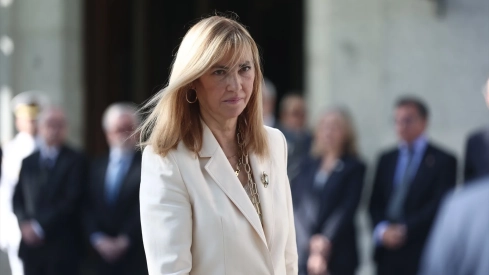
The president of the Supreme Court and of the General Council of the Judiciary, Isabel Perelló, has backed the actions of Judge María Tardón after Fernando Grande-Marlaska conveyed his concern to the CGPJ regarding the reservation imposed on the Police during the investigation of the Ceuta crisis.
Perelló has defended that the magistrate of the Audiencia Nacional acted in the "exercise of her constitutional functions" by preventing the agents who were preparing the report on the massive entry of people from informing their superiors. In her response to the Minister of the Interior, the president of the Judiciary has demanded "the utmost respect" for the decisions adopted during the investigation.
The magistrate also reminded Marlaska that the governing bodies of judges are "constitutionally and legally forbidden to approve, censure or correct judicial actions". The CGPJ, therefore, lacks the authority to review the order issued by Tardón or to rule on its appropriateness.
Perelló has also emphasized the duty of collaboration with judicial bodies. An obligation that extends to all citizens and is especially demanding for the Judicial Police, regardless of the body to which its members belong and their administrative dependence.
The response shares the Interior's concern about the seriousness of what happened in Ceuta, although it places the judge's actions within her powers. "The magistrate's action responds to the exercise of her constitutional functions, for which we must all show the utmost respect," Perelló wrote.
The clash arose from a report by the National Immigration and Borders Center of the National Police that analyzes the massive entry recorded on July 30 and 31. The document contains indications of an organized operation and attributes to Moroccan gendarmes an "active guiding" of people towards Ceuta, although it does not identify those who may have designed or directed the operation.
The director general of the Police, Francisco Pardo, informed Marlaska that he was unaware of the content of the document because Tardón ordered the investigators to keep the information within the judicial proceedings. He also maintained that no police report attributes the planning or execution of what happened to Moroccan forces.
Marlaska requested information to manage the crisis
The Minister of Interior had explained in his letter that he "scrupulously" respects judicial independence and the dependence of the Judicial Police on judges, courts, and prosecutors. His complaint focused on the fact that the secrecy order prevented potentially relevant information from reaching the political officials in charge of managing the crisis.
Marlaska believes that collaboration with Justice can coexist with the duty to inform the Government when public safety, foreign policy, and the defense of the State are at stake. The massive entry led the Executive to declare a situation of interest for national security, which is why Interior argues that it needed to know any useful data to make decisions.
The magistrate has sent the report to the Prosecutor's Office to determine if the Audiencia Nacional is competent to continue investigating the facts. The chief prosecutor of this body, Jesús Alonso, has personally taken on the matter due to its "singularity and transcendence".
