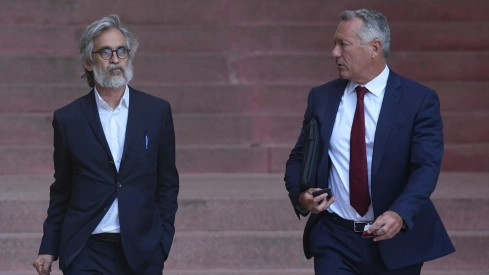
The lawyers representing the son of Mango's founder, Jonathan Andic, filed an appeal for reform on June 18 against the magistrate's decision to accept the Prosecutor's request to involve the Central Unit for Missing Persons of the Mossos d’Esquadra as a "specialized police unit accustomed to handling investigations based on circumstantial evidence from a technical-operative perspective."
In their brief, the defense argues that the challenged order does not specify "the object on which the intervention" of said unit should be developed and criticizes that it does not "define or particularize what" its participation in the investigation should consist of.
However, taking as reference the content of the Prosecutor's request — which calls for "providing a technical-operative analysis of the already existing circumstantial elements" and "contextualizing the already existing and obtained circumstantial elements to date" — the defense considers that the judicial mandate invades functions that correspond exclusively to the judge. According to the appeal, this task belongs to the "evaluative sphere, proper, exclusive, and excluding of the judicial authority," which does not require "police assistance with claims of expert knowledge" for this purpose.
The lawyers acknowledge that there are police specialties such as ballistics, dactyloscopy, or graphology, whose technical knowledge can be useful for forming judicial conviction. However, they emphasize that "this is not the case regarding circumstantial evidence," an area in which, in their opinion, the criminal process does not enable the judicial police to assist the judge in "logical-inferential reasoning."
For the defense, it is clear that neither the Instructor nor, eventually, the trial body, requires a technical-operative analysis of the circumstantial evidence requested by the Prosecutor, much less to "contextualize circumstantial elements." In their opinion, the Prosecutor is only seeking a kind of "uniformed rapporteur" to stage evidentiary assessments.
Likewise, the appeal questions the eventual use of intelligence expertise, considering that in this case "it would exceed the content, functionality, and scope of this evidentiary instrument." The defense argues that the investigation of an accident resulting in death, provisionally classified as homicide, "is far from being a complex process" that requires the instructing body or the court to rely on a "police analyst" to carry out its evaluative reasoning on the evidence gathered.
For the defense, the intention is to find a storyteller capable of converting a succession of scattered clues into a coherent and convincing narrative for the prosecution. It understands that the aim is to reinforce, through a persuasive narrative, what, in its opinion, the evidence alone fails to conclusively prove.
Add ElConstitucional.es as a preferred Google source for free.
Stay informed about all the latest breaking news with the best information. Against disinformation, for democracy and social rights.
