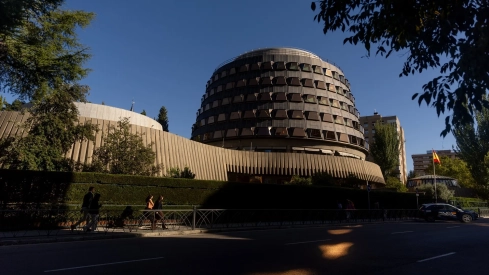
The decision of the Constitutional Court to apply the amnesty to the embezzlement of the procés has opened a harsh confrontation within the court itself. The five conservative magistrates accuse the progressive majority of invading the functions of the Supreme Court by instructing it to grant amnesty to former Catalan minister Dolors Bassa. They also criticize the ruling, drafted by the president of the Constitutional Court, Cándido Conde-Pumpido, for the tone used against the Criminal Chamber.
The plenary session has upheld Bassa's appeal against the resolutions with which the Supreme Court denied her amnesty for embezzlement. The former minister was sentenced to 12 years of absolute disqualification for her participation in the referendum of October 1, 2017. The Constitutional Court now annuls those resolutions and returns the procedure to the Supreme Court to issue a new one declaring that crime amnestied. This is one of the keys to the clash. The five dissenting magistrates accept that the Constitutional Court can review whether a judicial decision violates fundamental rights, but they argue that in this case it has gone further by pre-determining how the Supreme Court should rule.
Ricardo Enríquez, Enrique Arnaldo, Concepción Espejel, César Tolosa and José María Macías defend in their dissenting opinion that Bassa's appeal should have been dismissed. In their view, the Supreme Court's interpretation was reasonable and it was up to that court to decide how to apply the law. They therefore accuse the majority of assuming a task that belongs to ordinary jurisdiction and of turning the Constitutional Court into an instance that directly corrects the interpretation of the norm.
The disagreement goes beyond forms
The substantive discussion revolves around which embezzlements can be amnestied. The law excludes cases in which there was an intent of personal enrichment. The Supreme Court understood that the leaders of the procés obtained a patrimonial benefit by allocating public money to the referendum instead of paying for it with their own resources. The majority of the Constitutional Court rejects this reading because, as it explains, it would extend the exception to cover the embezzlement that the law itself intended to include in the amnesty. For the court, the personal enrichment referred to in the norm points to acts of private corruption unrelated to the financing of the independence process.
The Supreme Court had also invoked a possible detriment to the financial interests of the European Union. The Constitutional Court responds that this argument clashes with the facts recorded in the conviction and with a resolution of the EU Court of Justice from July of this year. The conservative magistrates also disagree with this reasoning and consider that the pro-independence purpose of certain acts does not, by itself, allow for ruling out the existence of personal gain.
Added to the legal dispute is the reproach for the language of the judgment. The five magistrates maintain that some epithets directed at the Supreme Court's argumentation are "unacceptable" from an institutional respect perspective. They criticize that it is required to adopt a specific decision with preferential and urgent character, an instruction they interpret as a sign of distrust towards the Criminal Chamber.
The resolution has already caused a movement in another procés case. Judge Pablo Llarena has provisionally suspended the national arrest warrants against Carles Puigdemont, Toni Comín, and Lluís Puig while studying the full text of the judgment. The measure prevents these orders from being executed before the Supreme Court examines the scope of the ruling; it does not yet imply the application of amnesty to the three.
