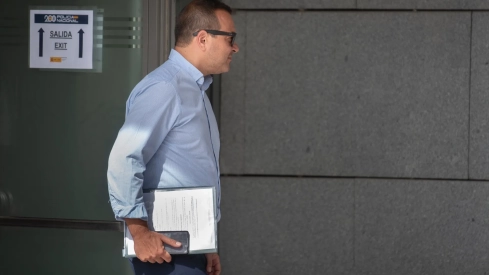
Gonzalo Sanz, former chief of staff to the former Government delegate in Ceuta, Miguel Ángel Pérez Triano, has ratified this Thursday before Judge María Tardón that he transferred the messages from the National Intelligence Center (CNI) to his superior received before the massive entry of people from Morocco. His statement maintains the discrepancy with Triano, who denied having known about these communications before they were declassified by the Executive.
Sanz has appeared as a witness in the Audiencia Nacional and, after an interrogation of more than two hours, has provided information from his mobile phone to support his account. The documentation will allow contrasting the communications related to the warnings prior to the entries on July 30 and 31 and reconstructing how the information circulated among those responsible for the Government Delegation.
The former advisor has confirmed the content of the letter with which he announced his resignation on September 11. In it, he assured that the CNI information "was transmitted by me to the delegate himself that same day". It was precisely the contradiction between that statement and Triano's public explanations that precipitated his departure from office.
The CNI warned of the call one day before
The declassified messages place the warning on July 29, the eve of the massive entry. At 1:52 p.m., a CNI member informed Sanz of a call on social networks to cross the border by fence and by sea the next day, coinciding with Morocco's Throne Day. The call indicated 8:00 p.m., although entries began earlier and lasted until July 31.
The agent also referred to two social media groups totaling about 180,000 followers, as an indication of the potential reach of the dissemination. This figure corresponded to the audience of the groups, without determining how many people would ultimately participate. In addition to the WhatsApp messages, there was a phone conversation of about eleven minutes between the agent and the chief of staff.
The existence of these contacts is recorded in the declassified documentation. What pits Sanz's and Triano's versions against each other is whether the content reached the delegate before the events. Sanz maintains that he communicated it to him personally the same day; his former superior maintains that he knew neither the content of the messages nor the existence of the call.
The witness has also reiterated what he included in his letter about the warnings conveyed from the Delegation to the competent ministries. In that letter, he defended the work done to get a response from the central Government and stated that there were reports demonstrating that warning effort. His version, therefore, combines disagreement with Triano about the specific messages from the CNI and the defense of the actions taken by the institution.
Two resignations and a chain of warnings under investigation
Triano resigned last Monday, after almost two months of crisis. When announcing his resignation, he assured that he had alerted the Executive "weeks before" and that he had conveyed the increase in arrivals and the need to adopt measures. He also alleged the pressures, insults, and threats suffered during that period.
Among the background information is a report sent to the Secretary of State for Security before the border emergency, published by 'elDiario.es'. The document warned of the "forecast of a serious overflow in the coming weeks" and demanded decisions in the face of possible massive entries that would exceed reception and management capacities. This prior communication adds another element to the investigation into the available information and the responses it received.
Sanz's statement comes a day after the president of Ceuta, Juan Jesús Vivas, appeared as a witness. The leader recounted that he tried to contact the President of the Government, Pedro Sánchez, ten times, and that three of those attempts ended in conversations with his chief of staff, Diego Rubio. According to Vivas, his requests for reinforcements and an emergency response did not translate into sufficient decisions before the entries.
Moncloa responded this Thursday with a record of nine calls between both cabinets from July 27 to 30, which it assures were answered at the moment or a few minutes later. Vivas has maintained his version and has stated that he can prove his communications. The discrepancy over these contacts adds to that regarding the CNI messages, although these are different exchanges.
Tardón is trying to reconstruct the prior warnings, communications between administrations, and actions taken during the crisis. Sanz's testimony must be contrasted with the documentation incorporated into the case, including the information provided from his phone, before drawing conclusions about possible responsibilities.
This Thursday, Sebastián Vega, head of the Ceuta Local Police during the events, also testified as a witness. Triano has not yet been called to testify in this case before the Audiencia Nacional, while the instructing judge has requested the referral from Ceuta of a complaint related to his actions.
