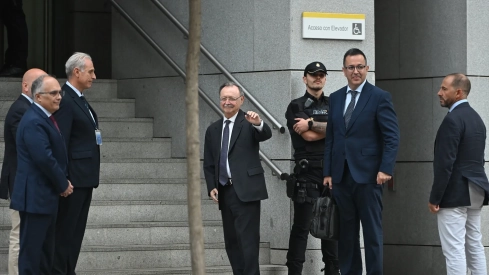
The president of Ceuta, Juan Jesús Vivas, has ratified that he requested help from the central Government days before the massive entry into the autonomous city of migrants from Morocco, at the end of July, although he has maintained that the Executive did not adopt the “preventive measures” that, in his opinion, were necessary to contain what he has described as an “invasion”.
Vivas made these statements in response to questions from journalists at the doors of the Audiencia Nacional, after appearing as a witness before Judge María Tardón, who is investigating the massive entry into Ceuta of people from Morocco that occurred at the end of last July.
The Ceuta president did not want to detail what he conveyed to the magistrate, although he did explain that he answered all questions and asked for confidence in the work of justice.
“What the national Government knew is not the same as what the city knew. The city Government did know that there was a very notable increase in the number of arrivals in Ceuta (in the previous days). Therefore, this was an alert call that invited preventive measures to be taken. Based on the information we had, we requested it. These preventive measures were not taken and we did not know that the invasion was going to occur,” he remarked.
First statement since proceedings were opened
The appearance of Juan Jesús Vivas is the first statement since María Tardón opened preliminary proceedings at the beginning of last August, and it occurred exactly two months after the day of the events.
The appointment also comes two days after the resignation of the Government delegate in the autonomous city, Miguel Ángel Pérez Triano, who at a press conference stated that he warned the central Government “weeks before” of the mobilization that was taking place on the other side of the border.
The judge's theses and the police report
Upon taking over the case, Judge María Tardón pointed to a situation of “permissiveness” and “a clear and undeniable management favoring the process from the territory of the Kingdom of Morocco”, a circumstance that, she noted, is evidenced through the behavior of the Moroccan Security Forces.
The magistrate admitted the appearance of Ceuta as a private prosecution in the process, considering that the autonomous city was “a direct and immediate victim” of the “serious events” that occurred at the Tarajal border, which caused the death of at least 83 people in their attempt to reach Spanish territory.
In a report commissioned by María Tardón, the National Immigration and Borders Center (CENIF) of the National Police attributed to the Moroccan security forces and bodies the “active guiding of the crowd towards the crossing points” during the massive entry of people, and pointed out that there was “planning”, both “prior” and “tactical”.
The CENIF also warned that what happened was not “incidental”, “occasional” or “spontaneous”, and pointed to the existence of “an earlier intellectual authorship and a material one” related to “monitoring and control functions”.
In that sense, the Police stressed that there were Moroccan uniformed officers who would have given “indications to the people who irregularly crossed the border to overcome obstacles” and would have “organized access to the area for large tonnage vehicles with a large number of immigrants”.
The report also highlighted the presence of ununiformed “dynamizing agents”, of “strong or athletic build” and with a behavior that, according to the document, “does not fit with the dynamic behavior of the crowd that enters and leaves Spanish territory”.
