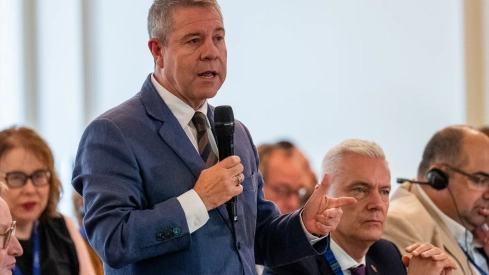
The president of Castilla-La Mancha, Emiliano García-Page, asked this Monday to be “realistic” about the housing problem and warned that, in the face of “complex problems,” “improvised solutions and especially simple solutions” do not work.
From Sigüenza, where he participated in the awards ceremony for the Regional Tourism Awards and the Plaques for Tourist Municipalities of the Region, the head of the regional Executive took the opportunity to refer to the Royal Decree on housing that the Council of Ministers is expected to approve this Tuesday, after the eviction of Maricarmen in Madrid, a situation that has generated protests in different parts of Spain.
“We must get to work,” said Emiliano García-Page, who offered his collaboration to the central Government and the Minister of Housing, Isabel Rodríguez. “They will have all our support,” assured the president of Castilla-La Mancha.
In this context, he defended that, “before being left-wing or right-wing,” it is convenient to ask “if one is effective or ineffective,” because, as he pointed out, “one can be ineffective on the left and on the right.” “To be effective and solve problems, before being left-wing or right-wing, one must be realistic,” he affirmed, while adding that “being realistic is not incompatible with dreaming or having utopias.”
Housing, property, and limits to stigmatization
García-Page insisted that “the realm of dreams, dreams they are” and defended that it is necessary to “have one's feet on the ground.” In this sense, he recalled that the Spanish Constitution recognizes the right to housing, but also protects private property, to which it grants constitutional status.
“Moreover, it is not only a property to which one has a right but also an economic asset,” warned the president, who gave as an example those who have saved for years to buy a home and leave it as an inheritance to their children. As he explained, these people cannot be considered “rentiers,” so he asked to speak “with propriety” and maintain a “realistic” view of the problem.
“Being able to move things forward or being able to address complex problems requires medium and long-term strategies,” concluded Emiliano García-Page, who also called for not generally stigmatizing certain sectors. “If we stigmatize all tourist accommodation as a problem, we will end up not being able to host 100 million tourists that Spain needs because they don't fit in hotels,” he pointed out.
Criticism of speculation and legislative deadlock
The president of Castilla-La Mancha showed, however, his rejection of “those who speculate or those who literally control land to drive up housing prices,” although at the same time he stressed that there are political and parliamentary limits that condition any reform.
In this vein, he recalled that there is no land law because it has been overturned in Parliament and that changes in housing legislation could not be promoted due to a lack of sufficient support in the Congress.
“The reality of housing is very complex,” summarized García-Page, who also linked this debate to the need for labor in Spain. As he indicated, the country tries to curb the arrival of workers, but at the same time needs part of that workforce to come from abroad, because “many here no longer want to work, at least in all the things that are needed.”
For all these reasons, he asked not to analyze the situation “linearly” and brought up the effect of tourist accommodation in historic centers. “If in many historic centers homes were not used for tourist accommodation, those houses would not be used because no one would have invested to rehabilitate them if they didn't have a business,” he said. “What we cannot do is, to dress one saint, undress another,” he concluded.
Add ElConstitucional.es as a preferred Google source for free.
Stay informed about all the latest breaking news with the best information. Against disinformation, for democracy and social rights.
