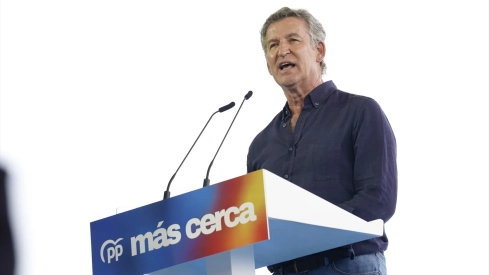
Alberto Núñez Feijóo has chosen the Ceuta crisis to open the new political year and launch his offensive against Pedro Sánchez from Andalusia. In the traditional fried egg event organized by the PP of Malaga in Alhaurín el Grande, the popular leader has called to transform "rage and hope" into an electoral majority capable of taking him to La Moncloa. "We are going for broke, in every city council, in every community and throughout Spain," he proclaimed alongside the Andalusian president, Juanma Moreno.
The message had a marked pre-election tone. Feijóo believes that this will be the last year of a legislature that, in his opinion, "should never have started" and has presented the PP as the political instrument of a change that he intends to extend beyond his voters. "The change is not of a single party, it belongs to society," he assured before summarizing his speech in one sentence: "What Spain has too much of is Sánchez."
Lo que le sobra a España es Sánchez.
— Alberto Núñez Feijóo (@NunezFeijoo) September 4, 2026
Por eso este es el curso político del cambio en España. pic.twitter.com/tHy35E95IL
Ceuta fuels the offensive against Sánchez
Most of his intervention has revolved around the management of the massive entry of people into Ceuta on July 30 and 31. One day after Sánchez's appearance in Congress, Feijóo has maintained that the president still does not know "what version to give" and has accused the Government of having received warnings, hiding them and ignoring them "deliberately and without remorse."
That last accusation goes beyond what has been accredited in the known documents so far. The report delivered this Friday by the Civil Guard confirms that before the crisis, communications circulated about a possible concentration of people at the border, but specifies that none anticipated the content or the magnitude of the subsequent collapse. Police warnings on July 28 and 29 also warned of a high probability of entries by swimming, although they warned that their materialization was uncertain.
Feijóo has defended the CNI and the National Police against what he considers an attempt to turn them into "scapegoats". "If they knew, they have to resign for being irresponsible, and if they didn't know, they have to resign for being incapable," he stated. He has also anticipated "political and judicial consequences," despite the fact that the investigation supported by the Prosecutor's Office seeks to determine who organized the massive entry and still does not direct criminal responsibilities against the Government.
The popular leader has accused Sánchez of exculpating Morocco and has assured that he aspires to be "the president that best suits Spain". The position expressed by the head of the Executive in Congress was more limited. Sánchez stated that so far there is no conclusive evidence that the Moroccan Government ordered the operation, acknowledged the passivity of its agents for several hours, and pledged to act firmly if the investigation proves responsibilities.
Feijóo has also questioned the diplomatic management of the crisis. He has described the summons to the Moroccan ambassador as "clandestine" and has accused the Government of presenting a meeting with the chargé d'affaires as a success. The Ministry of Foreign Affairs responded this Friday that the ambassador was formally summoned on August 21 to reject the statements of several Moroccan ministers about Ceuta and Melilla, although it has not specified who finally attended the meeting.
On a social level, the president of the PP has demanded that the debate on the rights of migrants include the daily situation of Ceuta residents. He mentioned reports of sexual assaults, the fear expressed by some healthcare workers, and the difficulties of families and minors to return to their normal lives. His priority, he said, is for Ceuta to regain "normality, security, and prosperity".
Mi prioridad es que Ceuta recupere la normalidad, la seguridad y la prosperidad.
— Alberto Núñez Feijóo (@NunezFeijoo) September 4, 2026
Y no vamos a parar hasta lograrlo. pic.twitter.com/pDxZo5SAAA
A roadmap with funding, security, and political change
The popular leader has extended his warning to the Government's parliamentary partners, whom he has defined as "the white label of this decadence". He has also addressed socialist officials who may try to distance themselves from Sánchez as the elections approach. "You are very late. There is no good PSOE and bad PSOE. You are the vote that keeps it where it is," he launched.
The concentrations called last Wednesday in support of Ceuta have served Feijóo to defend that there is a social mobilization on which to build his alternative. He has asked to convert indignation into a democratic response at the polls and has promised a Government that "does not lie" and that assumes responsibilities when it fails to fulfill its commitments. "If I don't keep my word, I will leave. And if I don't leave, you have to kick me out," he stated.
The other big issue of the event has been regional financing. Coinciding with the approval of the Treasury's proposal in the Fiscal and Financial Policy Council, Feijóo has promised a "fair" system if he governs and has rejected the existence of first and second-class citizens. His approach is to finance health, education, and social policies according to the needs of each person, regardless of the territory in which they live.
The popular leader has criticized the agreement reached by the Government with ERC, although he has not yet detailed the criteria or figures of his alternative model. The proposal approved this Friday incorporates almost 21,000 million euros additional for the communities and places Andalusia as the main beneficiary in absolute terms, with 4,846 million more per year. The PP rejects its bilateral origin and demands a joint negotiation among all territories.
Feijóo has also promised to strengthen the fight against organized crime on the coasts of Malaga and the rest of southern Spain. "We are going to pursue them, we are going to imprison them and they will disappear from our coast," he said. Moreno has accompanied that commitment by demanding more agents, specialized units, and material resources in the face of the expansion of drug trafficking networks along the Andalusian coast.
The intervention has also included a reference to the Adamuz railway accident. Feijóo has accused the Minister of Transport, Óscar Puente, of discrediting the conclusions of the Civil Guard and has called him an "unworthy minister". Before the families of the 46 victims, he has promised that the causes and possible responsibilities for the tragedy will be known.
Moreno vindicates Andalusia and support for Ceuta
Juanma Moreno has shared the firm tone regarding the autonomous city and has thanked the participation in the concentrations held in numerous municipalities. The Andalusian president has criticized the PSOE leadership for advising its officials not to attend and has considered that the socialist mayors missed an opportunity to stand with their neighbors.
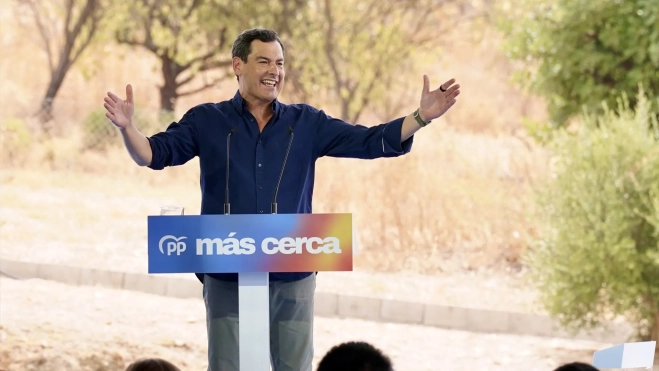
"Ceuta is not for sale," Moreno proclaimed, defending territorial integrity and calling for continued institutional and citizen support for the city. The president of the Junta has maintained that the defense of Ceuta must be above party lines, while hardening his discourse against the actions of the central government.
Ceuta no se vende.
— Juanma Moreno (@JuanMa_Moreno) September 4, 2026
Los españoles lo hemos dicho alto y claro: no estamos dispuestos a que se ceda ni un centímetro en la defensa de la integridad territorial de España. GRACIAS a todos por la lección de dignidad.
Sigamos así: todos juntos al lado del pueblo ceutí. pic.twitter.com/ObgmixPnzj
Moreno has also rejected the new financing model, considering that it responds to Sánchez's parliamentary needs and the pact with ERC. His Government has attended the Fiscal and Financial Policy Council to vote against it, thus distancing itself from the boycott promoted by Isabel Díaz Ayuso and maintaining a position of opposition within institutional channels.
The presidents of Ceuta and Melilla, Juan Jesús Vivas and Juan José Imbroda, have intervened through videos. Vivas has thanked the support received during the mobilizations and has defended that "territorial integrity cannot be divided", while Imbroda has called for maintaining political attention on the two autonomous cities.
