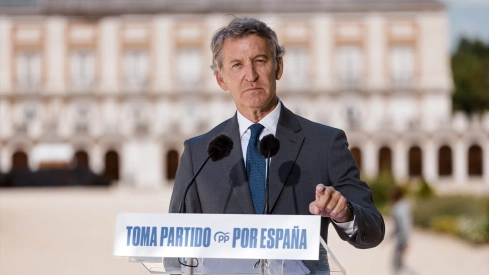
The president of the Popular Party, Alberto Núñez Feijóo, will take his plan to Brussels this Thursday to shield the borders of the European Union and allow immediate expulsions, with the aim of preventing a repeat of episodes like the one experienced by Ceuta at the end of July, when around 80,000 immigrants entered en masse.
At the summit of the European People's Party (EPP), prior to the European Council, the leader of the PP will once again denounce the "inaction" and "negligent abandonment" that, according to the party, the autonomous city has suffered from the Government of Pedro Sánchez for more than two months.
A European protocol against "hybrid attacks"
"A protocol must be created to protect the EU from hybrid attacks and wars like that of Ceuta. We must be able to act against elements of external destabilization," sources from the PP leadership indicated, on the eve of the meeting in the Belgian capital.
Alberto Núñez Feijóo himself insisted on this line on Tuesday, that the EU should have "an emergency procedure for situations like those in Ceuta." As he explained, the aim is for "European legislation to change and allow countries immediate expulsion" and "denial of asylum" to those who "invade a country."
Criticism for the presence of Moroccan ships
Feijóo also considers that the "revelations" known this week about the presence of Moroccan navy ships during "the invasion" are of "extraordinary gravity," an idea he will convey to his EPP colleagues this Thursday, as he himself announced. In his opinion, Pedro Sánchez should have deployed the Army in response to these movements in Ceuta's waters coinciding with the irregular migrants' crossing.
In addition to bringing this matter to his European partners, the popular leader has demanded that the President of the Government appear before the Permanent Deputation of Congress to offer explanations about these Moroccan incursions into Spanish waters. For the PP, the episode demonstrates "the negligent and unforgivable abandonment of 80,000 Spaniards by those who had the obligation to protect them."
The PP seeks to "Europeanize" the Ceuta crisis
In Génova, they maintain that Feijóo has managed to "sensitize" the EU to the Ceuta crisis, because the massive entry represented, in his opinion, "a before and after for ensuring the territorial integrity of Spain and Europe." However, the objective remains to "Europeanize" the crisis and prevent what happened from falling into "oblivion," according to party sources.
In his five visits to Ceuta, Feijóo has reiterated that the return of the thousands of irregular immigrants who remain in the city is protected by the European Pact on Migration and Asylum and by the Return Directive. He has also requested economic aid to extend the Tarajal breakwater, a permanent presence of Frontex (European Border and Coast Guard Agency), and improvements in European funding for the autonomous city.
The EPP supports an emergency mechanism
On September 21, during his trip to Ceuta with an EPP delegation led by its president, Manfred Weber, Feijóo thanked the European Commission for studying the possibility of equipping itself with an emergency mechanism to "activate immediate returns of all citizens who enter a European State" and to guarantee the "effective and real strengthening of the European border when it is attacked."
According to the PP, this approach has already gained support in Brussels. In August, 22 EU countries sent a letter to community institutions, promoted by the Italian government of Giorgia Meloni, criticizing the Spanish Executive's migration management after the Ceuta crisis. Subsequently, at the end of September, the EPP approved a resolution in Toulouse calling for the return of immigrants who entered the autonomous city irregularly and demanding that the European Union have the option to temporarily suspend asylum applications in cases of "hybrid attacks."
Sánchez, increasingly alone in the EU, according to the PP
In the circle of Alberto Núñez Feijóo, they believe that Pedro Sánchez is increasingly isolated in the European Union due to his migration policy. The trip to Brussels also takes place in the midst of the electoral pre-campaign in Spain, after the head of the Executive called early general elections for next November 29.
Sources from Feijóo's team expect this to be his last trip as leader of the opposition and that, at the next EPP summit in Brussels, scheduled for December 17 and 18, he will already attend as elected President of the Government. In Génova, in any case, they assert the weight of the Spanish PP within the EPP and emphasize that, at this moment, Feijóo even surpasses the CDU (Christian Democratic Union) in internal strength, despite the fact that Friedrich Merz managed to be invested as Chancellor of Germany with 28% of the votes while the PP, with 33% of the votes in the 2023 general elections, failed to reach the Moncloa Palace.