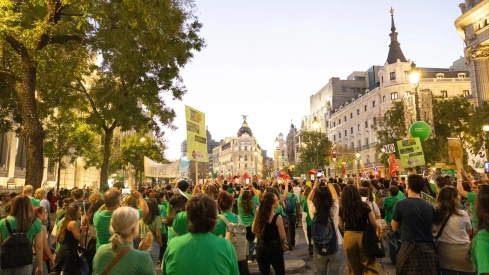
Housing and public education mark the pre-campaign for the November 29 elections. Madrid faces its second day of educational strike this Thursday after a demonstration that gathered 25,000 people, according to the Government Delegation, and ended next to the housing encampment in Puerta del Sol. Teachers, students, families, and tenants shared a square from which they demand the ability to study, work, and live in dignified conditions.
The mobilization maintains pressure on administrations while parties prepare their candidacies. Isabel Díaz Ayuso's Government questions the strike and seeks the eviction of Sol, where the protest has remained since September 26. Unions, for their part, are preparing a general strike for November 11 for housing, wages, and the cost of living, just two days before the start of the electoral campaign.
Classrooms take their demands to Sol
Wednesday's demonstration marched through the center of Madrid from Atocha behind the banner "We defend public education. We defend the future". Among green teacher shirts and yellow early childhood educator shirts, slogans such as "Ayuso, listen, public education is fighting" and "The teacher fighting is also teaching" were heard. The arrival at Sol once again brought together two mobilizations that had already converged on September 27, when "no housing, no education" was chanted.
The strike affects non-university public education, with some 65,000 teachers called to participate and more than 666,000 students in the region. Comisiones Obreras estimated the first day's turnout at 70%, compared to the 44.6% reported by the Ministry. The organizers demand fewer students per classroom, more professionals to address diversity, a monthly salary increase of 600 euros, and less bureaucracy, in addition to reducing weekly teaching hours to 17 in Secondary and 22 in Early Childhood and Primary. CSIF maintains its own call, with three full days of strike and subsequent partial strikes.
Working conditions and rental prices were also found in the testimonies of the march. Two teachers, Sonia Cantalejo and Sara Molero, explained to 'elDiario.es' that "Madrid is one of the worst-paid communities and where rents are most expensive". Other teachers described the difficulty of attending to students with different needs in overcrowded classrooms. Víctor and Aura, Philosophy and Literature teachers, summarized their request with a "we want to teach well". Early childhood educators attended after more than six months on strike, according to their platform.
The Minister of Education, Mercedes Zarzalejo, accused the organizers of pursuing political and electoral objectives and of wanting to "burn the streets". Aída San Millán, general secretary of the CCOO Madrid Education Federation, responded that the protest questions regional educational policies and recalled that it was organized before the early election. The day was also marked by police charges at the Complutense, which the university condemned, clarifying that it had not requested the intervention. The Government delegate, Francisco Martín, requested an urgent investigation. For this Thursday, the calendar disseminated by the Student Union includes a concentration at 12:00 in front of the Ministry of Education.
Housing prepares for the jump to 11N
The Sol encampment approaches three weeks with Maricarmen's case as a reference for the protest. The 87-year-old neighbor was evicted on September 23 from the house where she had lived for more than seven decades and subsequently died, after being admitted to the hospital. Her eviction prompted a mobilization that has spread to other cities and demands protection against evictions, contract stability, and rents that can be paid with a salary.
The Madrid Executive again went to court on Wednesday. It agreed to appeal to the Superior Court of Justice of Madrid to demand the "immediate eviction" of Sol, after justice refused to order the precautionary expulsion of the campers. The Community also sent a complaint to the Prosecutor's Office for threats and insults against Ayuso and for possible damages in the square. Its spokesperson, Miguel Ángel García Martín, insisted on pointing out possible links with organizations declared terrorist in other countries, without publicly identifying which these entities would be.
The conflict also has a parliamentary path. The new housing decrees are still pending validation, after the Government approved them again on October 6 to recover the measures that Congress had rejected four days earlier. The first includes protection against certain evictions of vulnerable people, measures on rents and actions to expand affordable housing. The second addresses the renewal of contracts. The PNV has announced its support for the first text and its rejection of the second, a decisive difference in the Permanent Deputation, the body that maintains functions of Congress after the dissolution of the Chamber.
The next big date for the mobilization will be November 11, with a 24-hour general strike backed by CCOO, UGT and other trade union organizations together with the Confederation of Tenant Unions. The call relates the cost of housing to wages and job insecurity. Its demands include rent reductions, stable contracts, protection against evictions and a larger public housing stock, in addition to wage and working hour improvements. The protest will arrive 18 days before the general elections.
Pensions and taxes open new clashes
The defense of public services continues in the debate on pensions. The PP spokesperson in Congress, Ester Muñoz, warned that the system "will collapse", while Alberto Núñez Feijóo has assured that he will maintain the revaluation in accordance with the CPI and has proposed changes to guarantee its viability for young people. The Minister of Economy, Carlos Cuerpo, defended the sustainability of the model on Wednesday and asked the PP to clarify its proposals, considering that it is sending contradictory messages. The PSOE has placed the protection of pensions among its pre-campaign arguments.
Taxation has also entered the discussion on how to finance education and health. The Minister of Finance, Arcadi España, warned on Wednesday that the IRPF reform proposed by the far-right Vox would reduce revenue by some 85,000 million euros, according to his department's estimates. The head of the Treasury demanded an explanation of what expenses would be reduced to compensate for that loss of income. The figure, calculated by the Government, exceeds the annual public spending on education and is equivalent to about 80% of that allocated to health.
The Ceuta crisis maintains another confrontation between the Government and the PP. Feijóo demands explanations for the entry of Moroccan ships into Spanish waters in July, coinciding with the massive arrival of migrants, while the Executive maintains that the episode was resolved through dialogue with Morocco. The Council of Ministers approved this week an additional 45.3 million euros to cover extraordinary expenses of the city, including those for social services, education, public health, and security.
The parties face these debates as they finish organizing their candidacies. Sánchez gathers eleven ministers in the PSOE's list proposals, with Margarita Robles as number two for Madrid, while the PP keeps its main positions unannounced and Frente Amplio and Podemos rush conversations to avoid electoral division. The socialists plan to ratify their candidacies on Saturday in Fuenlabrada. The deadline to register coalitions ends this Friday, October 16, at 23:59.
