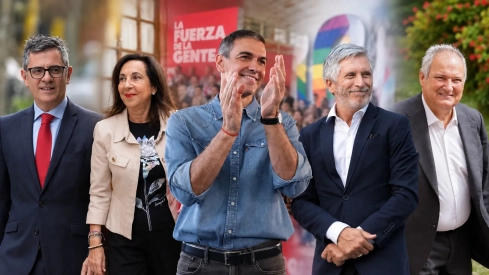
Pedro Sánchez will run in the general elections on November 29 with eleven ministers on the PSOE candidacies, according to the proposals known until this Wednesday. The main novelty is in Madrid, where Margarita Robles recovers the number two position she already held in 2016. The Minister of Defense will accompany the president ahead of Félix Bolaños, who maintains the third position, and Fernando Grande-Marlaska, who goes from heading Cádiz to occupying the fifth position in the Madrid candidacy.
The configuration of the lists allows the PSOE to bring government management to the campaign and distribute its main officials across decisive constituencies. It combines ministers with a long trajectory in the Executive, regional leaders, and new additions from the socialist leadership. The candidacies are progressing in the federations, although they still must pass the review of the Federal List Commission and the ratification of the Federal Committee.
Robles returns with Sánchez in the battle for Madrid
The Regional Committee of the PSOE-M approved this Wednesday the candidacy headed by Sánchez. Robles replaces Teresa Ribera as second, who held that position in 2023 and is now executive vice-president of the European Commission. Bolaños, Minister of the Presidency, Justice and Relations with the Cortes, repeats as third. Between him and the Minister of Interior is Pilar Sánchez Acera, organization secretary of the Madrid socialists.
The election of Robles coincides with data from the Center for Sociological Research that favor her electoral profile. The barometer published this Wednesday grants her a 5.15 out of ten and a degree of knowledge of 86.2%, the highest among the ministers. She is the only one of the eleven government members included in these proposals who passes. Her presence offers the PSOE a recognizable and well-valued figure to compete for support beyond its usual electorate.
The contrast appears in the fifth position. Grande-Marlaska obtains the worst ministerial rating, a 3.60, while Carlos Cuerpo leads the ranking with a 5.52 but has declined to run in the general elections. The selection therefore combines citizen valuation, experience, and political responsibilities. The CIS scores provide information on the image of the ministers, although they do not equate to the support that the candidacies will receive in each province.
The Madrid list also includes Manuela Villa as sixth and Rafael Simancas as seventh. They are followed by Aránzazu Figueroa, general secretary of Socialist Youth of Spain; Borja Cabezón, assistant to the federal Organization Secretariat, and Lorena Morales, head of Equality for the PSOE-M. The presence of Figueroa and, in twelfth place, Elena Arafat expands the space for young profiles in a candidacy that concentrates a good part of the institutional and organic weight of the party.
Albares moves to Cádiz and the Government is distributed throughout Spain
One of the movements with greater territorial significance is the transfer of José Manuel Albares to Cádiz, where he will replace Marlaska as head of the list. The Minister of Foreign Affairs leaves the fifth position he occupied for Madrid in 2023. His candidacy allows the socialists to defend in the territory the agreement on Gibraltar, with direct consequences for cross-border workers and the economic activity of Campo de Gibraltar.
In Valladolid Óscar Puente will repeat as number one, accompanied by Ana Redondo as second. The heads of Transport and Equality will share a candidacy in their province, despite Puente being among the ministers worst rated in the CIS, with a 4.15. In Barcelona, the Minister of Industry and Tourism, Jordi Hereu, will head the PSC list, with Eva Granados, Secretary of State for International Cooperation, as number two. Montse Mínguez will once again lead Lleida.
In Valencia, the candidacy brings together Pilar Bernabé, Arcadi España, and Rebeca Torró, in that order. The Government delegate and PSOE Equality secretary heads a list in which the Minister of Finance occupies the second place and the federal Organization secretary, the third. The bet combines Bernabé's public projection after the DANA of 2024 with two central figures in economic policy and party leadership.
The ministerial deployment is completed by Elma Saiz for Navarra, Milagros Tolón for Toledo, and Isabel Rodríguez for Ciudad Real. The Government spokesperson and Minister of Inclusion will head the Navarrese candidacy, while the heads of Education and Housing will lead their respective provinces. In Castilla-La Mancha, Tolón's proposal ahead of Sergio Gutiérrez represents a rapprochement between Ferraz and Emiliano García-Page's federation after the differences caused by the order of that list in 2023.
Five ministers are left out and the Senate remains pending agreements
Diana Morant, Óscar López and Ángel Víctor Torres have chosen to focus on the regional elections of May 2027, in the Valencian Community, Madrid and the Canary Islands. Neither Cuerpo nor Luis Planas will run, the latter having communicated his decision to leave the candidacy for Córdoba to concentrate on European negotiations for agricultural and fishing policy. The participation of the third vice-president and Minister for Ecological Transition, Sara Aagesen, remains unconfirmed.
Outside the Council of Ministers, Alfonso Rodríguez Gómez de Celis heads the proposal for Seville, followed by María del Carmen Castilla and Francisco Toscano. The Sevillian documentation places Rosario Andújar, Antonio Gutiérrez Limones and Eva Patricia Bueno in the Senate. Among the other known candidacies are Francina Armengol for the Balearic Islands, Adriana Lastra for Asturias, Gabriel Cruz for Huelva and Anabel Mateos for Almería.
In Madrid, the PSOE has approved for the Senate Antonio Hernando, Leticia Correas and José Luis García Sánchez. All three belong to the socialist space and the documentation presented includes a party's own proposal. The negotiation with Frente Amplio, initiated on Sunday to explore joint candidacies in certain constituencies, is still awaiting public confirmation of its results. An eventual pact in Madrid would require specifying how this proposal would be adapted; its internal approval, by itself, is insufficient to consider the conversations concluded.
The objective of these contacts is to concentrate progressive support to dispute the PP's majority in the Upper House, a negotiation distinct from the composition of the lists for Congress. The calendar leaves little room. This Friday, the 16th, is the deadline to communicate electoral coalitions and the PSOE's Federal List Commission meets. On Saturday, the 17th, the extraordinary Federal Committee of Fuenlabrada must ratify the socialist candidacies.
