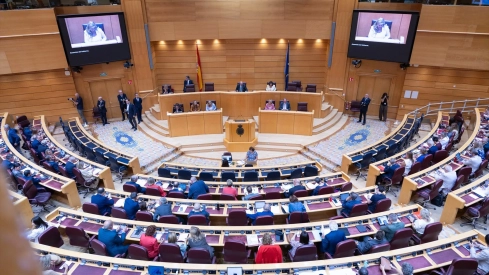
The PSOE and Frente Amplio have scheduled a meeting this Sunday to negotiate joint candidacies for the Senate in the general elections on November 29, as 'Público' reported on Friday. The conversation comes five days before the deadline to communicate coalitions and seeks to challenge the PP's absolute majority in the Upper House. The formula gaining ground involves territorial agreements, adapted to the constituencies where concentrating support can translate into more seats.
As ElConstitucional.es reported on Friday, Ferraz is studying "all alternatives and scenarios" to improve its results in both chambers. The approach is boosted by the citizen initiative Senators for Democracy, promoted by sectors such as culture, law, and journalism. From Movimiento Sumar, its co-leader Verónica Martínez Barbero confirmed that same day in an interview on 'Malas Lenguas', on La 2, that they are "in contact with the Socialist Party" to move in that direction.
The starting point explains the importance of the negotiation. In 2023, the PP obtained 120 directly elected senators, compared to 72 for the PSOE, an advantage reinforced by representatives designated by regional parliaments, who are also part of the Chamber. The 'populares' have used their majority to promote investigation committees on the Government and the socialist environment, including Pedro Sánchez's appearance on October 30, 2025. Ferraz denounces a "spurious" use of that parliamentary power and seeks to reduce the PP's capacity to set the agenda for the Senate.
Agreements by territories
In most provinces, four senators are elected, and each voter can mark up to three names, even from different parties. This combination usually favors a distribution of three seats for the most supported candidacy and one for the next. A small difference in votes can become a wide advantage in representation. If a progressive candidacy manages to reverse a result of three PP senators and one from the left, it could go on to obtain three and leave the 'populares' with one. To achieve this, voters would have to support the different candidates of the alliance.
Demographer Juan Antonio Fernández Cordón identifies 30 constituencies with possibilities to improve the left's results, based on 2023 data, in an analysis published by Economistas Frente a la Crisis. Among them are Asturias, Valencia, Teruel, Pontevedra, A Coruña, and Madrid. The work proposes reserving for the PSOE as many candidates as senators it obtained in each territory and distributing the possible gains between socialists and allies. It is a proposal to negotiate the composition of the candidacies, pending acceptance by the parties. His calculations depend on progressive mobilization and voter behavior, including the possible useful vote from Vox sympathizers to the PP. Previous results offer clues for agreement, while the distribution on 29N will depend on the support each candidacy obtains then.
The promoters see more options for agreement in Balearic Islands, Castilla y León, Asturias, Aragón, and the Valencian Community, although conversations are progressing at different rates. In the Balearic Islands, sources from Més and the PSOE describe contacts progressing at a good pace. In Castilla y León, the promoters of the initiative have held meetings with representatives of Frente Amplio, while the socialists avoid publicly specifying their position. Within Compromís, Iniciativa acknowledges contacts and conveys greater optimism; Més Compromís maintains a more cautious attitude. This internal difference conditions the possibility of building a shared proposal with the PSPV.
Until Friday, no similar advances had emerged in Asturias and Aragón. Difficulties also remain in other territories. The BNG prefers to stay out of pacts with state forces, while Adelante Andalucía assures that it has not received the proposal. Its decision to run separately for Congress leaves open a specific negotiation for the Senate, if the parties propose it. Catalonia and Euskadi present another electoral scenario, with a decisive weight of nationalist forces and a much smaller presence of the PP. In 2023, the popular party did not obtain any directly elected senator in the three Basque provinces, which modifies priorities compared to territories where they dominate the distribution.
Precedents and deadlines
The collaboration between socialists and other left-wing forces for the Senate has precedents with different results. In 2000, the PSOE of Joaquín Almunia and Izquierda Unida, led by Paco Frutos, agreed on candidacies in 27 constituencies, without preventing the absolute majority of José María Aznar's PP. The Entesa Catalana de Progrés offered a more favorable experience. In 2004 and 2008, the alliance of PSC, ERC, ICV, and EUiA won twelve of the sixteen senators elected in Catalonia. These are precedents that show the importance of territorial roots and the support that each agreement manages to gather.
In 2023, a joint candidacy of socialists and other left-wing forces won the seat for the Ibiza and Formentera constituency. This example needs an update for 29N. Formentera will elect its own senator for the first time, separate from Ibiza's, after the constitutional reform approved in May 2026. The general elections will thus elect 209 senators directly, one more than in 2023. In the Balearic Islands, any agreement must adjust to this new distribution and the particularities of each island.
The PP has already reacted to the rapprochement. Its general secretary, Miguel Tellado, presents the search for allies as a socialist attempt to "save face." Control of the Senate also affects long-term institutional decisions. The Chamber can veto laws, although Congress has mechanisms to lift that veto, and proposes four magistrates for the Constitutional Court by a three-fifths majority. The electoral negotiation seeks to change a balance of power that influences both legislative processing and appointments and investigative commissions.
Parties have until Friday, October 16, to communicate their electoral coalitions and until the 26th to present candidacies. The meeting scheduled for this Sunday must specify the territorial scope of the possible pact, the participating organizations, and the criteria for choosing their representatives. The promoters propose that decisions be worked out with regional and provincial structures. In constituencies where an alliance prospers, the names that will appear on the Senate ballot will remain to be finalized.
