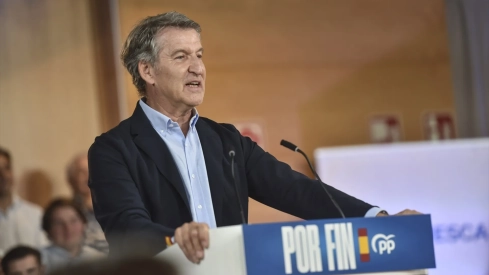
Alberto Núñez Feijóo keeps the PP candidacies for the general elections on November 29 under wraps. Cayetana Álvarez de Toledo appears as a possible number two for Madrid and Xavier García Albiol is among the options to head Barcelona, while the party delays announcements and works with its territorial structures. The preparation of the lists coincides with the possibility of an agreement with the far-right Vox to run together for the Senate in certain constituencies, pending confirmation by both formations.
The campaign direction is already defined. Miguel Tellado, general secretary of the PP, will be in charge, with Marta Varela as deputy director and Borja Sémper and Ester Muñoz as spokespersons. Alma Ezcurra coordinates the electoral program; Elías Bendodo, studies and demoscopy, and Luis de la Matta, political communication. The committee also includes Mar Sánchez in media and message coordination, while Diego Calvo presides over the Electoral Committee. Feijóo thus concentrates the preparation of candidacies and campaign strategy in his trusted team.
Cayetana and Albiol, two bets yet to be confirmed
The main unknown in Madrid is who will accompany Feijóo in second place. 'Vozpópuli' places Álvarez de Toledo as the president's choice and 'Artículo 14' reports that she leads the polls, although Génova keeps the decision unannounced. Her promotion would mean a jump from the sixth place she occupied in 2023, when Marta Rivera de la Cruz was number two. Choosing one of the most combative voices in the parliamentary group would reinforce the ideological profile of the candidacy at a time of electoral competition with Vox. Ezcurra has also appeared among the possibilities for Madrid and retains a central role in the preparation of the program.
In Barcelona, Albiol's name is still on the table. The mayor of Badalona was asked about that possibility last Thursday, during the meeting of the National Executive Board, and referred the decision to Feijóo. "Go up to the seventh floor and ask him," he replied, referring to the popular leader's office in Génova. His incorporation would allow the PP to present a candidate with municipal projection and media presence, although the party's decision and the mayor's own plans remain to be seen.
One confirmed departure is that of Beatriz Fanjul, who declines to run again for Bizkaia despite the PP having offered her to continue. "I am 35 years old and I want to do other things," the former president of Nuevas Generaciones explained to Europa Press. The national leadership maintains that she had communicated her intention to seek new professional experiences before the election call. Her departure opens the way for a replacement in a candidacy especially important for the representation of the Basque PP in Congress, whose new head of list is still not announced.
In Navarra, on the other hand, the coalition with Unión del Pueblo Navarro has already received the backing of its Political Council, with 93.5% support. UPN will designate the head of the list for Congress and the fourth position, in addition to the first and third candidates for the Senate. The representatives chosen at the proposal of the Navarrese formation will join the Mixed Group and will retain voting autonomy. The agreement allows to concentrate support that in 2023 ran separately, but maintains UPN's parliamentary identity and prevents its future seats from automatically integrating into the PP's groups.
The Vox option takes the Senate battle to the Constitutional Court
The possibility of another electoral alliance comes from information published this Wednesday by 'Vozpópuli'. According to the media, PP and the far-right Vox are exploring joint candidacies for the Senate in some provinces, conditioned on the success of the union between the PSOE and the forces of the Frente Amplio. The objective would be to protect their options against a concentration of the progressive vote and jointly aspire to three-fifths of the Upper House. This is an operation still open, without an announced agreement or a public list of affected constituencies.
The incentive is in the Senate election system, where citizens vote for specific candidates. In peninsular provinces, four senators are elected and each voter can mark up to three names, even from different formations. When voters support all three candidates from the same party, it is common for the most supported force to obtain three seats and the next one to obtain one. A shared candidacy seeks to concentrate these votes; the result depends on which candidates are the most voted and how preferences are distributed in each territory.
Reaching three-fifths would give the bloc that brought them together the capacity to agree on the four candidates for the Constitutional Court that the Senate is responsible for proposing, without needing the votes of other groups for that proposal. This threshold explains why the negotiation goes beyond the ordinary control of the Chamber. The renewal must follow constitutional procedures and the magistrates exercise their functions independently. The law also establishes that they continue in their positions until their successors take office, so the electoral result must then translate into a renewal procedure.
Génova plans to communicate its candidacies next week, according to EFE information, while decisions on names and positions remain open. Coalition pacts have a closer deadline than lists. Friday, October 16, marks the end of the period to communicate electoral alliances; candidacies for Congress and the Senate are presented between the 21st and 26th. An eventual PP-Vox coalition for the Upper House would have to be finalized within the first of those deadlines.
