
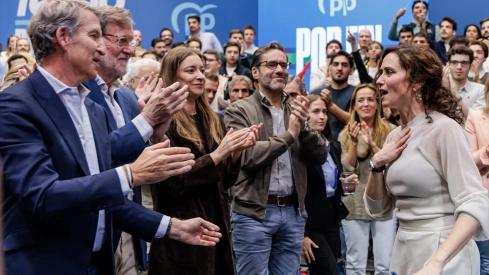
Who do Ayuso and Feijóo think they are?
It's a tough question, I know. It's a forceful question, but also a pertinent one. And I ask it because, in recent days, both the Popular Party of Madrid, chaired by Isabel Díaz Ayuso, and the Popular Party at the national level, chaired by Alberto Núñez Feijóo, have embarked on a battle —and they are also proud of it, because they have explicitly stated it on their own social networks— against journalists and analysts critical of the PP.
I am referring, among others, to the messages directed against our colleague and friend Sara Sántolalla, but also against other critical journalists and analysts, such as Afra Blanco. Critical of Feijóo's party at the national level and Isabel Díaz Ayuso's party in the Community of Madrid.
And the question is again the same: who do they think they are? Because in a democracy things don't work like that.
In a democracy —and this can be read, for example, in one of the great theorists of democratic principles, Robert Dahl, an American political scientist and professor— one of the basic principles is that citizens can access free information and, therefore, also information critical of political power.
And political power in a democracy is not only made up of the executive power, the Government of Spain, in this case led by Pedro Sánchez. Political power is also made up, of course, of the opposition, the Popular Party, Vox and the rest of the political parties.
The PP, however much it is the main opposition party at the national level, is also a governing party in numerous institutions. It governs, among other territories, the Community of Madrid through Isabel Díaz Ayuso. All political power, as a whole, must be exposed to the criticism of journalists and analysts. It would be unthinkable otherwise in a democracy.
That's why I insist: who do Ayuso and Feijóo think they are to attack those journalists who criticize them? That criticism is precisely one of the bases of a democracy, one of the bases of its checks and balances. When one exercises political power, and even more so when one holds public office, one must assume that one will be scrutinized.
The Popular Party, and I say it clearly, has lost its democratic sense, its democratic judgment. It seems to have forgotten how a democracy works.
A political party cannot wage war against journalists and analysts simply because they are critical of it. Its function is to explain its decisions, be accountable, and offer transparency to public opinion. What it cannot do is propose, as it has explicitly stated on its own social networks, a battle against those who criticize it because it does not like those criticisms.
How does that work, to put it colloquially, in a democracy? It is incompatible with democratic functioning for political power to scrutinize journalists whose very function is to scrutinize power. Journalists and political analysts offer information, analysis, and different points of view to citizens. That is something basic, fundamental, in any democracy.
And I ask again: who do Feijóo and Ayuso think they are to lash out against those who scrutinize them?
Our function as journalists is to scrutinize all political power. Of course, also the Government of Spain. Pedro Sánchez must be exposed to criticism. I myself, on multiple occasions, when I have deemed it appropriate, have criticized Pedro Sánchez's Government. There are many things for which the Government of Spain can be criticized. It would be unthinkable otherwise.
But, of course, the Popular Party, even if it is in opposition at the national level, has exactly the same obligation to expose itself to criticism and accept journalistic scrutiny.
The problem arises when it seems to lose that democratic judgment and builds its strategy based on 'likes', retweets, and what works on X, as seems to be happening now in Génova 13. That is, whatever gets more interactions automatically becomes the correct thing, the good thing, what must be done.
No.
A political party must be subject to the rule of law, to the rule of legality and, of course, to democratic principles. And exposing oneself to criticism, being scrutinized by journalists and analysts, is precisely part of those basic principles.
In a democratic country like Spain, things work the other way around: we are the journalists who scrutinize political power. It is not political power, it is not the Popular Party, it is not Ayuso or Feijóo who scrutinize journalists.
That's not how it works in a democracy.
And the Popular Party, quite naturally, even shared from its official account information published by 'El País' which stated that the PP had changed its strategy on social media and had launched attacks against Sara Sántolalla and Afra Blanco.
“You come to this having already cried,” responded the official account of the Popular Party. And it added: “That the Government has stolen two hands from us. Bribes, chistorras, jewels and gold, prostitution and hitmen, all with the money of hard-working people. And now they get squeamish? No, we are not going to let them get away with anything. And neither will the PP's CM. End.”
But what is that? What is that about the official account of a national political party threatening to “not let journalists and analysts get away with anything”? Are we crazy or what?
The Popular Party, and I say it clearly, has lost its democratic sense. And this does not stem solely from an abstract assessment, but from concrete facts and messages published from its own official accounts.
I hope that one of the great parties of our democracy, one of the main parties of the Spanish political system, returns to democratic principles and understands something elemental: journalists and analysts scrutinize political power. Not the other way around.
