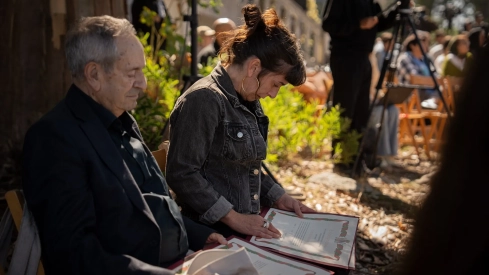
The consequences of the Civil War and the Franco dictatorship are still present in many Spanish families, even more than 80 years after the conflict. The grandchildren and great-grandchildren of people murdered during the war and post-war period may still carry symptoms of grief and post-traumatic stress, even if they did not experience those events. The pain, fear, and silence that marked their relatives have passed from one generation to another and keep open wounds that have not yet received full reparation.
This is reflected in the research 'Tears of the Past. Overcoming the grieving process of the Spanish Civil War through rites of passage', prepared by Francisco J. Leira-Castiñeira, PhD in History and researcher at Carlos III University of Madrid, and Raquel Martín-Ríos, PhD in Psychology and professor at Rey Juan Carlos University. The work, published in the journal Prisma Social in January 2026, analyzes how deaths and disappearances during the Civil War and the subsequent repression affected the victims' relatives and how that suffering has been transmitted over time.
The researchers used personal interviews, life stories, and psychological tests to study the experiences of the relatives. The quantitative part of the study involved 83 participants: 10.8% were first-degree relatives, 68.7% second-degree, and 20.5% third-degree. The sample includes descendants of victims from different moments of the conflict and the post-war period.
Among the detected symptoms appear recurring memories, images that the person does not wish to remember, distressing dreams, and a constant feeling of alertness. The authors explain that family history can end up forming part of the identity of the descendants, who come to feel as their own a suffering they did not experience directly.
The silence imposed by the dictatorship prevented many families from saying goodbye to their loved ones
One of the main reasons explaining the prolongation of this pain is that many families could not bury their loved ones or hold a farewell. During the Franco dictatorship, fear, repression, and the lack of institutional recognition made it difficult for victims' relatives to publicly express their loss. In many cases, silence became a way to protect themselves and survive.
The research highlights that the impossibility of recovering the bodies has made it difficult for many people to close the grieving process. Even today, there are families searching for the remains of their ancestors to find out what happened and offer them a dignified burial. The absence of a place to mourn their loved ones and the lack of information about their fate have kept a wound open that has reached subsequent generations. The study also analyzes the importance of funeral rituals. Close to 30% of the participating families who did not have the remains of their relatives had performed some type of symbolic ceremony to say goodbye to them. These acts, although they do not replace the recovery of the bodies, can help to acknowledge the loss and provide a space for remembrance.
The authors also warn that finding the remains does not, by itself, resolve the suffering. Families need psychological support and institutional backing to face the consequences of what happened. Therefore, they argue that memory policies should not be limited to locating and identifying victims, but should also address the emotional needs of their descendants.
The removal of Francoist portraits from Congress, a step in the reparation of victims
The research coincides with a new debate on how Spain recognizes those who suffered Francoist repression. This same month, the Congress of Deputies removed the portraits of Esteban de Bilbao y Eguía, Antonio Iturmendi Bañales, and Alejandro Rodríguez de Valcárcel, the three presidents of the Cortes during Francisco Franco's dictatorship. The images remained in the gallery of the Lower House despite claims that various political parties and memorial associations had raised for decades.
The decision was promoted by Sumar and had the support of the PSOE, while the PP abstained. The removal occurred after the agreement of the Bureau of the Permanent Deputation of Congress on October 13 and in compliance with the Democratic Memory Law. The president of the Chamber, Francina Armengol, defended that the measure contributes to recognizing the victims and repairing a historical injustice.
The removal of the paintings does not erase the consequences of the dictatorship nor does it resolve the claims of the families, but it represents a change in the way a democratic institution represents those who led the Francoist Cortes. For decades, the images of these officials remained in Congress, while the families of many victims continued to demand recognition, justice, and the recovery of their loved ones. Precisely, this October 31 marks the Day of Remembrance and Homage to the Victims of the Military Coup, the War, and the Dictatorship, a date included in the Democratic Memory Law. Researchers believe that there is still much work to be done: they demand more psychological attention, education about what happened, and public policies that allow families to process their grief.
Their conclusion goes beyond the recovery of remains. Democratic memory, they argue, must also serve for new generations to know what happened and for the past to stop being a reason for confrontation and to be addressed from the recognition of victims and the defense of democratic rights.
