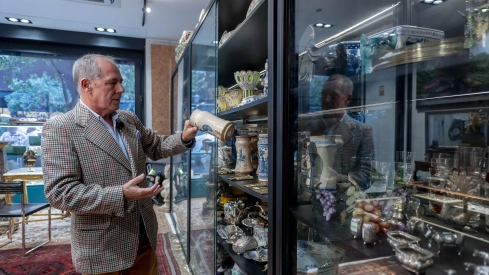
The heirs of dictator Francisco Franco have found a business in the objects they removed from the Pazo de Meirás, in Sada, A Coruña. The auction held in Madrid on behalf of the Martínez-Bordiú family has closed with more than half a million euros in awards, after two days in which some memorabilia linked to Francoism multiplied their starting price.
Among the most disputed pieces are a briefcase dedicated to the dictator, sold for 19,000 euros, and a photograph of Juan Carlos I dedicated to Franco, awarded for 8,000. The sale has provoked the indignation of memorialist groups, who question the origin of some assets and demand an investigation into whether they should be part of public heritage.
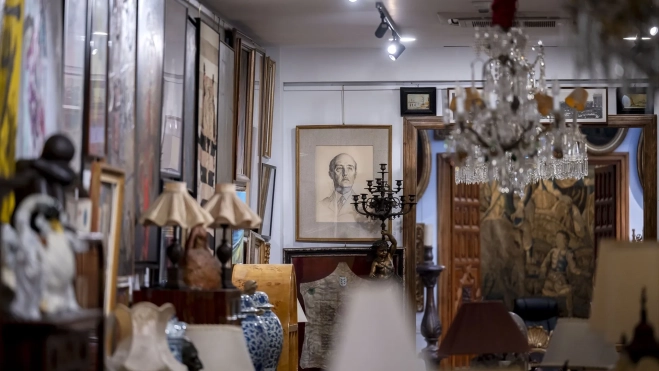
The amount reached corresponds to the gross amount of the awards. From this, commissions and expenses corresponding to the auction house, Magna Art Auctions, will have to be deducted, so it is not yet known how much the heirs will finally receive. The catalog brought together 689 lots with furniture, porcelains, paintings, decorative objects, and belongings removed from the pazo.
A 350-euro briefcase sells for 19,000
The interest in objects associated with Franco was reflected in the price of the brown leather briefcase that the house presented as personal property of the dictator. It started at 350 euros and ended up being awarded for 19,000, more than 54 times its initial price. On the flap, it bears an inscription dedicated to "Generalissimo Franco" recalling his status as head of the Falange during the dictatorship.
Another of the highest bids was for the silver jewelry box with the inscription "Carmencita", the name by which the dictator's daughter and Carmen Polo were known. The piece started at 120 euros and reached 14,000 euros. A family photograph of the Francos went from 80 to 2,250 euros, while a painting of the Pazo de Meirás dedicated to Carmen Franco rose from 50 to 6,000.
The photograph dedicated by Juan Carlos I to the dictator started at 200 euros and sold for 8,000. The image is dated 1970, when the then prince had been designated Franco's successor. Portraits of the dictator and tableware with symbols linked to his family also found buyers.
The highest bid was for a set of eight espingardas, ancient long-barreled firearms, for 20,000 euros. Among the antiques sold was also a 17th-century Talavera ceramic jug, which went from 350 to 10,000 euros.
The auction brought together buyers in the room and via internet and telephone. Among those who attended were people who expressed their admiration for Franco and their interest in obtaining a memento of the dictator; collectors attracted by the antiques and the history of the pieces also participated.
Memorialists question the removal of goods from the pazo
The sale comes after a long judicial and social battle to recover Meirás. The property was promoted by the writer Emilia Pardo Bazán and her mother in the late 19th and early 20th centuries. In 1938, during the Civil War, a board promoted by authorities of the time organized its acquisition to hand it over to Franco through contributions obtained in a context of repression and coercion.
A subsequent deed allowed the property to be registered in the dictator's name. In 2020, a court in A Coruña declared that the pazo belonged to the State and considered that transfer fraudulent. The Supreme Court confirmed in March of this year the public ownership of the property, declared in August Place of Democratic Memory.
The recovery of the pazo opened another dispute over its contents. Justice recognized the public ownership of numerous goods that should remain in the property; other objects remained in the family's hands and were removed this summer. The ownership of the building and that of each of its furniture and belongings have been examined separately.
The Commission for the Recovery of Historical Memory of A Coruña maintains that among the removed pieces there may be goods that should be public, including some that, according to their investigations, were already in Meirás in Pardo Bazán's time. Its president, Carlos Babío, denounces the lack of inspection and asks the State and the Xunta for explanations regarding the inventories used to determine which objects should be preserved.
The Association for the Recovery of Historical Memory had requested before the auction that it be suspended as a precautionary measure until the ownership of each piece was accredited. The auction house, for its part, defends the legality of the operation and assures that the objects left the pazo under the control of the administrations.
The Supreme Court also recognized the heirs' right to claim compensation for certain necessary and useful maintenance and improvement expenses incurred since the dictator's death in 1975. The amount must be set in the enforcement phase of the judgment.
