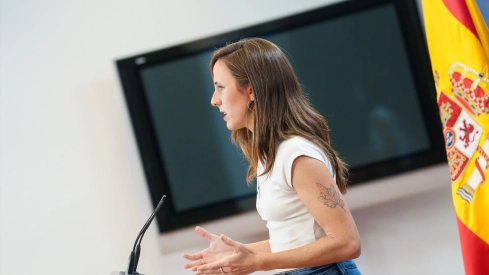
The general secretary of Podemos and deputy in Congress, Ione Belarra, has asked this Tuesday for prudence when it comes to pointing out those responsible for the disturbances registered in Barcelona and Bilbao, although she has left open the possibility that infiltrated police officers or people linked to the far right could be behind them.
In a press conference at the Congress of Deputies, Ione Belarra stressed that the Basque anti-fascist movement itself distanced itself from these events, and insisted that it cannot be stated with certainty whether the incidents are related to police infiltrations, something that, she pointed out, has been seen in “numerous mobilizations” throughout Spain's history, with far-right individuals or with the accumulated discontent among young people.
“I want to be prudent because the Basque anti-fascist movement itself distanced itself from this issue,” said the Podemos leader, who also warned that there is a “deep discontent” among many young people who live in a system “enormously violent against them, which prevents them from emancipating themselves, makes access to public education more expensive and frustrates their life projects.”
Criticism of the Government, PP and Vox for the response to the protest
The also candidate of Podemos for the Presidency of the Community of Madrid has blamed the Government and bipartisanship for not responding to the problems of youth, and has defended that “it is very difficult for a fuse to light if there is no underlying discontent.”
Belarra has also accused various media outlets, along with the PP and Vox, of using these episodes to “criminalize protest” and social movements, by “mixing” the disturbances with peaceful mobilizations for housing, encampments, the general strike on next November 11 and the indefinite teachers' strikes.
In that vein, she warned against attempts to “put everyone in the same bag” to justify police charges like those registered in the capital against teachers who were demonstrating peacefully. “The only way out of this is for there to actually be policies that respond to people's problems,” concluded Ione Belarra.