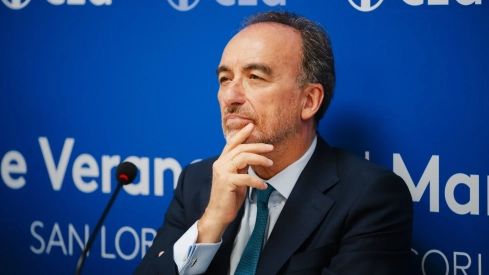
Manuel Marchena entered this Monday into the debate on citizen distrust towards Justice with a firm defense of the judiciary and a direct criticism of the use of courts as an extension of the fight between parties. "A society cannot distrust its judges," said the Supreme Court magistrate during the CEU summer courses in San Lorenzo de El Escorial.
The former president of the Second Chamber has called it a "tragedy" that a growing part of the citizenry perceives judges through ideological labels. He has also warned that "coexistence is undermined" when the idea spreads that Justice is in the hands of "fascists in robes," an expression he used to denounce the general discredit of the judicial career.
Marchena has also asked that the image of the entire system not be conditioned by the noise generated around a few investigations. As he explained, Spain holds approximately one million trials a year, while barely five or ten highly politically and media-impacted cases end up shaping public opinion on the functioning of the courts.
Surveys reflect very deep distrust
Marchena's call comes just days after two different surveys painted a deterioration difficult to ignore. The latest CIS study on democratic quality indicates that 76.9% of Spaniards doubt that Justice always acts impartially when investigating matters affecting political parties.
The same study shows that 88.8% believe that courts treat politicians and ordinary people differently. The average confidence in Justice is below passing grade and the discomfort also extends to the Government, political parties, the Constitutional Court, and the media.
The barometer prepared by 40dB for 'El País' and Cadena SER points in the same direction. Only 32.2% consider resolutions related to political matters fair and impartial, while 65.4% believe that 'lawfare' exists in Spain and three out of four citizens think that parties try to influence judicial decisions.
Marchena has argued that these data cannot be addressed by ignoring the responsibility of politics. In his opinion, when a party appears in court against another, parliamentary language enters the criminal procedure and the judge ends up subjected to the same distribution of labels that dominates public debate.
Parties outside popular prosecution
The magistrate has proposed limiting the access of political parties and unions to popular prosecution. He considers it "disastrous" for a party to be able to appear in an open case against an adversary to transfer to the courts a confrontation that should be resolved in representative institutions.
"The political battle must be fought in Parliament," he said. Marchena argues that, when the judicial resolution contradicts the expectations of a party, the magistrate ceases to be valued for his legal arguments and comes to be presented as an ally of the opposing bloc.
His criticism does not extend to the very existence of popular action. Marchena considers it an "indispensable" constitutional guarantee for citizens to be able to act in the face of crimes that affect power, especially when the Public Prosecutor's Office adopts a position that may favor a situation of impunity.
For this reason, he has warned that imposing unjustified limits would mean "flirting with the abyss". His proposal is to preserve the tool for citizens and social organizations, but prevent it from becoming a weapon of attrition between parties in corruption cases.
Marchena defends the jury and asks for more training
The magistrate has also vindicated the jury court as an institution that generally functions correctly. He has defended the democratic value of any citizen being able to become "judge for a day," although he considers it necessary to review some aspects of its regulation.
Among his proposals is requiring at least a high school diploma for those selected. Currently, it is enough to know how to read and write. Marchena has compared this requirement with those required to access other public positions and has argued that a responsibility such as deciding on a person's guilt requires minimum training.
It has also called for reducing the crimes subject to jury to those that can be assessed without especially complex legal knowledge. To this, it has added the need to simplify the instructions that magistrates give to their members, since in some processes their wording ends up increasing the "disorientation" of the citizens in charge of issuing the verdict.
