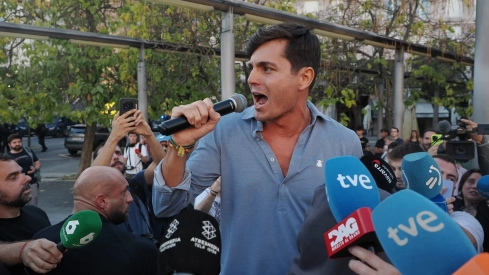
The activity of ultra Vito Quiles is once again under judicial scrutiny. The Provincial Court of Madrid has ordered the reopening of the investigation into the alleged coercion of Begoña Gómez, wife of the President of the Government, Pedro Sánchez, during an incident that occurred in a restaurant in Las Rozas. The decision represents a new judicial setback for the far-right agitator, who has made his confrontations with political figures a constant in his public exposure.
The procedure focuses on what happened last April 29, when Quiles approached Gómez while recording her and asking her questions in a hospitality establishment. The episode continued outside the premises, where, according to the disseminated images, the agitator continued recording her as she left the place accompanied by other people.
The judicial resolution prevents the matter from being closed before clarifying the circumstances of the encounter. Although the provisional dismissal initially considered that there were not enough elements to proceed with the proposed route, the Court understands that it is necessary to delve deeper into the facts and examine whether the reported conduct could constitute a crime of coercion.
From confrontation before the camera to the courts
The episode in Las Rozas once again brings to the forefront a fundamental question: the limits between the exercise of journalism and the harassment of a person who does not wish to participate in a recording. Asking a public figure is part of journalistic activity, but this condition does not make any behavior legitimate or exempt from possible criminal liabilities.
In this case, the investigation must determine whether Quiles' actions went beyond an uncomfortable question and came to limit Begoña Gómez's freedom. The Provincial Court considers that it is not enough to rule out certain physical contacts to resolve the matter, which is why it has ordered the continuation of the proceedings. The incident also once again focuses on the dissemination of these scenes on social media. Recordings of political confrontations can become viral content, but their repercussions do not replace the obligation to respect the rights of the people involved. The search for images and reactions does not, by itself, constitute a justification for any conduct.
The case had been provisionally shelved by the Majadahonda Court of Instruction. However, Gómez's legal representation appealed the decision and the Provincial Court has considered that there are reasons to continue investigating. The reopening is a setback for Quiles, although it does not amount to a conviction nor does it prove that he committed the crime attributed to him. It will be necessary to clarify what happened and determine if there is sufficient evidence to establish criminal responsibility.
Public exposure is not above individual rights
The case reopens the debate about those who use confrontations with politicians as a formula for visibility. Freedom of information protects journalistic investigation and the formulation of questions, even when they are uncomfortable for those in power, but it does not eliminate legal limits or the rights of people who appear before a camera.
The investigation against Quiles must precisely clarify where that boundary lies in the episode reported by Gómez. Meanwhile, the Court's decision prevents the provisional shelving from being interpreted as a definitive closure of the judicial controversy.
Quiles maintains the presumption of innocence, but will have to face a new phase of the procedure to clarify facts that the courts consider necessary to continue investigating. The resolution makes it clear that the episode cannot be considered closed and that it is up to Justice to determine if there was coercion.
