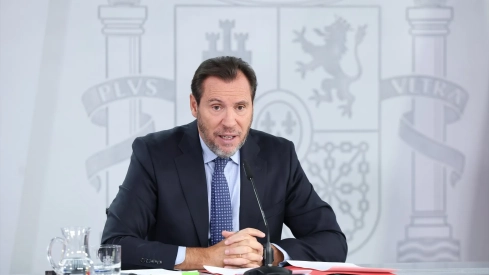
The Minister of Transport, Óscar Puente, appears this Tuesday after the meeting of the Council of Ministers to explain the measures that the Government will adopt after the train accident in Urda (Toledo), a disaster that claimed the lives of 69 people last week.
As detailed by the minister himself, the Executive's meeting has been exclusively dedicated to this railway accident and its consequences, with three main areas of action: aid to victims and their families, the limitation of the price of alternative transport to the train, and the reinforcement of security.
A shield of aid for those affected
Within the package approved by the Government, the Executive has articulated a shield of aid for those affected by the Urda accident, which doubles the amount of mandatory passenger insurance, advances compensation, creates a specific temporary disability procedure, and launches victim assistance offices.
The minister confirms that “The aid scheme is the same as that articulated for the case of the Adamut accident and will be endowed with an amount of 30 million euros. Along with this, we will incorporate measures to prevent the consequences of an accident from being aggravated by price increases that hinder access to necessary goods and services.”
Limits on alternative transport and more railway safety
The Council of Ministers has also addressed measures to cap the price of alternative transport to the train, in a context in which the Government seeks to prevent the impact of the accident from translating into added surcharges for users affected by the interruption of service.
They demand a railway alternative through Despeñaperros
Railway defense platforms from Andalusia and Castilla-La Mancha demanded this Tuesday in Jaén the adaptation of the conventional route through Despeñaperros as an alternative to the high-speed line AVE Madrid-Seville, which remains interrupted after the railway accident in Urda (Toledo).
The head of the railway sector of Comisiones Obreras (CCOO) in Jaén, Manuel Núñez, defended that “currently the high-speed line can be perfectly compatible with the conventional line,” and added that there is an interchange in Alcolea (Córdoba) that has worked and connected Jaén with high-speed, although he insisted that “a deep renovation of the conventional track” would be necessary.
Manuel Núñez also pointed to a “lack of planning” when the A-4 variant, the Autovía de Andalucía, was executed, and recalled that, if a third tunnel had been built, “we would have a doubled high-performance track with a low environmental impact that would act as a barrier effect for wildlife.”
The unionist also pointed out that from 2012 there was a “cutback” in the infrastructure and that several sections remained unexecuted, especially from Jaén towards Linares-Baeza. In that route, he specified, there is a section, Linares-Casas Torrubias, where “the platform is made, and the infrastructure stopped there.”
Demonstration on November 7 against railway isolation
The Castilian-Manchegan and Andalusian platforms will demonstrate in Jaén next Saturday, November 7 “against the railway isolation of the province of Jaén and against the railway bypass through Montoro and in favor of the new section Mora–Alcázar.” After the Urda accident, they have also incorporated railway safety as a “fundamental requirement.”
The spokesperson for the railway platform of central La Mancha, José Damián González, called for “massive” participation in the 7N mobilization and warned that, if such a “disastrous” railway policy continues, protests will continue.
Puente sees no decision made on Madrid-Barcelona
In parallel, the Minister of Transport, Óscar Puente, assured that there is “no decision made” about a hypothetical cut of the high-speed Madrid-Barcelona during a future remodeling, and stressed that the Government will “always” guarantee mobility “above almost any other parameter.”
Óscar Puente admitted that cutting the railway service of a line “is an idea that has clear disadvantages,” but specified that this reflection will have to be made when appropriate, analyzing “the pros and cons.”
Along with this, the Executive has included a third axis focused on reinforcing security, after what was agreed in the meeting dedicated to the train accident in Urda and the institutional response to the victims.