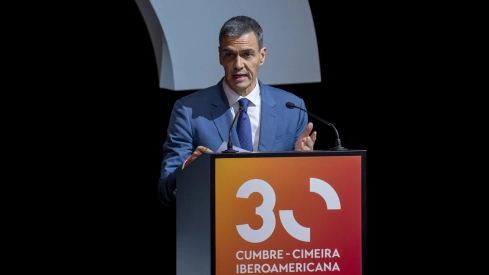
Pedro Sánchez has taken advantage of the inauguration of the XXX Ibero-American Summit to extend an invitation to the countries of Latin America and the Caribbean. The President of the Government has proposed that they strengthen their relations with Europe following the example of Canada, which in recent times has reinforced its ties with the European Union in a context of tensions with the Donald Trump Administration.
"Today I want to extend an invitation to our friends and brothers in Latin America and the Caribbean, that perhaps they follow, why not?, that example," Sánchez stated during the ceremony held this Wednesday at the Teatro Real in Madrid. The objective, he added, would be for both regions to build "a stronger, more ambitious alliance with greater weight in the world."
The head of the Executive did not expressly mention Trump or the United States during that part of his speech. The reference to Canada comes, however, after months of friction between Ottawa and Washington over tariff threats and the US president's statements about a possible annexation of the neighboring country.
Before the Ibero-American representatives, Sánchez warned of a tendency towards withdrawal in international politics. In his opinion, too many countries seem to have come to the "unfortunate" conclusion that to protect themselves they have to close off, erect barriers, and reduce cooperation.
"Against those who close off, we must open up; against those who build walls, we must build alliances; and against those who fuel war, we must be sowers of peace," the president defended.
Pedro Sánchez en la Cumbre Iberoamericana:
— RTVE Noticias (@rtvenoticias) November 4, 2026
"Frente a los que se cierran, nosotros debemos abrirnos; frente a quienes levantan muros, nosotros debemos construir alianzas; y frente a los que alimentan la guerra, nosotros debemos ser sembradores de paz".
En el #Canal24Horas pic.twitter.com/uusApRlzsA
The proposal positions Spain and Portugal as a link between the two shores of the Atlantic. Sánchez has maintained that the Ibero-American Community, made up of 22 countries, can act as a "catalyst" for a closer relationship between Europe, Latin America, and the Caribbean. "Spain will always be there to open the doors of Europe to them," he assured.
The president recalled the cultural and human ties that unite the region since before the first summit, held in Guadalajara, Mexico, in 1991. He also highlighted the agreements reached during these years and the cooperation deployed in the face of crises such as the pandemic.
An agenda to recover dialogue
The inauguration in Madrid opens two days in which Spain seeks to strengthen a community that arrives at the meeting with political differences and with the memory of the Cuenca summit, in Ecuador, which in 2024 ended without a joint declaration. The plenary of Heads of State and Government will be held this Thursday at the Royal Collections Gallery.
Relations with Europe are part of a broader agenda. Hours before attending the Teatro Real, Sánchez had defended at the Ibero-American Business Meeting in Las Ventas the need to reach agreements on artificial intelligence and its effects on production, supply chains, and employment.
The region's digital transformation leaders agreed on Tuesday to promote an Ibero-American Artificial Intelligence Alliance, whose document is now being submitted to the leaders for adoption at the summit. The initiative contemplates cooperation in data access, computing capacity, and the development of models adapted to Ibero-American languages and needs.
Among the planned issues are also a civil protection network to coordinate the response to disasters and an educational mobility initiative for young people inspired by the Erasmus program. Sánchez has insisted that the region needs its own voice in the face of challenges such as the climate emergency and against powers that "disregard international legality."
This purpose of cooperation will have to coexist with very different positions among the participating governments. The absence of the presidents of Brazil and Mexico, Luiz Inácio Lula da Silva and Claudia Sheinbaum, reduces the presence at the highest level of the two largest Latin American economies. Their countries, like the rest of the 22 members, will be represented at the event.
The Argentine president, Javier Milei, has also not attended the inauguration or the dinner offered by the Kings to the delegations. He is scheduled to participate in Thursday's plenary session and meet with the leader of the far-right Vox, Santiago Abascal, during his stay in Madrid. His visit comes after he called Sánchez an "unpresentable dictator" in October; La Moncloa has no bilateral meeting planned between the two.
King Felipe VI calls for renewing the community
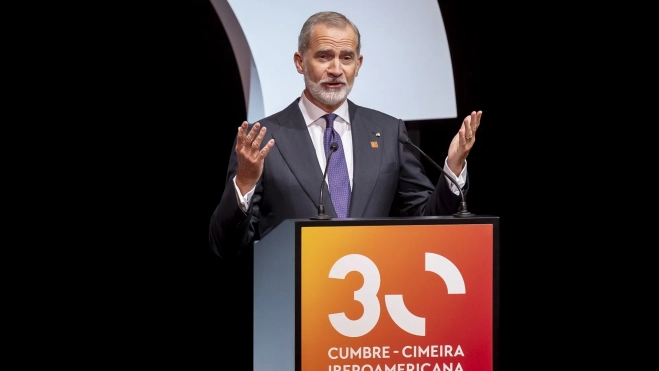
In his inaugural speech, Felipe VI recalled the 35 years that have passed since that first Guadalajara summit and vindicated the cooperation built since then. The King has called for continuing to renew the community and its system of meetings to adapt them to political, technological, and social changes.
The Head of State placed the event at a time of international transformation, with a multipolar order still with imprecise contours. Faced with this scenario, he defended coordination among the 22 countries as a way to find shared responses to tensions and rivalries.
During the previous business meeting, Felipe VI had also advocated for strengthening ties between the European Union and Latin America and the Caribbean. There he recalled the agreements with Chile and Mexico and the one reached between the European Union and Mercosur, in addition to having a few words for the victims of the Urda train accident and thanking the messages of condolence received.
The diplomatic day also includes the visit of the president of Ukraine, Volodímir Zelenski, who landed this Wednesday in Madrid. Sánchez is scheduled to receive him on Thursday, and the Ukrainian president will hold other meetings with leaders displaced to the Spanish capital on the sidelines of the summit.
