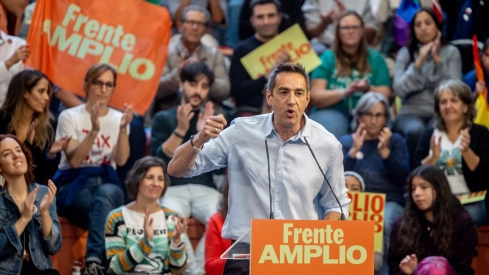
Frente Amplio wants tenants in the same building to be able to organize when the landlord fails to fulfill their obligations and pay the rent into a public fund for the duration of the conflict. Emilio Delgado, head of the coalition's list for Madrid for the November 29 elections, presented the proposal to regulate rent strikes this Thursday. The full monthly payment made within the deadline would have the same value as payment to the landlord and would protect those who meet the requirements of the future law from eviction for non-payment.
The coalition will incorporate two demands from the Tenants' Union into its program. Along with the regulation of rent strikes, it proposes giving housing unions the capacity to negotiate collective agreements with landlords. Delgado argued on 'Hoy por Hoy' that landlords already have organized representation. "There is an empty chair opposite," he said, explaining why he wants tenants to be able to sit down and negotiate on their behalf.
Rent would be paid in full and on time to avoid eviction for non-payment
The proposal foresees that tenants can resort to the fund when there is a justified breach by the landlord, such as lack of maintenance of the property. During the strike, they would continue to pay each full monthly payment, which would be deposited in the fund. The landlord could not initiate an eviction for non-payment or claim interest on those amounts. The coalition also proposes protecting participants from retaliation, such as refusal to renew their contract for joining the protest. The announcement leaves open who would verify the breach and under what conditions the money would be released.
The Urban Leases Law already obliges the landlord to make the necessary repairs to keep the dwelling in habitable conditions. It also allows the tenant to claim the cost of urgent repairs, after notifying the landlord, and considers non-payment of rent as a cause for terminating the contract. The reform proposed by Delgado would give tenants a collective way to demand that these obligations be met and to remain up to date with payments through the public deposit.
Rental strikes already have precedents in Spain. In Madrid, the Tenants' Union announced in 2025 that residents of ten blocks managed by Néstar-Azora had organized to demand collective bargaining. In that case, the protest consisted of continuing to pay the agreed rent and the updates they considered enforceable, and withholding the amounts that the organization challenged, including those for non-payment insurance.
Three tenants could form a union and negotiate for an entire block
The Frente Amplio program would set a minimum of three tenants to form a housing union. These organizations could negotiate lease agreements for a building or for a broader territorial scope. Thus, neighbors with the same problem could bring a joint claim to the owner, from pending repairs to contract conditions.
In 2024, households living in rented accommodation allocated an average of 26.7% of their net income to pay for housing, according to the latest annual report from the Bank of Spain. The average effort exceeded 30% in five of the six major cities analyzed. Frente Amplio has made housing the focus of its campaign and now adds a proposal on who negotiates rental conditions, in addition to the measures on prices and supply that are already in the electoral debate.
Delgado presented the measure one day after the general strike of 11N and on the same Thursday that the Permanent Deputation has validated by 35 votes to 34 the housing decree that extends protection against evictions and allows requesting extensions of up to two years in certain contracts. The second decree, which proposed indefinite rentals, has been rejected. Frente Amplio will open the campaign tonight in Vallecas with the slogan "A vote like a house."
Contact
We are listening. Get in touch.
