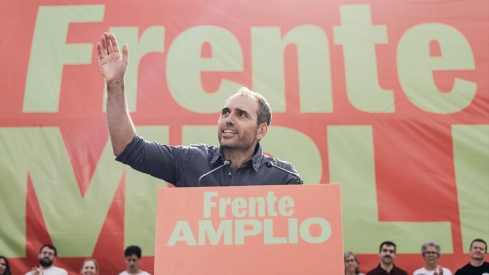
Frente Amplio has brought its proposal to recover public control of the railway to the European Parliament. The coalition has registered a petition for community institutions to review the rules that have opened the sector to competition and study their effects on safety, public service, and connection between territories.
The initiative comes a week after the Urda train accident, in Toledo, which left 69 people dead and more than a hundred injured. It also occurs in the midst of the pre-campaign for the general elections on November 29, with the future of the train and the safety of the network at the center of the political debate after Óscar Puente's resignation as Minister of Transport.
The document has been submitted to the European Parliament's Committee on Petitions by Toni Valero, leader of Izquierda Unida and number three of Frente Amplio for Madrid. His party asks the European Commission and Parliament to review the railway regulatory framework and move towards abandoning the liberalization of the sector.
Valero has argued that a "country model" is at stake in these elections and has placed the train as one of the examples of the decisions that will have to be made. In his opinion, an essential service for the working class cannot be "subordinated to the market" or to the "benefit of a few."
"Our commitment is clear, a one hundred percent public railway," said the IU leader, who has linked liberalization with a way of understanding public services subject to haste and economic profitability.
The petition demands a detailed response from the European Commission on the effects of successive railway packages and their relationship with safety, public service, and territorial cohesion. Frente Amplio wants to examine the consequences of the opening of the sector and to study measures to strengthen public management in its different activities.
"The train is not for enriching private companies, it is for guaranteeing the right to mobility, connecting our towns and cities, and providing a quality public service," Valero defended. The candidate also recalled its role in addressing the climate emergency.
The proposal for Renfe and Adif defended by Minister Bustinduy
The European initiative is part of a series of measures with which Frente Amplio wants to open a debate on the future of the railway network. This Wednesday, during a visit to Avilés, the Minister of Social Rights and campaign coordinator of the coalition, Pablo Bustinduy, proposed merging Renfe and Adif as a first step towards the renationalization of the system.
"We want to renationalize something that we have built and raised with the effort of the people," Bustinduy maintained, advocating for a unified command that facilitates management and places the railway "at the service of the general interest."
Currently, both are public companies, but they have different functions. Renfe provides passenger and freight transport services, while Adif manages infrastructure and railway traffic. Along with Renfe, other companies operate commercial high-speed services, including Iryo and Ouigo.
The separation between infrastructure and operation and the opening to new operators were developed within a European framework approved for decades. Community regulations allow certain integrated structures but require guarantees of independence in functions such as capacity allocation and access to tracks. Bustinduy's proposal would, therefore, have to specify how this union would be organized and how it would fit with European rules or with an eventual modification of these.
The minister also proposed an audit of the network, more investment in maintenance, and attention to commuter services used daily by thousands of workers. To finance improvements, he proposed allocating more than 13,000 million euros planned for airport expansions, including those in Madrid and Barcelona, to the railway.
A pact after Puente's resignation
Frente Amplio has also advocated for a State pact for the railway that includes a review of the system, reinforcement of personnel and investment, recovery of public leadership, and reversal of outsourcing. The coalition demands that commuter and medium-distance services receive attention comparable to that of high-speed rail, due to their importance for daily life and connection between municipalities.
Her candidate for President of the Government, Ada Colau, has called for a rigorous review of "what is failing in the railway system". "We need more trains, not fewer, but we have to guarantee that they are safe," she stated, defending the usefulness of the railway to connect the territory and advance towards more sustainable mobility.
The pressure for the Government to assume responsibility was present in Óscar Puente's appearance before the Permanent Deputation of Congress. Valero there called for the minister's resignation and considered his explanations insufficient because, in his opinion, they left out the debate on the railway model. Verónica Barbero, Sumar deputy and also a candidate for Frente Amplio, also demanded his departure due to political responsibility. Puente announced his resignation at the end of that session. Valero later assessed that he had done "the right thing" and that his decision represented "a sign of respect towards the victims".
The debate on liberalization occurs while judicial and technical investigations into the accident continue. On October 28, a Renfe AVE hit an Iryo train that was stopped on the Madrid-Seville line. Among the issues being investigated are the failure of the signaling system and the instructions given before the collision. The causes and eventual responsibilities must be clarified in these procedures.
