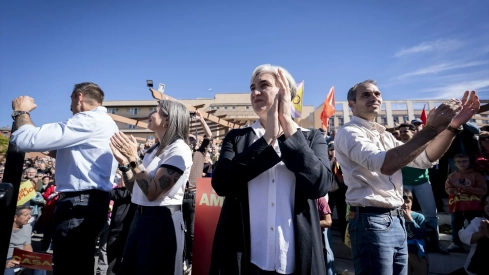
The Broad Front will run for Congress in 51 of the 52 constituencies in the general elections on November 29, with Teruel as the only exception. The coalition led by Ada Colau rules out extending the withdrawal of candidacies to other provinces to favor the concentration of votes in the PSOE and maintains its commitment to its own representation, through its lists and the territorial alliances it has closed.
The decision comes this Monday, when the deadline for registering candidacies ends, after several days of discrepancies on how to face elections marked by the separation between Frente Amplio and Podemos. The 52 constituencies of Congress correspond to the 50 provinces and Ceuta and Melilla, which each elect one deputy.
The campaign spokesperson, Pablo Bustinduy, has defended that the space will be an alternative "across the country" and has claimed its aspiration to become the "surprise and decisive factor" of 29N. Housing, wages and pensions are at the center of the proposal with which the alliance of Izquierda Unida, Movimiento Sumar, Más Madrid and the commons intends to regain support.
With this decision, the possibility of generalizing withdrawals in favor of the PSOE that some leaders had proposed for provinces with fewer deputies is closed. The understanding between both spaces is maintained in the Senate, where they have agreed on joint candidacies in more than 40 constituencies under the brand Senado de Progreso. For Congress, Colau's coalition maintains its own electoral offer.
Unity with Podemos is limited to Canary Islands, the Valencian Community and the Balearic Islands. In the first two, it shares a candidacy with forces such as Nueva Canarias and Compromís. The Balearic novelty was closed on Sunday, when Podemos agreed to incorporate its regional coordinator, Lucía Muñoz, as number three and independent on the Ara Més-Front Ampli list, headed by Carme Gomila.
In Catalonia, Podemos participates in the ERC candidacies, which will compete with the commons integrated into the Frente Amplio. In Andalusia, the presence of Adelante Andalucía adds another candidacy to the dispute for the electorate to the left of the PSOE. Territorial agreements have reduced fragmentation in some places, while state negotiation ends without a shared list between Colau and Irene Montero.
Teruel leaves the wound open
The Teruel exception comes from the decision announced by Chunta Aragonesista on October 21, with the argument of avoiding the dispersion of votes and facilitating a progressive majority. The province elects three deputies, which in 2023 were distributed between the PP, with two, and the PSOE, with one. CHA chose to concentrate its efforts for Congress in Zaragoza and Huesca.
Izquierda Unida rejected that withdrawal and studied how to maintain a candidacy. Finally, on October 23, it recognized that the legal alternatives examined depended on CHA within the registered coalition. Its Aragonese coordinator, Marta Abengochea, maintained the political discrepancy, but confirmed that she would respect the signed agreement and would comply with it "with loyalty and responsibility."
The conflict faces two criteria on the usefulness of running. Chunta prioritizes concentrating support in a province where it is especially difficult to get a seat for a small force. IU defends maintaining its own option for workers and rural areas, also in territories punished by depopulation and the loss of public services. The withdrawal affects the Broad Front; Podemos maintains its forecast of running separately in Teruel.
In Zaragoza, the candidacy will be headed by Marina Rodríguez, from CHA, and Jesús García Usón, from IU. Rodríguez has claimed the objective of "bringing the voice of Aragon to Madrid," while Usón has placed housing, salaries, and the strengthening of public services among his priorities. The list also includes Movimiento Sumar, Partido Verde, and Recortes Cero and aims to retain the representation obtained by Sumar in 2023.
The seats decided by the division
Madrid and Barcelona concentrate the best representation prospects, favored by the size of their constituencies, with 38 and 32 deputies at stake. The provincial breakdown by Sigma Dos published on October 20 placed the Broad Front at four seats for Madrid and three for Barcelona, in addition to one in Seville, one in the Balearic Islands, and a possibility of entering Zaragoza. This map corresponds to interviews from October 1 to 14, prior to the closing of alliances. In small provinces, exceeding the legal 3% allows participation in the distribution, but getting a deputy normally requires a much higher percentage.
The national poll by Sigma Dos published this Monday for 'El Mundo' attributes 7.4% and between 10 and 12 deputies to the Frente Amplio, with Compromís counted separately, between two and three, and Podemos with one. It is based on 3,122 interviews conducted from October 8 to 22. Its territorial update points to improvements for the space in Madrid, A Coruña, Zaragoza, and Las Palmas, while Seville appears as a more difficult place against the advance of the far-right Vox. This distribution shows that small changes in votes can decide the entry or loss of representation.
Estimates vary significantly among pollsters. SocioMétrica for 'El Español', published between Sunday and this Monday, places the Frente Amplio at six deputies, with two in Catalonia, and assigns three separately to the Front Valencià. It also does not grant representation to Unidad del Pueblo Canario. In the Balearic Islands, the incorporation of Podemos also changes the scenario on which previous polls were elaborated. Therefore, the data allows identifying the best-positioned candidacies and the disputed seats, without turning territorial unity into a guarantee of a seat or adding results from different alliances as if all polls grouped them equally.
An analysis by 'Cadena SER', based on 3,000 simulations, calculated a cost of between four and eight deputies for the separation of Frente Amplio and Podemos in two out of three scenarios. It specifically pointed to Bizkaia, A Coruña, Madrid, Asturias, and Pontevedra. The calculation assumes that a joint candidacy would retain exactly the votes of both forces, a hypothesis that depends on the behavior of their voters. It was published on October 24, before the agreement between Podemos and Ara Més-Front Ampli in the Balearic Islands.
