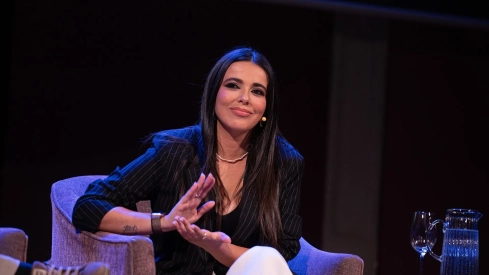
The communicator has denounced the use of personal images to respond to her criticisms of Ayuso, while other information professionals have engaged in confrontations with leaders and official party accounts. The Popular Party has once again placed a journalist at the center of its political confrontation after its Madrid organization disseminated a personal video of Sarah Santaolalla to respond to a criticism directed at Isabel Díaz Ayuso. The publication has reopened the debate on the limits of political communication and the use of social networks to discredit those who question public representatives.
The origin of the controversy lies in the images of Ayuso during the events of October 12. Santaolalla reacted with an ironic comment about the Madrid president: "Yesterday there was a party in the penthouse". The official account of the PP of Madrid responded by disseminating a video of the journalist dancing with some friends and accompanying it with the message: "Of course there was a party, Sara. And the best part is that there's a video".
Claro que hubo fiesta, Sara. Y lo mejor es que hay vídeo. https://t.co/SbVx7px5bH pic.twitter.com/f9byrdHJMf
— PP Comunidad de Madrid (@ppmadrid) October 12, 2026
The communicator denounced that the images belonged to her private life and were not published on her social media or on those of her friends. "The Popular Party has crossed all lines," she stated in an intervention in which she questioned where the party had obtained the material and why it was using it to respond to her political opinions. The journalist also pointed to Alberto Núñez Feijóo for the national leadership's support of the Madrid PP's actions. The episode is not limited to a dispute between a communicator and a political party. The national PP supported the actions of its Madrid organization, which broadened the controversy over the use of official accounts to respond to critics. The question is whether a political party should limit itself to refuting a journalist's arguments or if it is acceptable to resort to personal images to shift the debate towards her privacy.
Santaolalla denounces private video and demands explanations from the PP
The controversy continued during the days following the publication. On October 13, Santaolalla intervened in the program Mañaneros 360, on RTVE, to explain what happened and demand accountability from the party. The communicator questioned the party's use of personal images to respond to a political criticism and asked for explanations about the origin of the recording.
"My comment about Isabel Díaz Ayuso is based on public images. Their response, completely disproportionate, is through private images," she stated during her intervention. Santaolalla also expressed her concern about the possibility that there may be other personal recordings of journalists who have criticized popular leaders. The journalist also referred to Alberto Núñez Feijóo's minor children to defend the limits that, in her opinion, should be respected in political confrontation. "I would never use images of Feijóo's minor children for a public argument or public information," she noted.
The controversy also coincided with the dissemination of threats directed against the communicator. Santaolalla made public screenshots of intimidating messages, including one that read: "Your funeral will be awesome". The appearance of these threats increased concern about the consequences that public shaming of a person on social media can have. However, the authorship of each message must be determined individually and cannot be automatically attributed to the party. The confrontation between the PP and Santaolalla had already reached RTVE in August 2025, after the collaborator stated on television that one had to be "very idiotic or have very little information to continue believing the Popular Party and Vox", the Popular Group in Congress demanded that the public corporation dismiss her.
The party considered that her statements constituted an insult to millions of Spaniards and announced that it would register parliamentary questions about her collaborations. In its statement, the PP defended that the public remuneration of the analyst was incompatible with those expressions and demanded that her participation in RTVE be rescinded. The request was included in the official statement of the Popular Party on August 27, 2025. The episode had a second derivative when Jaime de los Santos, deputy secretary of Education and Equality of the PP, responded to the journalist's criticisms with statements about prostituted women that also generated controversy. The president of RTVE, José Pablo López, came out in defense of the corporation's professionals and political pluralism on television.
Months later, the PP of Madrid again confronted Santaolalla, this time through the dissemination of a personal video. Although both episodes are different and must be analyzed separately, the succession of actions allows examining how the conflict between the party and the communicator has evolved: from demanding her departure from RTVE to responding to her criticisms with images unrelated to the debate on Ayuso's management.
Miguel Ángel Rodríguez despises a journalist from ElConstitucional.es
The confrontation with journalists has also reached this newspaper. On October 7, a reporter from ElConstitucional.es asked Miguel Ángel Rodríguez, Ayuso's chief of staff, about the authorship of 'Íntimo', the book that the Madrid president will publish on December 2, and about the circumstances of its announcement a few weeks before the general elections on November 29. Rodríguez assured that the book had been written by the president herself: "It's her book written by her," he replied when expressly asked if Ayuso had received help to write it. The advisor also predicted that the work would be "the editorial success of the year." However, when the journalist wanted to know why it was announced in the middle of the pre-campaign and if chapters would be advanced before the vote, the conversation became tense.
"You have no idea. Write a book and you'll find out what the deal is," Rodríguez replied to the reporter. The chief of staff did not clarify the questions about possible advances or about the chosen moment to announce the publication. The response, reported in this newspaper's information, shifted the exchange from the questions posed by the journalist to a disqualification of his knowledge on the matter. The episode was explained live by Hugo Pereira, director of ElConstitucional.es, on the program Malas Lenguas, on La 2. Pereira recounted how the conversation with the chief of staff had taken place and contextualized the questions the reporter had raised about the authorship of the book and the publication schedule.
The intervention allowed a direct episode affecting the exercise of journalism to be brought to public television: a reporter asking a political official about a current issue and receiving a response that questions his knowledge instead of resolving the issues raised.
This case presents a difference from Santaolalla's: here, no private images of the journalist were disseminated, but rather a verbal confrontation occurred during an informative question. However, both episodes allow addressing the same issue: how representatives of Ayuso's circle respond when journalists ask uncomfortable questions or criticize the president.
Journalists question the use of social media to discredit their critics
The Santaolalla controversy has also provoked reflection among information professionals. On October 14, the journalist participated in a debate with Chema Garrido, director of El Plural, and Hugo Pereira, director of ElConstitucional.es, in which they questioned the use of official PP accounts to target journalists. "Criticism is legitimate, violence is unjustifiable," they summarized. During the conversation, Pereira defended that journalists must scrutinize those who exercise political power, both the Government and the opposition. "We do not run in elections, we are not on any electoral list," he recalled.
Santaolalla also questioned the informative relevance of the personal images disseminated by the PP. "What relevant information is that?" she asked when referring to the videos of journalists dancing when they were young. The communicator defended her right to enjoy her private life without those images becoming material to discredit her opinions.
The debate does not imply that parties must give up responding to the media, nor that journalists are exempt from criticism. Political parties can deny information, discuss opinions, and demand corrections when they believe false data has been disseminated. However, this capacity does not eliminate their responsibility for the content they publish, especially when they use official accounts to expose aspects of a person's private life. Freedom of the press also does not mean that journalists cannot be questioned for their statements. The difference lies in whether the response focuses on the arguments and the information published or if it shifts towards privacy, personal disqualification, or pressures on their professional continuity.
The confrontations between the PP and various information professionals have taken different forms, from documented threats in 2024 to social media disputes in October 2026. The Santaolalla case has reopened a fundamental question: where does legitimate political defense end and where does the personal targeting of those who question power begin?
