The Government is preparing to take the General State Budgets for 2027 to Congress even if it reaches the vote without the necessary support. Sources consulted by 'ElConstitucional.es' assure that the Executive is working with the end of December as a deadline to present the project, once the internal agreement between PSOE and Sumar is closed and negotiations with its parliamentary allies are exhausted.
The decision has an important political component. After an entire legislature governing with the extended 2023 accounts, Pedro Sánchez wants the groups to have to pronounce themselves on a project with more social spending, housing measures, and new aid for families. Moncloa assumes the possibility of a defeat, but considers that keeping the Budgets locked in a drawer would have an even greater cost just a few months before the general elections.
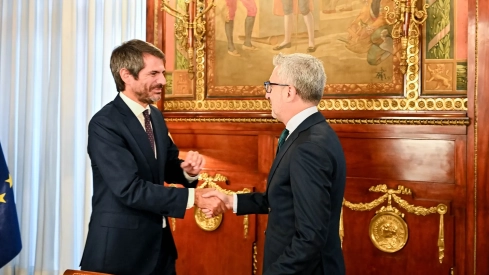
The negotiation officially began this week with the meeting between the Minister of Finance, Arcadi España, and the Minister of Culture and spokesperson for Sumar, Ernest Urtasun. The meeting served to organize conversations that had been taking place for weeks with greater discretion and to set shared priorities before approaching the other parties.
The Treasury has promised that the project will incorporate "the largest social spending in history". This statement must now be specified in items, beneficiaries, and deadlines. The starting point is a non-financial spending limit of 226,032 million euros, 6.6% higher than that used as a reference for 2026 and the highest approved to date.
A social shield against the far-right advance
PSOE and Sumar share a fundamental political reading. Institutional discourses are insufficient to contain a far-right that grows by exploiting discontent, economic insecurity, and deteriorating expectations. Housing, wages, childcare, care, and the quality of public services will be the response that the coalition will try to counter the messages of hate and the authoritarian solutions of Vox.
This approach makes the Budgets more than just an annual statement of income and expenses. They will also be the card with which the Government will try to regain the initiative after the Ceuta crisis and to translate good macroeconomic data into everyday life. "It is time to convert economic growth into social progress," Sumar defended after the first meeting.
Hacienda has put forward measures to facilitate access to housing, support young people, protect the purchasing power of pensioners, and strengthen healthcare, education, science, and the creation of stable employment. It also wants to expand investments linked to the ecological transition and offer protection to families, self-employed workers, and businesses against potential external crises.
Sumar intends to go much further. Urtasun arrived at the meeting with housing as the top priority and demanded resources to build a large public rental housing stock, contain prices, and close off the avenues used to circumvent regulation through temporary or tourist rentals.
The minority partner also wants to incorporate a universal child-rearing benefit, which has been demanded for years by the Minister of Youth and Childhood, Sira Rego. The proposal aims to reach all families with minor children, regardless of their income, and has been placed by Sumar among the main tools to reduce child poverty, which remains well above the European average.
To fund part of this aid, the group has registered an initiative in Congress that taxes assets over 50 million euros at 3%. The party estimates that it would affect around 1,500 taxpayers and would raise 4.2 billion euros. The money would be allocated to a specific child protection fund.
The list continues with a significant increase in allocations for dependency and care, more investment in commuter and medium-distance trains, public transport subsidies, the universalization of education from zero to three years, and free public school meals. Sumar also demands a tax reform that increases the contribution of large fortunes and capital gains.
Housing once again divides the coalition
The coincidences announced by Hacienda hide significant differences. Housing will be the main battleground between PSOE and Sumar, both due to the amount of money allocated to expanding the public housing stock and the degree of intervention on prices and the activity of large property owners.
The tension was exposed just one day before the budget meeting. The PSOE abstained from a Sumar initiative that sought to prevent investment funds from buying homes. The two parties also have a new decree with measures on rents pending, initially announced for July, then postponed until September, and still without a date to reach the Council of Ministers.
Sumar believes that the budget would lose much of its political meaning if housing is reduced to aid without the capacity to lower rents. The PSOE shares the diagnosis of the problem, although it maintains greater reservations about some intervention formulas and wants to ensure that any measure reaches Congress with a sufficient majority.
Tax reform will open another discussion. Hacienda will have to decide how much of the tax proposed by Sumar it assumes, what revenue it can guarantee, and how it fits the new benefits into accounts that must also cover the increase in pension spending, European commitments, and already announced investments.
To that equation, defense is added. Podemos has made the increase in military spending a red line and has already warned that it will reject a budget that consolidates what Ione Belarra calls "the greatest rearmament in history". Each item allocated to this area will narrow the margin to close the social package and further complicate conversations to the left of the PSOE.
The project also begins with a technical difficulty. Congress rejected the stability path proposed by the Government twice with the votes of PP, Vox, and Junts. Hacienda maintains, based on a report from the State Attorney's Office, that it can use the fiscal objectives sent to Brussels as a reference and continue the processing. It will be a path without clear precedents and susceptible to a new political and legal dispute.
A majority that today seems impossible
The agreement between PSOE and Sumar will only be the first part of the journey. Junts and Podemos, two decisive forces in Sánchez's investiture, currently maintain a frontal rejection. If both maintain their position, the accounts will lack parliamentary progress from their first vote.
Junts broke its agreement with the PSOE and already voted alongside PP and Vox against the deficit targets. Carles Puigdemont's party describes the staging by the ministers as a "disgrace" and recalls the message launched by its deputy Josep Maria Cruset during that debate. "Don't count on us," he stated from the rostrum.
Podemos has not yet received a formal proposal either and presents the process as an electoral maneuver by Sánchez. Its rejection of military spending distances any initial understanding, although the Government hopes that the pressure of voting against housing, care, or childcare measures will force the purple party to discuss the content when a complete document exists.
The rest of the partners leave some doors open. The Basque Nationalist Party has already been summoned and will attend the meeting with a willingness to negotiate. EH Bildu maintains its usual discretion, ERC is skeptical but willing to listen, and the Galician Nationalist Bloc has extended a hand for a possible agreement. Their votes, however, will be insufficient if Junts and Podemos remain in rejection.
The reform of regional financing will cross these conversations. ERC demands that the Government comply with the pact to develop a new model and the singular financing of Catalonia. The Executive wants to advance in that project before closing the Budgets, although it also needs to gather a parliamentary majority to approve it. The negotiation of one law will inevitably condition the other.
The calendar adds pressure. Article 134 of the Constitution establishes that the Government must present the Budgets at least three months before the current accounts end, which places September 30 as the ordinary deadline. That deadline is already unattainable. The late presentation allows the procedure to continue, but makes it difficult for the new accounts to come into force on January 1.
A project registered at the end of December would open 2027 with the 2023 Budgets again extended while Congress processes the new accounts. It would be the fourth extension of a text approved in December 2022 and already converted into the longest-running in democracy.
The Government can legally survive another budget defeat and continue using credit modifications to adapt the accounts. Politically, the scenario will be much more uncomfortable. The amendments to the entirety by PP, Vox, and Junts could return the project to the Council of Ministers before the debate on the items begins.
PSOE and Sumar will then have a document with which to go to the elections and point out those who prevented its approval. Junts and Podemos will have to explain why they rejected accounts that incorporated part of the social agenda that both demand. The first struggle will be fought within the Government; the definitive one will reach Congress, where the majority that invested Sánchez remains broken today.
Add ElConstitucional.es as a preferred Google source for free.
Stay informed about all the latest breaking news with the best information. Against disinformation, for democracy and social rights.
