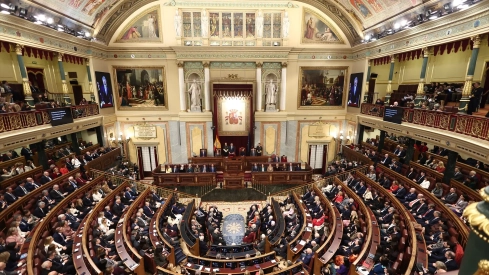
Congress approves this Thursday a reform of its Regulations that will make it easier for minority parties to have their own parliamentary group starting next legislature. The modification lowers the required vote percentages and aims to adapt rules from 1982 to a Chamber much more fragmented than that of the first democratic decades.
The initiative goes ahead with the support of the PSOE and the formations that usually support the Government, after a process marked by the frontal opposition of the PP and the far-right Vox. The majority was already outlined in May, when the Plenary accepted to begin processing the reform by 178 votes to 171.
The vote is included in the so-called 'sweep plenary', the extensive extraordinary session with which Congress is closing pending matters before the August break. The change exclusively affects the internal functioning of the Chamber and does not modify the electoral system, the number of deputies obtained by each candidacy, or the majorities necessary to approve laws.
From 5% to 3% across Spain
The Regulations maintain as a first option the possibility of forming a group with a minimum of 15 deputies. The reform modifies the alternative provided for candidacies that do not reach that figure. Starting next legislature, one or more formations may constitute a group if they gather at least five seats and obtain 3% of the valid votes across Spain or 10% in the set of constituencies where they have presented a candidacy.
Until now, the percentages were set at 5% statewide and 15% territorially. The reduction expands the possibilities for nationalist, regionalist, or state-level parties with reduced representation, provided they reach the floor of five deputies.
The change also resolves a recurring anomaly. In different legislatures, parties that had sufficient representation to have a differentiated political presence have needed temporary transfers of deputies from other formations to formally meet the requirements during the constitution of the groups.
This happened at the beginning of the current legislature with ERC and Junts. PSOE and Sumar temporarily lent several parliamentarians so that both formations could register their groups, after which the deputies returned to their original organizations. The Bureau endorsed the operation through an interpretation of the Regulations that had already been used in previous stages.
The new wording replaces this type of agreement with previously written criteria. The same conditions will apply to any party regardless of its political position or the pacts it maintains after the elections.
Why it matters to have your own group
The difference between having a group and being integrated into the Mixed Group goes far beyond the name. A parliamentary group has its own turns in debates, the ability to present initiatives in a differentiated way, and stable presence in essential bodies of the Chamber.
It also has representation in the committees, the Board of Spokespersons, and the Permanent Deputation, in addition to its own question in government control sessions. This autonomy allows it to defend a political agenda without sharing the available time with other forces from very different ideologies and territories.
Having its own group also opens access to greater economic resources, support staff, workspaces, and parliamentary subsidies. In the Mixed Group, all these elements must be distributed among parties that may only share their inability to meet the regulatory requirements.
The promoters argue that the reform will avoid an oversized Mixed Group and facilitate the organization of debates. Their central argument is that a party that has obtained five seats and hundreds of thousands of votes should be able to convey its position to Congress with a recognizable voice.
The proposal came from deputies of ERC, Junts, Podemos, Compromís, and BNG and has since received the support of Sumar, PSOE, EH Bildu, and PNV. The Basque nationalists have argued that the new conditions better reflect the political plurality expressed at the polls.
PP and Vox denounce a payment to partners
PP and Vox have focused their rejection on the potential beneficiaries of the reform. Both parties have accused the PSOE of modifying the rules to reward the forces that have supported the Government during the legislature and facilitate their parliamentary survival after the next elections.
Pedro Navarro has stated that the Regulation is being used as a negotiation instrument and has rejected the creation of what he calls "artificial groups." The PP believes that parties should reach the previous thresholds and criticizes that the change increases the resources allocated to parties with few seats.
The 'populars' have tried to introduce a strictly proportional distribution of intervention times, subsidies, and material resources. They have also proposed the automatic dissolution of groups that, during the legislature, lose the minimum number of members required to be constituted.
The far-right Vox has accused the Executive's partners of lowering the conditions to "ridiculous" levels and has linked the initiative to their electoral expectations. Among their amendments was to prevent parties integrated into the same electoral coalition from forming separate groups.
The parliamentary majority has rejected these proposals, considering that they restricted representation and extended the reform to matters that were outside its initial objective.
The PSOE has denied that the new rule alters the functioning of the Chamber or grants a particular privilege. María Adrio has defended that it corrects a rigidity of the Regulation and offers a stable solution for situations that until now were resolved through political agreements and decisions of the Bureau.
A reform with effect in the next legislature
The text needs a final vote by absolute majority to be definitively approved. This special requirement derives from the provision of the Regulation itself that regulates its reforms and obliges to gather at least 176 votes in the overall vote.
The new regulation will begin to apply when the Congress resulting from the next general elections is constituted. The electoral results will then determine which parties reach five deputies and meet any of the new percentages.
After the constitutive session, the formations will have the regulatory period to communicate the creation of their groups. The Congress Bureau will check the seats and percentages obtained before authorizing their constitution.
