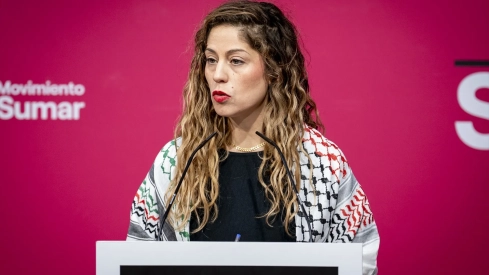
The departure of Lara Hernández has not closed the crisis of Movimiento Sumar. One of the people who internally accused her of workplace harassment has taken the case to the Labor Inspectorate, which will now have to analyze whether there was workplace mistreatment in the environment of the now former coordinator of the party founded by Yolanda Díaz.
The complaint was registered in early June, weeks before Sumar's anti-harassment committee filed the internal complaint opened against Hernández. The filing came after the affected individuals withdrew their accusations within the party's procedure, so the internal body did not assess the merits of the facts.
Hernández herself has stated that she has not received any notification from the Inspectorate and that she has a "clear conscience". She also maintains that she is facing "a political operation that has not stopped" even with her resignation. The former leader, who on Wednesday announced her departure from all positions and her resignation as a member, insists that she has "never" harassed anyone.
The complaint was filed, but the merits were not resolved
The nuance is important. Hernández presented the internal filing as proof that the accusations against her had not prospered. However, the procedure ended due to the withdrawal of the complaints, not because the anti-harassment committee concluded that the facts were false.
Some workers later pointed out that the internal body did not offer sufficient guarantees, that it did not adequately protect their anonymity, and that it was not accepted to provisionally remove Hernández while the case was being processed. In that context, at least one of them has decided to resort to the labor route.
The complaint to the Inspectorate is technically directed against Sumar's parliamentary group in Congress, as it is the employing structure. The Inspectorate's powers focus on demanding labor responsibilities from the employer if irregularities are proven, not on criminally judging the person accused.
Months of internal war in Yolanda Díaz's party
Hernández's case does not appear in a vacuum. Sumar has been dragging an organic crisis for months that has led to resignations, cross-accusations, and a difficult-to-disguise feeling of internal decomposition.
The first major shake-up came with the resignation of Laura Moreno as Secretary of Organization. In her letter, Moreno accused Hernández of having removed her from her responsibilities, of leaving her isolated from the party structures, and of having suffered a deterioration in her mental health. That departure made public a war that had been brewing for a long time.
Then came the anti-harassment file, the wear and tear on Hernández, and the fight for the new leadership. The resigned leader has spoken of a “toxic environment” and of having suffered the “hardest and dirtiest” side of politics. Her entourage points to an internal maneuver to remove her from the path before the extraordinary assembly.
A formation that arrives very damaged to July 11
Movimiento Sumar will hold an extraordinary assembly on July 11 with a single candidacy on the table. The list will be headed by Verónica Martínez Barbero, parliamentary spokesperson, and Rosa Martínez, Secretary of State for Social Rights. The Minister of Culture, Ernest Urtasun, remains as the main political reference within the new stage.
The new leadership will have to try to recompose an organization that has lost muscle in just fifteen months. And it is that 34 of the 65 members of the current governing body will not repeat in the new list, a departure of more than half of the team chosen in the previous stage.
The data portrays the blow. Profiles linked to the start of the project, leaders close to Yolanda Díaz, intermediate positions, and people aligned with Hernández are leaving. The void left by Díaz herself when she abandoned organic command and announced that she will not be a candidate again is also noticeable.
The difficult landing of post-Yolandism
Sumar was born around the person and personality of Yolanda Díaz, but it never managed to become a stable party with a life of its own apart from her figure. Hernández's crisis has ended up functioning as a symptom of a broader problem: a formation built at full speed, dependent on the leadership of the vice president and now forced to survive without her on the front line.
The assembly on July 11 will try to stage an end of an era, if it survives its agony. Pessimism and the feeling of an end are the order of the day among militants and leaders of the party. The problem is that the complaint to the Inspectorate keeps alive the case that precipitated Hernández's resignation and exposed internal fractures. The new leadership will arrive with a single list, but also with a damaged organization, with opposing sectors and too many exits to sell normality.
Meanwhile, Hernández is preparing her return to her position as a Secondary school teacher in Madrid and reserves the possibility of defending her honor through other channels. The Labor Inspectorate now has room to investigate over the next few months. Sumar will try to turn the page on the 11th, although the labor file will remain open long after the photo of the new leadership.
