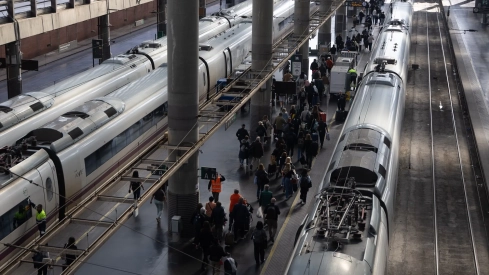
The Renfe train drivers' strike, called for November 10 and 12, may cause cancellations and delays in railway services throughout Spain. Given this situation, FACUA-Consumers in Action reminds that affected passengers have the right to request a refund of the ticket price, receive food and accommodation if needed, use alternative transport and, in certain cases, claim compensation.
The strike has been announced by the Spanish Union of Railway Drivers (Semaf) to demand compliance with the agreements signed last February between the unions and the Government, related to strengthening the maintenance of railway networks and increasing staff.
FACUA, which scrupulously respects the workers' right to strike, reminds that railway companies must comply with Regulation (EU) 2021/782 of the European Parliament and of the Council, of April 29, 2021, which establishes the rights and obligations of railway passengers.
What are the minimum services during the Renfe strike?
The minimum services established for the strike days vary depending on the type of railway transport:
-
Commuter trains: 75% during peak hours and 50% during the rest of the day.
-
Medium Distance: an average of 65%.
-
High Speed and Long Distance: 72%.
-
Freight: 20%.
What can passengers affected by the strike claim?
According to FACUA, travelers whose journeys are affected by cancellations or delays of at least 60 minutes, both at departure and arrival at the destination, have the right to choose between the following alternatives:
-
A refund of the total ticket price.
-
Continuation of the journey under comparable transport conditions as soon as possible.
-
Continuation of the journey or transport by an alternative route, under comparable transport conditions, on a later date convenient to the traveler.
Furthermore, when the railway company has not communicated alternative transport possibilities within 100 minutes of the scheduled departure time, the passenger may arrange travel on their own with other railway, coach, or bus providers. In that case, the railway company must reimburse the necessary, appropriate, and reasonable expenses arising from such transport.
Free food and accommodation if the delay exceeds 60 minutes
European Regulation 2021/782 also provides for assistance for passengers affected by delays. When the delay exceeds 60 minutes, the railway company must offer free meals and refreshments in an amount appropriate to the waiting time.
If the traveler needs to stay one or more nights at the location, the company will have to provide them with accommodation in a hotel or other establishment, in addition to transportation between the railway station and the accommodation.
How much money is due for Renfe delays?
One of the aspects highlighted by FACUA is that passengers may also be entitled to financial compensation when the train has not been canceled but arrives late as a result of the strike, provided that the ticket amount has not been reimbursed.
Article 19 of European Regulation 2021/782 establishes the following compensations:
-
Delays between 60 and 119 minutes: compensation of 25% of the ticket price.
-
Delays of 120 minutes or more: compensation of 50% of the ticket price.
The association emphasizes that the fact that the delay is caused by a strike does not exempt railway companies from providing these compensations.
Specifically, point 10 of Article 19 states that "strikes by the staff of the railway undertaking [...] are not covered by the exemption" provided in the regulation to avoid the payment of compensation.
Similarly, the explanatory memorandum of European Regulation 2021/782 states that "strikes by the staff of the railway undertaking and actions, or their absence, by other railway operators using the same infrastructure, by infrastructure managers or by station managers, should not exempt from liability for delays".
FACUA reminds that these compensations are minimum amounts, so railway companies can establish higher compensations.
However, the association clarifies that these compensations would not apply to tickets purchased during the strike days (November 10 and 12). Nor will they apply when the passenger has been informed of the delay before purchasing the ticket or when the delay resulting from the continuation of the journey on another service or from transport by an alternative route is less than 60 minutes.
Finally, FACUA reminds users that they can contact the association to have their cases studied and to assess possible actions in defense of their rights, as well as to claim other compensation for damages suffered.
Contact
We are listening. Get in touch.
