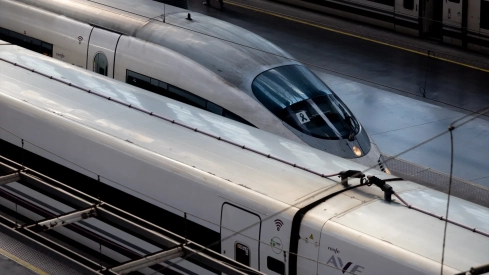
The Spanish Union of Railway Engineers (Semaf) maintains the strike days called in Renfe for November 10 and 12 after meeting this Thursday with Carlos Cuerpo, who has temporarily taken over the affairs of the Ministry of Transport after Óscar Puente's resignation. The meeting ended, according to the organization, "without progress" in their demands regarding railway safety, although both parties will meet again this Friday.
The meeting served as a first contact between the First Vice President of the Government and the representatives of the engineers, led by Semaf's general secretary, Diego Martín. Also participating were the president of Renfe, Álvaro Fernández-Heredia, and the Secretary of State for Transport, José Antonio Santano.
The union maintains that the strike is a means to achieve its demands and calls for "concrete, material and verifiable" commitments before backing down. Its position is based on the disagreement it maintains with Transport and public companies regarding the fulfillment of the measures agreed in February to improve safety.
The meeting comes at a particularly delicate time for the railway. The Urda accident, in Toledo, in which 69 people died on October 28, has reopened the debate on network safety and has triggered a crisis in the Transport management. Puente resigned this Wednesday and the President of the Government, Pedro Sánchez, temporarily entrusted the portfolio to Cuerpo.
The vice president then met with the president of Adif, Luis Pedro Marco, who presented his resignation to him that same Wednesday. Cuerpo has now begun contacts with workers' representatives, with a new meeting with Semaf scheduled for this Friday.
Three strike dates and eight affected operators
The first of the days that Semaf maintains in Renfe will be Tuesday, November 10 and will last 24 hours. For Thursday 12, partial stoppages are planned between 06:20 and 09:20 hours, 14:20 and 17:20 hours and 21:20 and 23:20 hours. The specific effects for travelers will depend on the minimum services and the schedule established for each day.
To these two dates is added the strike on November 17, called by the general company committees of Renfe and Adif to demand improvements in safety. Semaf has also registered its own call for that day, aimed at train drivers from eight operators. Along with Renfe are Iryo, Ouigo, Transfesa, Continental Rail, Tracción Rail, Captrain, and Medway, so the mobilization affects both public and private companies.
The organization already carried out a first day of strike on October 29, a day after the Urda tragedy. Its demands date back to the agreement signed on February 9, 2026, with Transportes and the presidents of Renfe and Adif, which allowed the cancellation of the strikes planned for the following two days.
That pact contemplated the creation of working groups with different professional profiles to develop and implement rules and procedures that would strengthen safety. Semaf denounces that the calls have been postponed and that the commission in charge of monitoring the agreement has not even met.
Renfe maintains a different version. The company defended, after the first strike was announced, that it had fulfilled the commitments that depended on it. Regarding the 24 measures that it placed outside its scope of competence, it assured that 17 had been executed and the remaining seven were in an advanced stage of processing.
The demands extend to other groups in the sector. The Independent and Civil Servants Trade Union (CSIF) has submitted an urgent plan to Cuerpo that includes strengthening staff and external maintenance audits, as detailed by the union in its proposal on railway safety, and maintains its call to participate in the Renfe and Adif mobilizations.
On the other hand, Semaf has indeed called off the specific strike it had planned in Ouigo for this Friday and for November 9 and December 4 and 8. The sectoral call for November 17 is still on and also includes the drivers of that operator.
