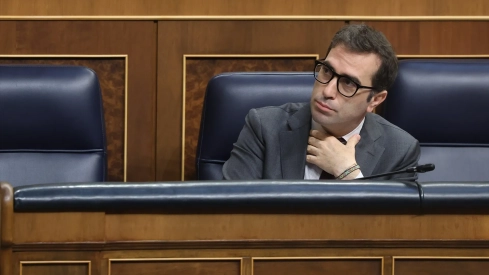
Carlos Cuerpo receives Transport with two resignations in just twenty-four hours and a responsibility that goes far beyond replacing Óscar Puente. The first vice president must restore confidence in the railway after the tragedies of Adamuz and Urda, guarantee the application of the announced safety measures, and address the workers' demands. He will do so while retaining Economy, Trade, and Business and with just over three weeks left until the general elections on November 29.
Pedro Sánchez has turned to the government's best-rated minister to tackle a crisis that has hit the Executive and disrupted its pre-campaign. The choice brings a profile associated with technical solvency and restrained communication, but it also places Cuerpo in a different spotlight than he has had until now. Every decision regarding the network, maintenance, or railway officials will be scrutinized under the impact of two fatal accidents in the same year, with victims and their families awaiting explanations.
In his interview on Wednesday night on RTVE, Cuerpo placed the restoration of confidence in high-speed rail and the entire network as a priority. He began his intervention by remembering the victims of Urda and acknowledging the work of the emergency teams. He then linked this objective to concrete actions on procedures, technical means, personnel, and investment.
Carlos Cuerpo, vicepresidente primero del Gobierno, asume la cartera de Transportes:
— Telediarios de TVE (@telediario_tve) November 4, 2026
"Una vez asumidas estas responsabilidades, me gustaría que mis primeras palabras fueran de recuerdo para las víctimas del accidente". pic.twitter.com/w0vTtcQyNB
Adif and the unions mark the first decisions
The first day of Cuerpo at the head of Transport affairs ended with the resignation of the president of Adif, Luis Pedro Marco de la Peña. The head of the railway administrator, in office since September 2024, communicated his decision during a meeting in which the Secretary of State, José Antonio Santano, also participated. He had already conveyed to Puente his intention to leave the position. Cuerpo confirmed that he accepted the resignation and described it as "appropriate."
Carlos Cuerpo, sobre la dimisión del presidente de Adif: "Hemos tenido una reunión esta tarde y me ha presentado su dimisión aludiendo a los mismos motivos que Puente. Es una decisión acertada". pic.twitter.com/AohRIvAqhq
— RTVE Noticias (@rtvenoticias) November 4, 2026
The relief opens an immediate need for direction in the public company that manages the railway infrastructure. Renfe provides transport services; Adif manages the tracks and facilities through which trains circulate. This difference helps to understand the importance of its presidency in this crisis. Essential maintenance, traffic management, and investment execution tasks depend on its organization, precisely the areas on which the demands for review are now concentrated.
Cuerpo must give continuity to the security measures announced by Transportes, including the double validation of certain orders when protection systems fail and traffic operates under degraded conditions. Also on the table are the extraordinary security review, the acceleration of the deployment of the European ERTMS level 2 system on the Madrid-Seville line, and the temporary reduction of frequencies while the planned actions are carried out. The challenge is to convert these announcements into applied procedures, with verifiable responsibilities and deadlines.
The other immediate meeting will be with the unions. The vice president announced for this Thursday a meeting in a sector that has called protests and strike days to demand more security. Workers raise issues of personnel, training, maintenance, and working conditions that also require looking at the daily functioning of the system. In RTVE, Cuerpo also alluded to an investment increase of up to 50% over the next five years, approaching 19,000 million euros. The execution of these resources and their translation into improvements will be part of the examination of his management.
Carlos Cuerpo, sobre las jornadas de huelga en el sector ferroviario: "Mañana tenemos una reunión con los sindicatos. Es importante que intentemos anticipar que esas jornadas de huelga, si es que se producen, sean en las mejores condiciones posibles". pic.twitter.com/brgncO2l4c
— RTVE Noticias (@rtvenoticias) November 4, 2026
The credit of the highest-rated minister
Cuerpo arrives at this responsibility with a unique position within the Government. The last CIS barometer that evaluated the ministers, published in October, gave him a 5.52 out of ten, the highest score in the cabinet. Only two other members of the Executive passed, Pablo Bustinduy and Margarita Robles. This evaluation is prior to the Urda accident and his new assignment, so it does not yet allow us to know how citizens will receive his performance in Transport.
His career explains part of that image as a manager. Born in Badajoz in 1980, he graduated in Economics from the University of Extremadura, completed a master's degree at the London School of Economics, and obtained a doctorate from the Autonomous University of Madrid. He joined the body of Commercial Technicians and State Economists and worked for the European Commission and the Independent Authority for Fiscal Responsibility before assuming responsibilities in the Treasury. In December 2023, he replaced Nadia Calviño at the head of Economy and last March he was promoted to First Vice President.
It is a career built mainly in economic administration and institutions, with experience in European negotiation and analysis of public accounts. This preparation can be useful for ordering investments and coordinating departments, although Transport adds a very specific operational requirement. Cuerpo will have to rely on railway teams and the knowledge of those who work on the ground, while maintaining his economic and commercial responsibilities.
The director of 40dB, Belén Barreiro, already highlighted in a profile published in July by EL PAÍS that Cuerpo "polarizes relatively little". This ability to arouse less rejection constitutes a political advantage in a moment of strong confrontation. Now he must sustain it with decisions about a public service that millions of people use to work, study, or visit their families.
Muchas gracias, presidente @sanchezcastejon por la confianza para asumir esta enorme responsabilidad, con la memoria de las víctimas del accidente muy presente.
— Carlos Cuerpo (@carlos_cuerpo) November 4, 2026
Mi agradecimiento personal también a @oscar_puente_ por todo el trabajo y la entrega estos años. https://t.co/saCPKgI2AF
Train management enters the 29N campaign
The assignment is provisional, until the formation of the new Government that emerges from the elections. However, the ministry's needs do not adjust to the electoral calendar. Cuerpo must ensure administrative continuity and the application of urgent measures during these weeks, in addition to leaving actions whose development will widely exceed 29N on track. A change in political direction does not by itself resolve the questions about the causes of the accidents, which must be clarified through the corresponding investigations.
For the PSOE, his arrival offers the possibility of regaining initiative after the blow caused by Urda and Puente's departure. As ElConstitucional.es has reported from internal sources, the party's electoral tracking showed an unfavorable scenario. The Sigma Dos poll published on November 2 placed the PSOE at 24.6%, compared to 31.1% for the PP and 19.3% for Vox. Its fieldwork was carried out on October 29 and 30, before both resignations and the ministerial reshuffle, so these data describe the starting point and do not yet measure the effect of the latest decisions.
The margin to change this situation will also depend on the response to the demands that remain open. The PP has transferred the pressure directly to Sánchez and maintains that Puente's departure does not exhaust political responsibilities. Frente Amplio demands a review of the railway model and a strengthening of public control. Cuerpo must address this discussion while explaining what is being done to protect travelers, what actions require more time, and how their compliance will be evaluated. Attention to victims and the clarification of what happened will remain Government obligations throughout the campaign.
The vice president had already publicly expressed his concern for those affected on the day of the Urda accident. Upon accepting the assignment now, he again placed their memory at the center of the message with which he thanked Sánchez for his trust. Over the next few weeks, he will have to maintain that attention along with information about the ministry's decisions, without anticipating conclusions that investigations have not yet established.
Cuerpo will respond again on this new responsibility this Thursday in the premiere of La Séptima. He will be Javier Ruiz's first guest on 'La última hora', whose broadcast begins this Thursday at 9:00 p.m. The interview will come after the scheduled meeting with the unions, on his second day in charge of Transport matters.
