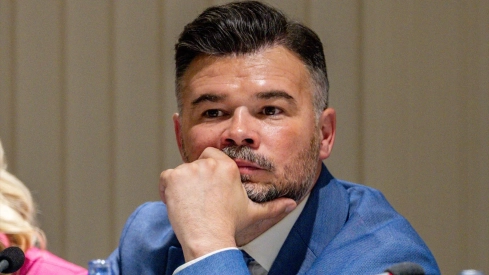
The republican spokesperson for ERC, Gabriel Rufián, has become the main focus of ERC's internal negotiation ahead of the general elections on November 29. The republican leadership wants him to once again head the candidacy for Barcelona and considers him one of its main electoral assets. Oriol Junqueras has taken for granted that he will repeat and Elisenda Alamany has defined him as “the best asset we have for this election”. But Rufián has not yet taken the step and maintains an open negotiation with the leadership.
The republican spokesperson does not present his continuity as a simple personal decision. His entourage assures that he demands “a minimum of working conditions and influence on the strategic line” after the years he has been representing ERC in Congress. The warning is clear: if these conditions are not met, “he will go home”. Among his demands are to have greater weight in the configuration of the lists, the ability to influence the election of his parliamentary team and more autonomy to guide ERC's strategy in Madrid. It is precisely here that the main clash appears: the leadership wants Rufián, but does not seem willing to hand over control of lists whose procedure is regulated by the party itself.
The conflict is not new. Already in June, deputy Jordi Salvador publicly responded to Rufián's demands with a particularly harsh warning: “ERC is not a personal platform or a space for ultimatums”. Salvador demanded “respect for the group's team, the party and the militancy” and concluded: “Patience has a limit”.
Rufián's demands clash with internal balances
The problem for Rufián is that his demands directly affect the distribution of power within ERC. The regulations approved by the party establish mechanisms for candidacies to be decided by territorial structures and militancy. In addition, the leadership retains the ability to propose up to 25% of the candidates on the lists for Congress. This design limits the margin that the spokesperson claims to decide who accompanies him and how his team is configured.
Added to this is the political distance between Rufián and the leadership regarding the electoral strategy. The spokesperson has long advocated for greater convergence among left-wing forces to avoid electoral fragmentation, while ERC has maintained a more cautious position and does not contemplate diluting its acronym in a common candidacy. Rufián is now listening to different left-wing actors before deciding what role he wants to play on 29-N.
Thus, the negotiation has two levels: on the one hand, what conditions Rufián needs to continue as ERC's candidate; on the other, what space the leadership is willing to grant him to influence the lists and the party's strategy in Madrid. The tension arises precisely because both parties need each other: ERC wants to keep its main parliamentary face and Rufián needs the party's structure to run in the elections.
Departures, candidacies and a symbolic rival: the cracks become visible
Internal differences are no longer solely in the realm of negotiation. Two of the seven deputies ERC has had in Congress during this legislature, Jordi Salvador and Pilar Vallugera, have announced that they will not run again in the 29-N elections. Both maintained a distant relationship with Rufián. Vallugera's farewell has been especially significant: she publicly thanked several colleagues, but did not mention Rufián, Inés Granollers, or Etna Estrems, the latter two considered close to the spokesperson.
Meanwhile, the internal process is also showing different sensibilities. Teresa Jordà and Etna Estrems want to run to head the list for Girona and, if both gather the necessary endorsements, they could face each other in primaries. The move is important because Estrems is considered close to Rufián, while Jordà represents a different sensibility within the party. The most striking episode has occurred in Barcelona, where activist and ex-deputy Joan Puig has announced an "strictly symbolic" candidacy to protest against Rufián's continuity. His message has been direct: "he no longer represents us." Although Puig himself acknowledges the difficulties in gathering the necessary endorsements to truly compete against him, his candidacy turns the discontent into a public gesture within the primary process.
Rufián pushes while ERC finalizes its lists
The atmosphere in ERC is marked by negotiations and different sensitivities within the party. While the leadership and Oriol Junqueras back Rufián, the spokesperson keeps his decision open and demands more room for maneuver. The loss of deputies, discrepancies over the lists, the struggle for Girona, and the appearance of a symbolic candidacy against him reflect tensions that go beyond the formation of candidacies.
The calendar now forces positions to be finalized. Rufián must decide whether to run and gather the necessary endorsements, while ERC moves forward with the preparation of the lists. His decision will be key, but so will the outcome of the negotiation over his conditions: the spokesperson seeks more weight in the selection of candidates and greater influence in the strategy the party will follow in Madrid.
